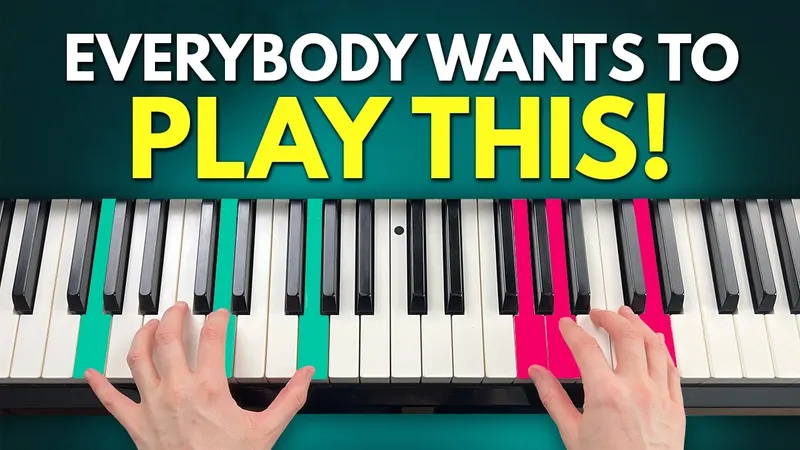
Lesson summary
Your left hand loops four chords in A minor (A minor, F major, G major, A minor), playing only the root and the fifth, in a 1 2 3, 1 2 3, 1 2 rhythm. Your right hand stays on five keys, A to E, the first five notes of the A minor scale. You start with one note in the same rhythm, then walk up and down three notes, break up the A minor chord and swap between two notes. At the end you mix all these ideas into your own improvisation.
- An easy left hand with four chords in A minor, using only root and fifth
- A simple rhythm to count, 1 2 3, 1 2 3, 1 2
- The five right-hand notes you need, A to E
- Little melody ideas with one, two and three notes
- How to break up the A minor chord into a melody
- How to mix the ideas into your own improvisation
Before you start
Where the white keys are, and how to play two notes together with your left hand. You don't need any experience with improvising.
An acoustic piano or a digital piano. That's all, no sheet music needed.
About 15 minutes a day. Take one idea at a time, and keep the left hand going while you try it.
Step-by-step guide
Here's what the video covers, in six steps. Click a time to jump straight to that part.
-
The left-hand chords
We're in A minor. The chords are A minor, F major, G major and A minor again, and then they repeat in a loop. Leave out the middle note of each chord (the third) and play only the root and the fifth together, with your little finger and thumb: A–E, F–C, G–D, A–E. The chords are close together, so there are no big jumps.
AmFGAm
-
Give the left hand a rhythm
Count 1 2 3, 1 2 3, 1 2 for every chord and play the chord on each "1". You could also count it as 1 and 2 and 3 and 4 and, which is the correct way, but 1 2 3, 1 2 3, 1 2 is easier for this exercise. Keep this going through the whole improvisation.
-
Five notes and your first idea
Put your thumb on A and your other fingers on the next white keys, up to E. These five notes, A, B, C, D and E, are the first five notes of the A minor scale, and they're all you need. Start with just the A, played with your thumb in the same rhythm as the left hand, over all four chords.
-
Walk up and down three notes
Now play A, B, C going up, one note on each count of 1 2 3. Then the same from the top down: C, B, A. Then take the upper three notes: C, D, E, and from the top down, E, D, C. Every idea gives you a bit more variation.
-
Break up the chord and swap two notes
Play the A minor chord one note at a time: A, C, E. Then play A, C, E for the first two bars and walk down the scale, D, C, B, A, until you land on the A again, without losing the rhythm. You can also swap between two notes: A and C, or E and C. Or play C and E over the first two bars, D and B over G major, and C and A over A minor.
-
Put all the ideas together
Now mix the ideas. Start really softly, then bring in the first ideas, add more movement and higher notes. To finish, play softly again, like at the beginning, so it's clear the end is coming. This is how improvisation works, and how songwriting starts.
 Enjoyed making up your own melodies?Modern Piano 1In my course you learn to play the piano with chords and patterns, and how to improvise beautiful melodies on the spot, without depending on sheet music.Learn more about the course →
Full transcript
Prefer to read along? Here's everything I say in the lesson. Click a time to jump to that moment in the video.
Video transcript · about 1,600 words
Intro
Hello and welcome to a new piano tutorial. Today we are going to improvise together. And don't worry, it's going to be simple, fun, and very beautiful. You will only need five notes in your right hand. So, if you've always wanted to improvise but didn't know how to start, in this tutorial, I will show you what you can do, every step slowly and clearly.
And yes, you can also download the free sheet music I prepared for you. Just click the link in the video description below. And if you are new to this channel, make sure to subscribe and just give this video a little thumbs up.
Left-hand chords
First of all, we will start with the left hand. We are in the key of A minor. And the chords we will use are A minor, F major, G major, and A minor again. And then these four chords repeat in a loop. But we will leave out the middle notes, the thirds, and just play the root and the fifth together, like this.
Okay. So, we only play the pinky and the thumb together. Practice this. 1 2 3 4, 1 2 3 4, 1 2 3 4, 1 2 3 4. And you can play them in a loop during the whole improvisation. And the best thing is that the chords are so close together that you don't have big jumps in the left hand here.
Now in the next step we will give the left hand a little bit of rhythm. We will use the 3 2 rhythm. What does this mean? I will show this to you. We will count 1 2 3, 1 2 3, 1 2. And every time we count the one, we will play the chord like this. 1 2 3, 1 2 3, 1 2. Then on the F again. 1 2 3, 1 2 3, 1 2. 1 2 3, 1 2 3, 1 2. 1 2 3, 1 2 3, 1 2.
Let's try this together now. One, two, three. One, two, three. One, two. One, two, three. One, two, three. One, two. One, two, three. One, two, three. One, two. One, two, three. One, two, three. One, two.
For sure, you could also count 1 and 2 and 3 and 4 and. One and two and three and four and. One and two and three and four and. One and two and three and four and. Like this the counting would be correct, but I think for this exercise it's a little bit easier to just count the 1 2 3, 1 2 3, 1 2 rhythm.
How to improvise
Now let's improvise some beautiful melodies. I know that this is a step that can feel a bit overwhelming, especially when you are used to play always with sheet music. Many piano players just don't know where to start or how to start and what to play in the right hand. But now I will show you some simple ideas that you can simply apply.
And we are going to improvise now with just five notes. So place your thumb on the A and all your fingers up to the E. Okay, these five notes, these five keys, are the first five notes of the A minor scale. And you will only need these five keys to create your own melodies. Isn't that great? So let's try a few fun variations.
First, only play the A with the thumb. And we will use the same rhythm with our thumb like in our left hand. So we are playing 1 2 3, 1 2 3, 1 2. Then we go to the F. 1 2 3, 1 2 3, 1 2. G. Back to A minor. And the thumb stays on the A all the time. And we are doing the same rhythm. One, two, three. One, two, three. One, two. One, two, three. One, two, three. One, two. One, two, three. One, two, three. One, two. One, two, three. One, two, three. One, two.
Next idea. Here we go up with the first three notes. That means A, B, C. Okay? Like 1 2 3. And then we will do this together with the left hand. One, two, three. One, two, three. One, two. One, two, three. One, two, three. One, two. One, two, three. One, two, three. One, two. One, two, three. One, two, three. One, two.
Now, you can do the same but from the top to the bottom. That means C, B, A. Okay? Like C, B, A. One, two, three. One, two, three. One, two. One, two, three. One, two, three. One, two. One, two, three. One, two, three. One, two.
Now we covered the first three notes. And now let's take the upper three notes. Okay. C, D, E. And we will play them like this. One, two, three. Like C, D, E. Okay. One, two, three. One, two, three. One, two. One, two, three. One, two, three. One, two. One, two, three. One, two, three. One, two. One, two, three. One, two, three. One, two.
And now you can go from the top to the bottom, like E, D, C. Okay. 1 2 3. E, D, C. 1 2 3. E, D, C. Okay. And like this we get more and more variation here.
By the way, if you haven't downloaded the free PDF with the sheet music for this tutorial yet, just check the video description below. You will find a link there where you can get it easily, and it will help you remember all these improvisation ideas much better. But now let's go on, because there are some really nice improvisation ideas waiting for you.
Now what you also could do is you could just play the full A minor triad and break it up like this. A, C, E. So here we count 1 2 3. So let's try this out. One, two, three. One, two, three. One, two. One, two, three. One, two, three. One, two. One, two, three. One, two, three. One, two. One, two, three. One, two, three. One, two.
Now, what you can also do, you can play the A minor over the first two bars, and then you are playing down the scale until you land on the A again. Like this. You are starting A, C, E. In the next bar two, A, C, E. And now you are going down the scale like D, C, B, A. And you don't lose the rhythm, right?
So we start again. 1 2 3, 1 2 3, 1 2. Again. 1 2 3, 1 2 3, 1 2. 1 2 3, 1 2 3, 1 2. 1 2 3, 1 2 3, 1 2. Like this. It gives us a nice little contrast, because we don't repeat exactly the same melody four times and we vary it a little bit like this.
Or you can alternate between the A and the C. This way we can build up the whole improvisation, and then it really starts to move. I will show you. Look. So here I alternated between the C and the A. 1 2 3, 1 2 3, 1 2. 1 2 3, 1 2 3, 1 2. And then I added the left hand. 1 2 3, 1 2 3, 1 2. 1 2 3, 1 2 3, 1 2. 1 2 3, 1 2 3, 1 2. 1 2 3, 1 2 3, 1 2.
Now try the same thing with the E and the C. One, two, three. One, two, three. One, two. One, two, three. One, two, three. One, two. One, two, three. One, two, three. One, two. One, two, three.
What's also nice is when you are doing C and E over the first two bars. One, two, three. One, two, three. One, two. And here again. And on the G you are going to D and B. And when you are on the A minor you are going to C and A. So we are starting here. Second bar. Third bar, D and B, and last bar, C and A.
Putting all the ideas together
In the next step, now the real fun begins. We are going to mix all these ideas together. And for example, you can start really soft and then develop some movement in it. For example, you could start really softly playing this. And after this you can bring in the first ideas. And now just repeat. Now more movement. Higher notes.
And then for the end, I could repeat this what we played in the beginning, that we really play it softly to announce that the end is coming. Okay, for example, like this. And this is how improvisation works and how songwriting starts: when you are putting these little ideas together and really start to play with expression and dynamic.
By the way, if you like to learn more about this chord-based approach of learning the piano and your dream is to build beautiful melodies like this spontaneously, then check out my online course, Modern Piano 1. The link is also in the video description below. So, I really hope you had fun today and that you got lots of ideas for your own improvisation.
If you like this tutorial, please give it a thumbs up and don't forget to subscribe to my channel so you won't miss anything new. And of course, feel free to download the sheet music for this tutorial. The link is down in the video description. And if you liked the rhythm pattern today, you should totally watch this video next. In this video, I will show you five beautiful pop piano rhythms that every piano player has to know. I would love to see you there.
Questions about this lesson
I've never improvised. Is this lesson for me?
Yes. It's made for adult beginners, returning players and anyone who has always wanted to play freely. You start with just one note and build up slowly, so you're never asked to make something up from nothing.
Which notes do I need?
In your right hand only five: A, B, C, D and E, the first five notes of the A minor scale. In your left hand the root and fifth of each chord: A–E, F–C and G–D. They're all white keys.
How do I count the rhythm?
Count 1 2 3, 1 2 3, 1 2 and play on every "1". That's eight counts per chord, grouped three, three and two. You could also count 1 and 2 and 3 and 4 and, but the 1 2 3 count is easier while you're learning.
Do I need to read sheet music?
No. Everything happens on five keys in your right hand and four chord shapes in your left, so you can keep your eyes on your hands.