Lesson summary
The whole lesson uses four chords: D minor, C major, A minor and G major. Your left hand plays one bass note per chord, and your right hand plays the chord up and down while you count to six. Once that flows, you leave out beat five and repeat the top note or go back to the third, add intervals (two notes together), and finally choose your own notes from each chord on beats four and six. That's your first improvisation.
- A flowing arpeggio pattern on D minor, C major, A minor and G major
- How a small accent on beat four makes it sound more expressive
- Two variations that leave out beat five, and how to mix them
- An interval pattern that gives you goosebumps
- How to improvise with the notes of each chord
- How to build everything into your own mini song
Before you start
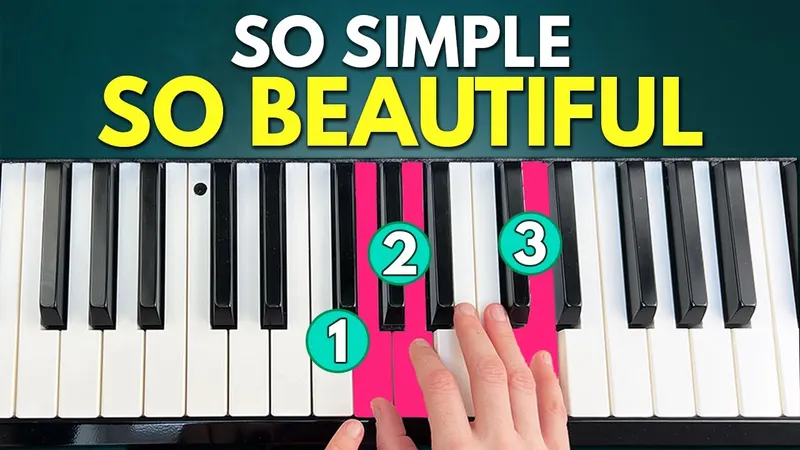
How to play a simple three-note chord (a triad) with your right hand. If D minor, C, A minor and G are new to you, the guide below lists their notes.
An acoustic piano or a digital piano. I use the sustain pedal in this lesson, and it makes the pattern sound lovely, but you can learn the notes without it first.
About 15 minutes a day. Take one step at a time and only move on when it feels comfortable. The basic pattern comes first, everything else builds on it.
Step-by-step guide
Here's what the video covers, in seven steps. Click a time to jump straight to that part.
-
Learn the four chords
Your left hand plays four bass notes: D, C, A and G. Your right hand plays the matching chords: D minor (D–F–A), C major (C–E–G), A minor (A–C–E) and G major (G–B–D). All four use only white keys.
DmCAmG
-
Play the basic pattern
Count to six on every chord. The left hand starts on 1, then the right hand plays the chord up and down. Once it feels easy, play it a little faster and it becomes a flowing arpeggio (a chord played one note after another). Then add a little accent on beat four in the right hand, every time. It's a tiny thing that makes a big difference.
-
Leave out beat five
Now leave beat five empty and play the top note of the chord (the fifth) twice: on beat four and on beat six. That gap gives you a lovely rhythm. Then mix it with the basic pattern: one bar basic, one bar with the gap.
-
Go back to the third
Another option: still leave out beat five, but instead of repeating the top note, go back to the middle note of the chord (the third) on beat six. Play the basic pattern in bars one and three and this variation in bars two and four, with the sustain pedal.
-
Start improvising
First play the full chord on beats four and six, so the shapes get into your fingers. Then choose any note of the chord instead: one on beat four and one on beat six. In D minor that's D, F or A; in C major C, E or G; in A minor A, C or E; in G major G, B or D. The secret is to place your hand on the chord shape first, so all the right notes are under your fingers. And don't look at the sheet music: watch your fingers.
-
Add intervals
An interval here means two notes of the chord played together. Play the root, then the third, and then the third and fifth together on beats four and six. For more intensity, play that interval on beats four, five and six. Watch my hand in the video to see how it moves from chord to chord.
-
Make your own mini song
Put everything together: the basic pattern twice, then the variation that goes back to the third, then the intervals, then the more intense interval pattern, and if you like, a round of free improvisation. To finish, play a C major chord in your right hand, in any inversion, or just one of its notes.
 Want to play freely like this?Modern Piano 1In my course you learn to play with chords and patterns step by step, so you can sit down at the piano and create beautiful music on your own, without relying on sheet music.Learn more about the course →
Full transcript
Prefer to read along? Here's everything I say in the lesson. Click a time to jump to that moment in the video.
Video transcript · about 2,700 words
Intro
If you ever wished you could sit down at the piano and play something beautiful without needing complicated sheet music, then you are going to love today's lesson. I am going to show you a simple chord pattern that sounds absolutely beautiful and gives you endless possibilities for improvisation.
And the best part is that you only need four different chords. And if you are new here on the channel, I'm Melanie. I studied music education. And on this channel, I help adults learn piano in a creative and enjoyable way. And now before we start, don't forget that you can download the free sheet music for this tutorial. You will find the link below in the video description. Okay. Then I would say let's jump right in.
The left hand
In the left hand, we only use four simple bass notes. We will begin with the D, then we go to the C, then to the A, and then to the G.
The right-hand chords
And in the right hand, we are playing the matching chords. That means we start with D minor, then we go to C major, then we go to A minor, and then we are going to G major. Okay? But now we will play these chords together with the left hand with a beautiful arpeggio.
The basic pattern
The basic pattern sounds like this. Okay. So we are simply playing the chord up and down and we are starting every time with the left hand. 1 2 3 4 5 6. Then we are going to the next chord, to the C major. 1 2 3 4 5 6.
Next chord is A minor. 1 2 3 4 5 6. Now comes C major. Okay. 1 2 3 4 5 6. Okay. And when you play this a little bit faster, you will get a beautiful arpeggio pattern like this.
Add expression
So practice this a few times in a row, and then make also sure to make it a little bit more expressive. That means that we will emphasize the note on beat four in the right hand every time a little bit. Okay? That you really can start to hear a cool rhythm. Yeah, tiny little things like this make a big difference.
Repeat the top note
Now, let's make it even more interesting and we will build in more variation. Instead of playing the full pattern every time, we are going to leave out beat five. Now, do you see this? So here we just leave it empty and then we get a cool rhythm. So instead of playing 1 2 3 4 5 6, we will just leave out beat five.
So we will play 1 2 3 4 5 6. Yeah. And we will repeat the top note. Okay. Just like this. 1 2 3 4 5 6. Okay. So the highest note we will play twice. And we will do this with every other chord too. So we are starting on D minor. 1 2 3 4 5 6, 1 2 3 4 5 6, 1 2 3 4 5 6, 1 2 3 4 5 6.
Observe now my little finger. Then you can see, okay, when you have the chord, yeah, you have the root, the third and the fifth. And we are taking the highest note, the fifth, and we will repeat it. Yeah. We will play it on beat four and on beat six. 1 2 3 4 5 6, 1 2 3 4 5 6, 1 2 3 4 5 6, 1 2 3 4 5 6. Okay.
Mix the two patterns
Now let's alternate between the original pattern and this new variation. And what we will do now is that we will play one time the basic original pattern and then one time the variation where we leave out the note on beat five. So then again one time the basic pattern and one time here where we leave out the note on beat five. Together this sounds like this.
1 2 3 4 5 6, 1 2 3 4 5 6, 1 2 3 4 5 6, 1 2 3 4 5 6. Okay. And yeah, this sounds really good.
Go back to the third
And here comes another option. So instead of repeating the highest note like this, 1 2 3 4 5 6, we will now go back to the third of the chord again. Yeah. 1 2 3 4 5 6. So when this is the chord, we will play it up, 1 2 3 4 5 6, and back to the third, with the other chords too. Yeah. Then A minor and G major.
Yeah. Now both hands together with the sustain pedal. 1 2 3 4 5 6, 1 2 3 4 5 6, 1 2 3 4 5 6, 1 2 3 4 5 6. Yeah. And when you play this a little bit faster, this will create much movement and this is going to sound so beautiful.
Mix in the second variation
So this is really fun to play, and again you can try alternating this with the original pattern. That means we are starting with the original pattern here in bar one and bar three. Yeah, this is the original arpeggio pattern. And then in bar two and four, this is our second variation, where we go back here to the third of the triad and where we leave out this beat five. Okay, together it sounds like this.
Improvisation
Wonderful. Right. And now comes the really fun part. We are going to start improvising. But first, let's prepare our hands. Look, we will do a little exercise now before we start improvising. And we will start that we play on beat four and six the full chord. Okay. So, we are starting 1 2 3 4 5 6. Okay. 1 2 3 4 5 6.
Now next measure, C major. 1 2 3 4 5 6. Next measure, 1 2 3 4 5 6. And the last one, G major. 1 2 3 4 5 6. Together it sounds like this. 1 2 3 4 5 6, 1 2 3 4 5 6, 1 2 3 4 5 6, 1 2 3 4 5 6.
So practice this first, that you really get those triads into your fingers. Okay. And now what we can do when we want to improvise is that we can just choose any of the chord tones. That means in the first measure you can choose between the D, the F and the A. In the second measure, yeah, where we have C major, you can choose between the C, E, and G. A minor. Yeah. Here you just take one of those three notes, A, C, or E. And then G major. Yeah. Just choose between G, B or D.
Example 1
So for each chord, just choose one note from the chord on beat four and one note from the chord on beat six. I will play you an example. Okay? And the secret is that you already place your hand in the chord shape. That way all the correct notes are right underneath your fingers.
So when I am in the first measure, yeah, I prepare my hand that I have the D minor triad. And then I just spontaneously choose two of the notes, like 1 2 3 4 5 6. Or I could take 1 2 3 4 5 6. Or 1 2 3 4 5 6. Yeah. And then when you go to the next measure where you have C major, first thing you do is you take your right hand and put it here to the C major shape. And then just take one of these three notes. Yeah. 1 2 3 4 5. And now a second one.
Let's take this one. Yeah. And for sure you could take other combinations, like 1 2 3 4 5 6 or 1 2 3 4 5 6 or 1 2 3 4 5 6. Yeah. And then you prepare the next shape. A minor. And then just spontaneously. Yeah. 1 2 3 4 5 6. Or 1 2 3 4 5 6. Or 1 2 3 4 5 6.
Yeah. Just the notes of the triad that you have underneath your fingers. And then you move your right hand to this chord shape. And then you have the correct notes under your fingers. And then you just have to press down and decide for two notes, like 1 2 3 4 5 6 or 1 2 3 4 5 6 or 1 2 3 4 5 6, 1 2 3 4 5 6, for example. Yeah. And this is so easy.
And I tell you one thing: when you don't look into the sheet music, it will get easier. When you just concentrate on preparing the chord shapes, then you will be right. And then you will be able to play this spontaneously.
Example 2
And there are so many possibilities. For example, let's try out another combination. Yeah. 1 2 3 4 5 6, 1 2 3 4 5 6, 1 2 3 4 5 6, 1 2 3 4 5 6.
Example 3
Or you could maybe take two times the same note, like 1 2 3 4 5 6, 1 2 3 4 5 6, 1 2 3 4 5 6, 1 2 3 4 5 6.
And by the way, quick question. Have you ever tried improvising before? Just write yes or no in the comments and let me know if this is already familiar to you. And if you've already created your own little melodies using this pattern, yeah, tell me about it in the comments below. I read every comment.
A rhythm variation
And now let's learn one more really beautiful pattern. And now I show you another trick. You can just make a little variation in the rhythm. Okay. Now we are playing 1 2 3 4 5 6. Yeah. And you can choose the notes of the triads. I will play you an example, like 1 2 3 4 5 6, 1 2 3 4 5 6, 1 2 3 4 5 6, 1 2 3 4 5 6.
Yeah. And this is so beautiful when you really try to emphasize beat four here. And yeah, I always took the same note. I always took the third, the third of the chords. Yeah. And this is so beautiful and emotional.
The interval pattern
Now let's learn one more really beautiful pattern. This time we are using intervals. So you start on the D minor triad and you are playing the root and the third, and then you play third and fifth together. Yeah. That means you play the middle note twice here, like this. We are starting with the left hand and then 1 2 3, and then comes the interval two times. Okay. 1 2 3 4 5 6.
So on the four and the six comes the interval grip. Okay. 1 2 3 4 5 6. Very beautiful. Same thing with all other chords too. Yeah. Move your right hand to the C major triad. And then 1 2 3 4 5 6. So here again this is the triad, and we start with the root note, then comes the third, and then third and fifth as an interval.
Then next one, place your hand for A minor, and then 1 2 3 4 5 6. And then C major. Okay. 1 2 3. Now the interval. Okay. And now let's repeat this in the right rhythm. Okay. 1 2 3 4 5 6.
And I think with those intervals here, it sounds so emotional that you get goosebumps instantly while playing this. And now we will make it even more intense. This time we simply repeat that interval on beat four, five, and six. Yeah, three times in a row. And this will sound much more powerful. So give it a try. It will sound amazing.
Yeah. And when you alternate this with the pattern before, this is so beautiful, for example. Yeah. So there are so many possibilities how you can play around with this a little bit, and yeah, just using these four chords. And I think this is really amazing.
Before we continue now, don't forget that you can download the free exercise sheet and the notes for this lesson. You can just use the link below in the video description, and that way you can practice everything at your own pace at home.
Your own mini song
And now let's put everything together. We will now build our own mini song with everything we learned so far in this lesson. And yeah, for example, you could begin just with the normal basic arpeggio pattern. Yeah. That you are playing 1 2 3 4 5 6, 1 2 3 4 5 6, 1 2 3 4 5 6, 1 2 3 4 5 6. Then you repeat it again. D minor, C major, A minor, G major.
And after that we will play the variation where you are going up the triad notes and then go back to the third. Yeah. And we will leave out the note on beat five. And because this is so beautiful, we will just repeat it. Wonderful. Now the next thing we can do is that we bring in the intervals. And why not repeat this?
And maybe you know what comes next. Now is a great time for this more intense interval pattern. Yeah. Like 1 2 3.
And then, if you want, only if you want, okay, you can start with your free improvisation. And here you just play notes of the triads. Yeah. Think of the D minor triad, the C major triad and the A minor triad and the G major triad. And prepare your hand. And then you have always the right notes under your fingers. And then, yeah, you could start like this. And in the next round when you are improvising, you are choosing other notes.
Yeah. So, don't look into the sheet music. Just look on your fingers. Just prepare the chord shapes. And then on beat four and six, just press down two keys spontaneously. Then when you want to come to an end, you can just play a C major triad. Yeah. Maybe you are playing something like this here.
Yeah, you can just play the C major triad in root position or in the first inversion or in the second inversion. Yeah. Or just take the root note or the third or the fifth. Yeah. Everything's possible. And in the left hand also you can play a 1–5–8. But if you want to take it easy, yeah, then just play the root note or the fifth of the chord or the G major triad. Everything's possible. Yeah. But just to give you an idea what you can do when you want to come to an end.
So, I hope you enjoyed this exercise. If you want to become more confident with chords and learn how to play freely without relying on sheet music all the time, make sure to check out my online course, Modern Piano 1. The link is in the video description below. And in the course, I show you how to create music at the piano independently and very confidently, okay? Because my goal isn't just to teach you songs.
My goal is to help you become free at the piano. Yeah. That you can just sit down, start playing, and create beautiful music on your own. Yeah. So, I would say thank you so much for watching. And if you enjoyed this lesson, make sure to subscribe and give this video a thumbs up. And now, make also sure to click on that video next, because in this video, I will show you another amazing way to play something beautiful on the piano right away. So don't miss this, and I will see you…
Questions about this lesson
Do I need any black keys?
No. D minor (D–F–A), C major (C–E–G), A minor (A–C–E) and G major (G–B–D) only use white keys, so you can concentrate on the pattern.
What is a triad?
A chord of three notes: the root (the note the chord is named after), the third and the fifth. In D minor that's D, F and A. In this lesson your right hand always starts from the triad shape, which is why all the right notes are under your fingers.
I've never improvised. Can I still do this?
Yes. You don't make anything up from nothing: you just choose one note of the chord on beat four and one on beat six. Place your hand on the chord shape first, and every note you choose will sound good.
Do I need to read sheet music?
No. In fact, improvising gets easier when you don't look at the sheet music. Concentrate on preparing the chord shapes and watch your fingers instead.