Lesson summary
Passacaglia by Handel and Halvorsen sounds impressive, but it's built on one simple idea: the left hand repeats the same eight chords over and over, always with the same 1–5–8 shape. Over that cycle the right hand plays a falling pattern (variation 1) or a rising pattern (variation 2) that simply moves one white key lower every two bars. Learn the chords by heart, practise two bars at a time, and you'll be playing the whole piece with both hands.
- The 8-chord progression in A minor, and how to memorise it
- An easy 1–5–8 pattern for the left hand
- Variation 1: a gentle falling pattern for the right hand
- Variation 2: the same idea, turned around
- How to put both hands together without stress
- When to change the sustain pedal
Before you start
Where middle C is and how to find the white keys. Reading music helps, but isn't necessary.
An acoustic piano or a digital piano. A sustain pedal makes it sound lovely, and I really recommend practising with it. You can learn the notes without one first.
About 15 relaxed minutes a day. Take it two bars at a time, there's no rush.
Step-by-step guide
Here's what the video covers, in five steps. Click a time to jump straight to that part.
-
Learn the 8 chords
The whole piece repeats one cycle of eight chords in A minor, one chord per bar. Learn the first four by heart, then the next four, then play all eight in a row.
AmDmGCFDmEAm
-
The easy left-hand pattern
Instead of full chords, the left hand plays the same 1–5–8 shape on every chord: root, fifth and the root an octave higher (A – E – A for A minor). Count 1 2 3 4 on each chord, then move to the next one.
-
Right hand: variation 1
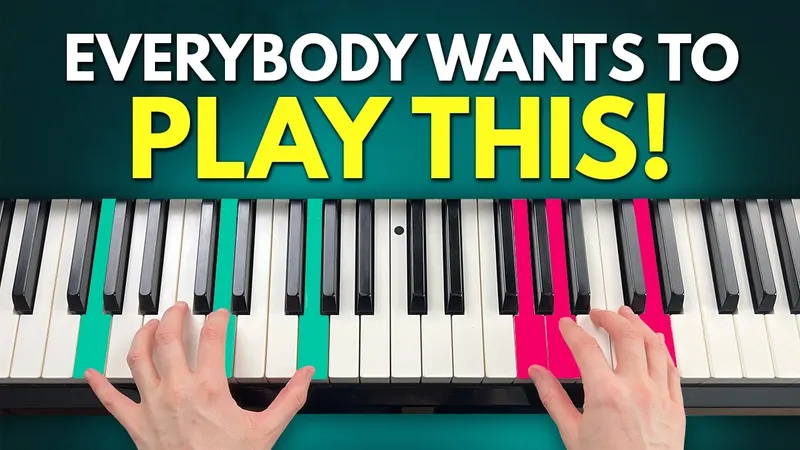
Start on two C's, an octave apart: the lower C with your thumb, the upper C with your little finger. Keep coming back to that upper C while the other notes walk down the white keys, step by step. When your thumb reaches F, carry on down with your thumb until you're back on C, then play the upper C one last time. That's two bars. Play the same pattern from the two B's, then from the two A's. The last two bars are just A, G♯, A, A. Watch my hand in the video to see the movement.
-
Right hand: variation 2
The same idea turned around. Start at the top: the upper C with your little finger, then the lower C with your thumb. Now climb up the white keys, coming back to your thumb in between. When your little finger reaches G, carry on up with it until you reach C. Then the same from the two B's and the two A's. The last two bars are the same as in variation 1.
-
Put both hands together
Go very slowly and practise two bars at a time before joining them up. Change the sustain pedal on beat 1 of every bar, so the chords don't blur together.
 Enjoyed playing with chords?Modern Piano 1In my course you learn beautiful chord progressions like this one step by step, so you can sit down and play freely, without sheet music.Learn more about the course →
Full transcript
Prefer to read along? Here's everything I say in the lesson. Click a time to jump to that moment in the video.
Video transcript · about 2,900 words
How to play Passacaglia
This is one of the most beautiful piano pieces you can play and it's much easier than it sounds. Today I will show you a simplified version of the famous Passacaglia by Handel and Halvorsen. And even though we make it easier, it still sounds
absolutely beautiful. So if you are looking for a piano piece that really touches your heart, then this one's for you. And if you are new here, subscribe to the channel and give this video a thumbs up. It really helps me a lot. And by the way, you can download the sheet music and the chord progression for free. You will find the link in the video description below.
Okay, first let's look at the left hand. And here is the good news. The left hand repeats the same idea again and again. Here you can see we have eight different chords and we always use the same pattern. We use 1–5–8. Let me quickly show you how it works. Look, you see the chord symbols above and instead of
The chord progression
playing just the triads, we will use the same 1–5–8 pattern again and again. So let's start with the chord A minor. Instead of playing A minor, you just play the root note, the fifth, and then the root note again one octave higher. And this is the 1–5–8 shape. And we will apply this shape on every
other chord too. That means the next chord is D minor. Okay. Then we go with the pinky to the D and then again 1–5–8. Okay. Then we jump up to the G and then again 1–5–8. Then we go down to the C and then again 1 5 8. Then we go up to the F.
Okay. Then to D minor, then E minor, and up to A minor again. Okay, so that's the whole chord progression. And if you remember these chords and patterns, you've already learned a big part of the piece. And by
the way, if you enjoy learning to play piano with chords and patterns, make sure to check out my online course, Modern Piano 1. It's a modern approach to piano playing, where you will learn how to play more freely and how to create beautiful music with chords instead of always relying on sheet music. You will find the link in the description below. And I would recommend you to learn this chord progression by
heart. That you really know instantly what to play in the left hand. Yeah. That you begin with A minor, A, E, A, then D, A, D, G, D, G, C, G, C. Yeah. And that you really maybe first learn the first four chords. A minor, D minor, G major, C major. And if
you really know them by heart, then you take the next four chords and you are learning F, C, F, D, A, D, then E, B, E, and A, E, A. Okay. So then you do that again and again. Yeah. F major, D minor, E minor, and A minor. And then you put all the chords
together. Yeah. A minor, D minor, G major, C major, F major, D minor, E minor, A minor. Okay. All right. Now, let's have a look at the rhythm for this chord progression. And the rhythm is really easy. Look, you always play 1 2 3 4. Then you go to the
The easy left-hand pattern
next chord. 1 2 3 4 up to G major. 1 2 3 4 1 2 3 4 Now F major 3 4 1 2 3 4 1 2 3 4 1 2 3 4 Okay, so this is the
left hand. And just a quick reminder, you can download the sheet music and the chord progression for free. The link is in the description below so you can use it while practicing. Okay, now let's look at the right hand. Like I told you before, the left hand repeats the same chord progression over and over again like a cycle. And over this repeating
pattern, we can play different variations with the right hand. And I'm going to show you two beautiful and easy variations you can play. And we will start now with our first variation. So let me play this for you quickly and then you can already hear how it sounds.
Right hand: variation 1
Okay, now let's look at the right hand alone. So look, this is the middle C and we are starting with these two C's here. Start by playing the lower C with your thumb and then the upper C with your little finger. And then now keep coming back to this upper C while the other notes move down step by step only the
white keys. Okay? Like this. And then when your thumb reaches the F, you simply continue down with your thumb. Yeah. Until you reach the C again. And then one last time the higher C. Okay. So let's do that again. thumb, pinky, and then note by note down, but
you always come back to the pinky again. Okay, now the thumb reaches the F and then the thumb plays the white keys down. Okay, wonderful. So, let's do that once more. Yeah. And you can just watch my hand to
get the pattern. Okay. All right. So that was the first part. So practice this a few times until the movement starts to feel natural and then we will have a look at the next two bars. And now comes the cool part. We take exactly the same pattern and move
everything one white key down. So in the first two bars we started from the C. Now we start the same pattern with the same movement. One white key down and we start on the B. Okay. So you start again with your thumb pinky and then you just go down all white keys. Yeah. And you always keep coming back to your pinky.
When your thumb now reaches the last note, then you just play the next notes with your thumb until you are reaching the lower B. And then one last time to the higher B. Okay? Like this. Wonderful. Try to play this with me
together. So we start with the thumb pinky and then we are just going down. So now thumb on the E and thumb on the D. Thumb on the C and thumb on the B. And then one last time back to the higher B. Okay. And look this is exactly the
same movement like we had before. Now same thing but we are starting on the two B's. And now the good thing is when we look at the next two bars we just keep playing this pattern but this time we
are starting from the A. Okay. A and A and we are playing exactly the same pattern. So we are starting with the thumb pinky and then we start going down every white keys. Yeah. Now thumb reaches the D and then you play the other notes with your thumb
down until you reach the A and then one last time the higher A like this. Yeah. So we have three times exactly the same pattern with the same movement. But the first two bars we are starting from
the C. The next two bars we are starting from the B. And then the next two bars we are starting one white key lower on the A. Yeah, that means once you got the
movement then you can play nearly everything from the first variation. Okay. But now let's look at the last two bars. These ones are a bit different. Here you just play A then G sharp back to A and then A. Yeah. Like a little jump.
Okay. And when we count this will sound like this. 1 2 3 4 and 1 2 3 4. Again with me. One 2 three four and. One, two, three. One last time. Okay. One, two, three, four. And one, two, three, four.
Okay. Now, let's put everything together. And I would say you can try to play with me together. We start here on the C. Three and four. And Now start from the B.
Now start from the A. One and two and three and four and one and two and three and four and one. Okay. All right. So, this is the first
variation. Now, let's also learn the second variation. And this is where it gets really easy because it's very similar to the first one. We simply turn the idea a little bit around. Let me show you this. I will play it once for you.
Right hand: variation 2
Okay. All right. So, this is how the second variation sounds. So, again, we start with the two C's, but this time we don't start at the bottom. We start at the top. Okay. So, first play the upper C with your little finger and then you play the lower C with your thumb. Okay? And then you just go all the white keys
up, but you keep coming back to your thumb in between. Okay? So, you're starting pinky, thumb, and now just climb up all the white keys. And when you reach the G with your pinky, then just go with your pinky ahead. Okay. And that's it. Okay. So again, pinky, thumb, and then just play all
white keys up. And in between, keep coming back to your thumb. And when your pinky reaches the G. Then simply continue moving up with your little finger until you reach the C again. Okay? Again. G. And now again you are starting pinky thumb and
then okay and that's it. So these are the first bars. And now I would say practice this movement. Yeah. That you really get this under your fingers. And when this works then we will have a
look at the next two bars. And now we are doing exactly the same movement and we will start from the B. Okay. So start with your little finger then down to the thumb and then move back up until you reach the higher B again and then one last time the lower B.
Okay? Like this. Okay. And then the next two bars here we have the same pattern from the A. Okay. So first we started from the C then from the B and now from the A. Okay. And we are starting pinky thumb and then
we go up again until we reach the A. Okay. So this third part goes like this. And then the last two bars they are exactly the same like in variation one. Okay. That means you are playing a
G sharp A Okay. So I would say let's try all four parts together. Here we will play now the whole variation number two with just the right hand alone. Okay. So put your pinky and your thumb on the two C's and then this time we will start from the top. Okay. three and four and
Okay. Now from the B. Now from the A. One and two and three and four and one. Okay. All right. So this is variation
number two. Now let's put both hands together. And if this feels difficult at first, go very very slowly. There is no need to rush. And you know the left hand keeps repeating our 1–5–8 pattern and the right hand plays our first variation. Okay. So let's now try to combine both hands. So when you start the A and the C
Putting both hands together
are coming together. Yeah. And on the first note you play in the right hand C C. Then comes the next note in the bass and you are playing B C. Then comes the next note in the bass which is the A. And here you are playing A C G C and that's it. Yeah. Again 1 and 2 and 3 and four and
and then you are just doing the same with the next bar. Yeah. Here these both keys are starting together. That means F C then E C D C Okay. And I would say just begin with
practicing the first two bars. Yeah. So this is the first thing you can start with. Okay. And when you really can play this, then you just practice the next
two bars where we are starting on the B in the right hand and in the left hand you play the G and then you go down to the C. Doesn't it sound so beautiful? Yeah. And then you can start again here from the B and on the G.
Yeah. And again. And then if you feel ready, you can put those first two sections together. And now let's look at the next
part. And this is the part where we start from the A. Okay? And here you play the F. When you play the thumb on the D, you also play the D in the bass. Yeah. Repeat this pink section alone. Yeah. From the F in the bass
to the D in the bass. Okay. All right. And then we have a look at the last two bars. And here you start on the E and in the right hand on the A. Yeah. And you are counting one, two. Then comes E and G sharp together. And then A.
Okay, let's do that again. 3 4 1 2 3 4 and 1 2 3 4. Again. 1 2 3 4 and 1 2 3. One last time. 1 2 3 4 and 1 2 3 4. Okay, now let's put
everything together and then we can play variation number one with both hands. Okay. Three. Four.
Okay. And you can also see that I change the pedal on beat one in every bar. And like this, the harmonies won't blend into each other so much. Yeah. And this is very important that you also practice this with the sustain pedal.
All right. Now, let's do the same thing with variation number two. And I think this will now get easier for you because once you mastered variation one, then we'll also master variation two. Okay? And here you can do the same thing. You
can start practicing just the first two bars and then it's a little bit easier because it's not so overwhelming as if you would try all eight bars at once. Okay. So you just take the first two bars and then you begin to practice. Yeah, make sure that you are here on the two C's and in the left hand on the A and then you are starting one and two
and three and four and now you go to the D and here to the G. Okay, practice this first and then you can also do this a little bit faster. Yeah, repeat this really several times.
And then you take the next two bars and here remember you started on the B. Yeah. And again then you put all four bars together. So you are starting on the C.
Now from the B. Now the next two bars. And here you are starting from the A. Okay? And in the left hand you begin with the F. down to D minor. And then you can just play this tiny little pink section again where you are
starting from the A. Yeah. Just repeat this several times and then we look at the last two bars and they will be easy for you because you already know them. Okay. 1 2 3 4 and 1 2 3 4. Okay. So now let's put
all four parts together. And I think this will sound really beautiful. So make sure that you are on the right keys. And also in the left hand here you are starting and then we just begin three and four and D minor. up to G,
C, down to D minor, E minor, and up to A minor. Okay, so let's practice this also with the pedal. We start with the yellow section where we start from the C.
Now we start from the orange section where we are starting from the B. Now the pink section where we are starting from the A. 1 2 3 4 and 1 2 3 4. Okay. And this is the beautiful piece. And there we have
it. Two beautiful variations for the right hand. And if you like to learn many more beautiful chord progressions, be sure to check out my course, Modern Piano 1. Inside the course, I will guide you step by step that you are becoming more and more confident enough that you can sit down at the piano and simply play beautiful music on the spot. And you will find the
Learn to play chords on the piano
link in the description below. So, thank you so much for watching. If you enjoyed this lesson, don't forget to subscribe and give this video a thumbs up. And before you leave, click on this video next because I'm going to show you another simple technique that will make your piano playing sound even more beautiful without relying on sheet music. And I hope to see you…
Questions about this piece
Who wrote Passacaglia?
The melody comes from the last movement of a harpsichord suite by George Frideric Handel (Suite No. 7 in G minor, published in 1720). In the 1890s the Norwegian composer Johan Halvorsen turned it into his famous Passacaglia for violin and viola, and that's the version most piano arrangements are based on.
Is this version suitable for beginners?
Yes, if you know where the white keys are and can play a little with both hands. The left hand plays the same 1–5–8 shape on every chord, and in each variation the right hand repeats one movement, just starting one white key lower every two bars. That makes it much easier than it sounds.
What key is this version in?
Handel and Halvorsen wrote it in G minor. This simplified version is in A minor, which has no sharps or flats, so you play almost only white keys. The only black key is the G♯ in the right hand near the end.
Do I need to read sheet music?
Not to get started: I go through both hands step by step in the video, so you can follow along with me. But the sheet music is definitely handy. It has the notes and the chord progression, so you can put it on your piano and practise without pausing the video every few seconds. Get the free sheet music.