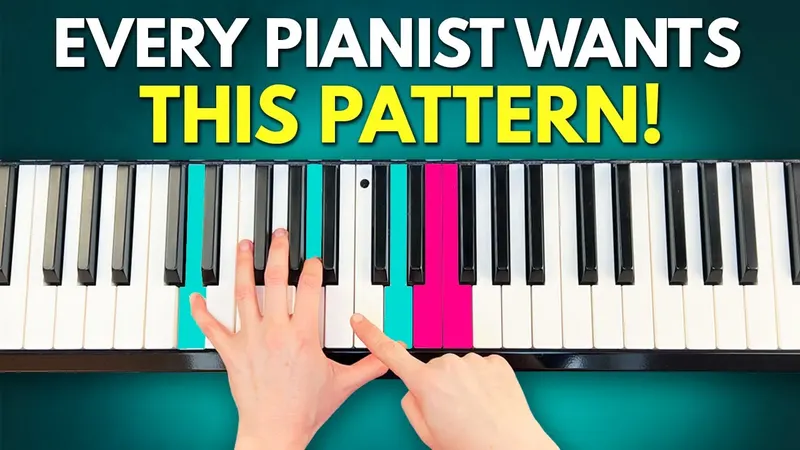
Lesson summary
The chords are A minor, F major, C major and G major. Your left hand starts simply, with the root and fifth held for a whole bar, and later plays a flowing 1–5–8–9–10 pattern. Your right hand learns three short melody patterns, from alternating E and C to C, B, G, C. Put together with a relaxing part, eight bars of improvisation and an ending, they make a whole piece that you can play along with me.
- Three short, emotional melody patterns
- A simple left hand with root and fifth
- The flowing 1–5–8–9–10 left-hand pattern
- How to connect the patterns smoothly
- A relaxing part and eight bars to improvise
- A whole piece to play along with
Before you start
Where the notes are on the white keys and how to count 1 and 2 and 3 and 4 and. Crossing a finger over the thumb comes up in the second left-hand pattern.
An acoustic piano or a digital piano with a sustain pedal, which gives the second left-hand pattern its dreamy sound.
About 15 minutes a day. Learn one melody pattern at a time, and practise the second left-hand pattern until it's relaxed.
Step-by-step guide
Here's what the video covers, in seven steps. Click a time to jump straight to that part.
-
Left-hand pattern 1: fifths
The chords are A minor, F major, C major and G major. Your left hand plays only the root and the fifth together, held for the whole bar: A and E, F and C, C and G, G and D. Count 1 2 3 4 and play it a few times in a row.
AmFCG
-
Three melody patterns
Pattern 1, the easiest: alternate between E and C in the first three bars, and between D and C in the fourth, counting 1 and 2 and 3 and 4 and. Pattern 2: D, C, D, G, over and over. Pattern 3: C, B, G, C; your hand spans a whole octave, so stay loose and relaxed. Then play all three one after another.
-
Left-hand pattern 2: 1–5–8–9–10
One octave lower, play the root, the fifth, the octave with your thumb, then cross over with your middle finger to the next white key and play the next one with your index finger: A, E, A, B, C. It's always the same shape: F, C, F, G, A; C, G, C, D, E; G, D, G, A, B. Use the sustain pedal for the dreamy sound.
-
Put the patterns together
Now play the three melody patterns with the new left hand, one after another. Practise the left-hand pattern so well that you can play it relaxed, then focus on the right hand. Anticipate the changes: before pattern 3, be ready to get your little finger up high in time.
-
The relaxing part
A part to breathe: your left hand goes back to pattern 1, and your right hand holds a C major triad in second inversion (middle finger on C) for three bars. In the fourth bar, play a G major triad and move to C on beat 3; the second time, move to B. Practise the jump from pattern 3 into this part: see the next chord in your mind.
-
Eight bars to improvise
Your left hand plays pattern 1, and your right hand plays freely with the white keys for eight bars. Keep it simple: you can even use just one note, like E, and go to D over G major. The main thing is not to lose the rhythm.
-
The ending, and the play-along
Then play the three melody patterns again with the second left-hand pattern, and end with C, G, C in both hands. After that, play the whole piece along with me, and then with the play-along track on your own.
 Want to create melodies like this yourself?Modern Piano 1In my course you learn to find chords and inversions quickly, without thinking so much, and to create beautiful melodies at the piano.Learn more about the course →
Full transcript
Prefer to read along? Here's everything I say in the lesson. Click a time to jump to that moment in the video.
Video transcript · about 2,700 words
Intro
Hello and welcome to a new video from Piano with Melanie. Today I'm going to show you how you can play beautiful, emotional melodies on the piano. You will learn different patterns for both the right and the left hand. And there's even a short improvisation section where you can let your creativity flow. And the best part: I created a free play-along track, so you can easily practise at home and play along with me.
You can download the sheet music and the play-along track for free. The link is in the video description below. If you are new here, make sure to subscribe to the channel and give this video a thumbs up. It helps more piano players find these lessons.
Left-hand pattern 1
So let's first have a look at the left hand. Here we will play the fifth of A minor, A and E. Then we will play the fifth of F major, F and C. Then we go down to C major and we will play only C and G. And then at the end we go to G major once, and there we only play the fifth. That means G and D. And we will play the chords during the whole measure. That means for four beats.
And now we will try this with our left hand together. 3 4, 1 2 3 4, 1 2 3 4, 1 2 3 4, 1 2 3 4. A minor, 2 3 4. F major, 2 3 4. C major, 2 3 4. G major, 2 3 4. Wonderful. Okay. And you can play this in a row, so that you really get familiar with the left hand.
Three beautiful melody patterns
And now we will bring in the right hand. Here I have three beautiful melody patterns for you. And we will begin with the first pattern, which is also the easiest one. And here you are going to play the notes E and C, like this. And you will always alternate between them. And you will do this in the first, second and third measure. And in the fourth measure, you will play D and C. And you will alternate between D and C.
Let's look at this together. 3 and 4 and. 1 and 2 and 3 and 4 and. 1 and 2 and 3 and 4 and. 1 and 2 and 3 and 4 and. 1 and 2 and 3 and 4 and. So take a look at this, and then we will play both hands together.
Okay, let's begin. 3 and 4 and. 1 and 2 and 3 and 4 and. 1 and 2 and 3 and 4. Now change to C major. 3 and 4. And now D, C, D, C, D, C, D, C. And again. 2, 3 and 4 and. 1 and 2 and 3 and 4 and. 1 and 2 and 3 and 4 and. 1 and 2 and 3 and 4 and. Beautiful.
Okay. Melody pattern number two. Here you are going to play the notes D, C, D, G, D, C, D, G, and so on. And this we will repeat over all measures. So just try to play this a few times in a row, just the right hand alone, until you really have it under your fingers. And then, if you feel ready, we will add the left hand. Okay?
3 and 4 and. 1 and 2 and 3 and 4 and. 1 and 2 and 3 and 4 and. 1 and 2 and 3 and 4 and. 1 and 2 and 3 and 4 and, and again. Okay. So, this is really going to sound very beautiful. Now go down to C, and then up to G. Okay. All right. So this was pattern number two.
Now let's look at pattern number three. Here you are going to play the notes C, B, G, C. Okay. So you see, now you have to grab a whole octave with your hand, but try to stay very loose and relaxed with your hand, and just repeat it a few times in a row, so that you get used to it. And I think this sounds really very nice.
And now we will try out the whole thing together with the left hand. 3 and 4 and. 1 and 2 and 3 and 4 and. 1 and 2 and 3 and 4 and. 1 and 2 and 3 and 4 and. 1 and 2 and 3 and 4 and. Let's repeat this again. Wonderful. C major and G major. Isn't this beautiful?
Let's repeat all three beautiful patterns for the right hand now, and play them one after another. The sheet music for this tutorial you can also download for free. The link you'll find below in the video description. So, let's begin. 3 4, 1 2 3 4, F major, 2 3 4, C major, 2 3 4, G major, 2 3 4. And now pattern two.
Okay. All right. Don't lose your concentration. Just go on with this beautiful pattern. Now back to G. And now prepare yourself for pattern number three. Okay. All right. F major and G major again. Wonderful. Now we have all three patterns together.
Left-hand pattern 2
Now things are getting a little bit more complicated, because now I have another beautiful left-hand pattern for you. Instead of playing the whole thing up here, we will go just one octave lower. And there we will start with the root note, go to the fifth, then with the thumb to the octave, and then we will cross over with the middle finger to the next white key. And then with your index finger to the next white key. Okay, this is our new pattern, like this.
So just try this out a few times. And this exact pattern we will now apply to all the other chords too. So on F major we are starting again with the root, the fifth, the octave. Then we are crossing over, and just a little bit higher. Okay. Then the whole thing on the C major. Okay. Cross with your middle finger and one white key up. And then the whole thing on G major: G, D, G, then A and B. Okay?
And the thing is, it's always the same shape. And when you keep practising this, then it gets more and more familiar, and you can just apply and copy this to all the other chords. It's only that the starting note changes, okay? But the distances between the different keys stay the same. So you really get this under your fingers, and then it gets easier and easier. So just practise along with me. F major, now C major, and back to G major.
Okay. All right. And really try to play with the sustain pedal, because this is what gives us this dreamy sound, because otherwise this would be too dry. This doesn't sound beautiful, right?
The new left hand with the melody patterns
And now this is the moment where we are putting everything together. We have our new pattern for the left hand, and we will now combine this with the three beautiful melody patterns in the right hand, directly one after another. Okay, are you ready? We will start with pattern number one in the right hand. 3 4, 2 3 4, 1 2 3 4, 1 2 3 4, 1 2 3.
So this is the first pattern. Practise this slowly. Try it out, so that you're really looking, okay, which notes come together in both hands. Okay. And perhaps if you do this for the first time, this can be a little bit tricky, but once you get it, it gets easier and easier. Trust me. The most important thing is that you've already practised this left-hand pattern so well that you can play it totally relaxed, and that you can really concentrate on the right hand.
So, let's try the second melody pattern now. 1 2 3 4, 1 2 3 4, C major and G major. And this sounds really beautiful. So just do it another time. Wonderful. And the last bar. So now let's try out the last melody pattern, the third one, with both hands together. 3, 4. I think this is my favourite one, because it's so emotional, right? Wonderful.
So now let's put all three melody patterns together with our new left-hand pattern. And here it's really important that you can connect the different patterns with one another. So when you want to change from the second to the third pattern, you are really on time with your little finger high up here. So you really have to anticipate a little bit what's coming in these examples.
3 4, 1 2 3 4, 1 2 3 4. Wonderful. So keep in mind, now pattern number two is coming in the right hand. Okay, no problem for us, because we already practised it very well. And now get your mind ready to go high up here, and just enjoy the beautiful sound. Isn't this amazing?
The relaxing part
And now, if you want to have a little bit more variation, I have a new special part for you, which gives us a little bit of time to breathe and which sounds really relaxing. We are just playing a little bit less. So we are going to the first accompaniment pattern in the left hand, and in the right hand you are going to play a C major triad in second inversion. So the middle finger is on the C.
And this C major triad you are going to play over the first three bars. So 1 2 3 4, 1 2 3 4, 1 2 3 4. And in the last bar you are going to play a G major triad in the right hand. So 1 2 3 4. So on the 3 you are going to the C. So again: 1 2 3 4, 1 2 3 4, again C major, and then go to G major, and the C.
Okay, we will repeat this again, but it would sound a little bit incomplete if we just stopped at the C here. And this is why, the second time we repeat this, we do exactly the same: for the first three bars we are going to play the C major triad, and then in the fourth bar we are going to play the G major, but then we go to the B. Okay.
So let's do the complete part together. So the first time you go to the C, and the second time you go to the B, like this. 3 4, 1 2 3 4, 1 2 3 4. The right hand keeps playing C major, and then go to G major and C. And again, C major in the right hand, again C major in the right hand, C major in the right hand, and then G major and to the B. Okay.
And by the way, if you still have problems with the inversions and you want to be quicker without thinking so much, then I can really recommend my online course, Modern Piano 1. More information about it you will find down in the video description.
So when you are going from the third melody pattern into the relaxation part, as I call it, okay, with the chords that we just hold, there we have to practise the transition, because it's a little bit tricky, because you are coming from this melody pattern and then you really have to jump a little bit with your hands. Look, so you really have to be there on time, and yeah, this is a point you really have to practise. So do this again and again.
You already have to see the next chord in your mind. Okay? So you really have to practise this again and again. Maybe just the right hand alone, so that you really get these chords, or the left hand separately. And then you are going to practise this with both hands together. Wonderful. 2 3 4, 1 2 3. And there you have all the time in the world, and you can relax a little bit.
The improvisation part
Now, I have something really beautiful for you, for all of you who want to improvise a little bit and play freely. Here we have eight bars, and there you can really play what you want. The left hand we will play with the easy accompaniment pattern, pattern number one. And with the right hand you can improvise freely. And I can just give you a little example of how this could sound.
Look, I'm only using the white keys for my improvisation. And the trick is to keep it easy. Easy doesn't mean that it doesn't sound beautiful. Yeah. Just as an example. So really try to keep it simple. And what you can also do is just take one note. For example, try out the E. And on the G you go to the D. Maybe this sounds a little bit better.
And then you try out different things. You can use all the white keys, completely freely. And the main thing is that you don't lose the rhythm while improvising.
The last part and the ending
And then you can finish the whole piece, and you are going into our three beautiful, emotional melody patterns, and you can take the second left-hand pattern, the sparkling one. And then we just repeat this whole part with the three melody patterns. So we begin with the first melody pattern, like this. Then we go to the second melody pattern, and then the third one, the most beautiful one.
So I'll go through it a little bit more quickly now. And now at the end, when you've arrived here, then you just play C, G, C, and in the right hand also C, G, C. And like this we have a beautiful ending. If you like this video so far, then please give it a thumbs up, and don't forget to subscribe to the channel. Then you won't miss the future ones.
All parts with the play-along
And now we will do this all together with the beautiful play-along. And like this we can practise it wonderfully. I will just play it once for you, and then you can just relax and listen to it. Pattern two. Now pattern number three. I always can't wait for this part to come. So now the beautiful left-hand pattern. Wonderful. D, C.
And the second melody pattern combined with the beautiful left-hand pattern. And now get yourself ready for the third melody pattern, which is the most beautiful. All right. Now, here comes the relaxation part, as I call it. And now G major and to the C. And then repeat: C major second inversion. And again. And now to G major and to the B.
And then the improvisation part. Just feel free, try out some things. Just use the white keys. And after the eight bars, you start again: melody pattern number one with the sparkling left-hand pattern. Pattern number two, also combined with the beautiful left-hand pattern. And then now you really have to be ready for the third melody pattern. The last round, so to say. And then just play the ending.
Practise with the play-along
Okay, I will put the play-along here into the video so that you can practise along with it. But I will also attach it to the free PDF sheet, so that you can practise better at home, and you can download the sheet music and the MP3 below in the video description. You can just practise the right hand, or just practise the left hand, or you can just use it to improvise.
So feel free to use it however you want, and don't be shy. Just try out different things. And I would say now it's your turn. You can play together with the play-along. And I would say have fun, and I will count you in. 1 2 3 4.
Questions about this lesson
Which chords does this lesson use?
A minor, F major, C major and G major. Your left hand plays them as root and fifth, and later as the 1–5–8–9–10 pattern.
What are the three melody patterns?
Pattern 1 alternates between E and C, and between D and C in the last bar. Pattern 2 is D, C, D, G, repeated. Pattern 3 is C, B, G, C, spanning an octave.
I've never improvised. What do I play in the improvisation part?
Anything on the white keys, as simple as you like. You can even stay on one note, like E, and move to D over G major. Just keep the rhythm going.
What is the play-along?
A backing track to play along with, so you can practise the whole piece at home: the right hand, the left hand, or your own improvisation. At the end of the video you can play along with it.