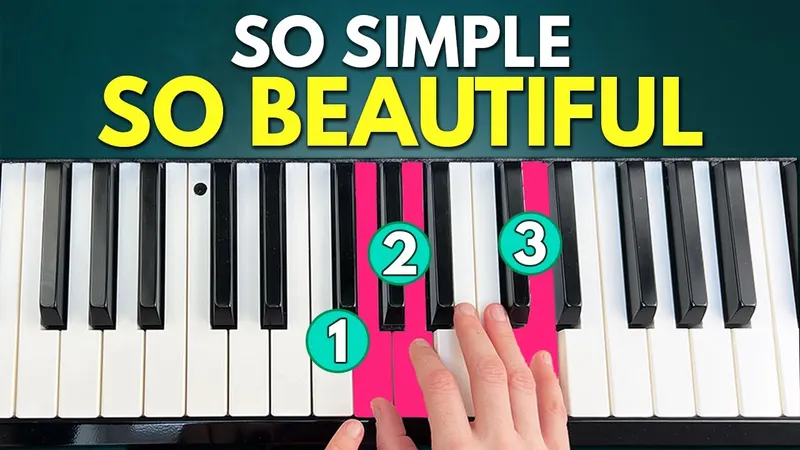
Lesson summary
Your left hand plays one of the most beautiful patterns, 1–5–8–9–10, on four chords: C major, F major, G major and F major again. Your right hand starts with just C and G, first together, then rocking between them like a pendulum. Then your little finger moves up to A and B for a little melody. In the last exercise your thumb keeps coming back to C while you choose the other notes yourself: your first improvisation.
- The dreamy 1–5–8–9–10 left-hand pattern
- How to use the sustain pedal with it
- A pendulum between thumb and little finger
- A little melody with your little finger
- How to improvise with any white key
- Why repeating a phrase makes it sound like a song
Before you start
Where the white keys are and how to count 1 and 2 and 3 and 4 and. Crossing a finger over your thumb is part of the left-hand pattern, so take your time with it.
An acoustic piano or a digital piano with a sustain pedal. Without it, the pattern sounds too dry.
About 15 minutes a day. The left-hand pattern takes a while to get familiar with, so practise it first.
Step-by-step guide
Here's what the video covers, in six steps. Click a time to jump straight to that part.
-
The 1–5–8–9–10 left hand
The chords are C major, F major, G major and F major. On each one, play the root, the fifth and the octave, then cross over with your third finger to the next white key (the 9) and play the next one up (the 10), using only notes of the C major scale: C–G–C–D–E, F–C–F–G–A, G–D–G–A–B. Count 1 and 2 and 3 and 4 and, and use the sustain pedal: it sounds more dreamy.
CFGF
-
Exercise 1: C and G together
Your right hand plays C and G together on every beat, 1 2 3 4, over all four chords. Together with the left hand it already sounds beautiful. Then play it a little faster.
-
Exercise 2: a little swing
Keep C and G, but rock between your little finger and thumb like a pendulum: G on the beat, C on the "and" in between, counting 1 and 2 and 3 and 4 and. Played a little faster, it really begins to flow.
-
Exercise 3: a melody with your little finger
Play C and G together four times in the first bar. In the second bar, move your little finger one white key up: C and A. In the third bar, one more white key up: C and B. In the last bar, one key down again: C and A. It's a nice stretch for your hand.
-
Exercise 4: the melody as a pendulum
Take the same melody, G, A, B, A, and play it in the pendulum style again, switching between your little finger and thumb. Then add the left hand and get into a nice flow. Try to play with feeling.
-
Exercise 5: choose your own notes
Your thumb plays C on every "and". On the beats (the little x marks in the sheet music) you choose any note of the C major scale, so any white key. The only rule: always come back to C. Don't think about fingering, just keep the flow. If you find a phrase you love, repeat it: your ear remembers it, and it starts to sound like a song.
 Want to play freely at the piano?Modern Piano 1In my course you learn chords, patterns, inversions and improvisation, so you can sit at the piano and play freely, without needing sheet music.Learn more about the course →
Full transcript
Prefer to read along? Here's everything I say in the lesson. Click a time to jump to that moment in the video.
Video transcript · about 1,700 words
Intro
Hello and welcome. In today's tutorial, I will show you how to create beautiful melodies using just a few simple notes. It's going to be relaxing, creative and just so much fun to play. After this video, you might not want to stop, because playing this little exercise can be really addictive. If you are new here, please feel free to subscribe and give this video a thumbs up.
The left-hand pattern
For the first step, let's look at the left hand first. Here we will use one of the most beautiful left-hand patterns. We will play a 1–5–8–9–10 arpeggio as a pattern. The chords are C major, F major, G major and F major again. Let's start with C major. Here you play the root, the fifth and the octave.
And then you cross over with your third finger and play the next white key. And then again the next white key up. So you play 1 5 8 9 10. Imagine you would give numbers to every white key, starting from the C. So then you have 1 5 8 9 10. But you will only use the notes from the C major scale. Do this a few times. If you want, you can also play with the sustain pedal, like this. It sounds more dreamy.
And then we will go to the next chord. Now we start on F major. So we begin with the root, the fifth, then the octave, and then we cross over with the third finger to the 9 and with the index finger to the 10. So 1 5 8 9 10. Same thing for G major. There you start on the note G and you are counting 1 5 8, crossing, 9 10. All right. And then you go back to F major: F, C, F, G, A.
It really takes a while to get familiar with this pattern. So practise this first, and then let's repeat the whole chord progression. Now we play the following rhythm. We start on C major down here. 1 and 2 and 3 and 4 and, 1 and 2 and 3 and 4 and, 1 and 2 and 3 and 4 and, 1 and 2 and 3 and 4 and, and back again.
We start on C. Then we go to F major, right? Then comes G major, and then back to F major. And also make sure to use the sustain pedal, because with the sustain pedal it really will sound more dreamy. When you don't use the sustain pedal, it really sounds too dry. By the way, you can download the PDF with the sheet music for free. The link is in the video description below.
Right hand, exercise 1
So, step number two. Now I will show you different ways of what you can play with your right hand. Exercise number one. First, we add the right hand. You will play C and G together on each beat. So C and G together. And you are playing 1 2 3 4, 1 2 3 4.
When you put both hands together now, this would sound like this. 1 and 2 and 3 and 4 and. Okay. And the next one. 1 and 2 and 3 and. Now don't forget the 4 and. 1 and 2 and 3 and 4 and. 1 and 2 and 3 and, now don't forget the 4 and. And then you repeat this whole chord progression from the beginning. So let's do this a little bit faster. 3 and 4 and.
Right hand, exercise 2
And this is really beautiful, right? So if you are enjoying this so far, make sure to subscribe, and you will find lots of beautiful exercises here. And now we keep playing the C and the G in the right hand. But this time we play it like a little swing. We will move back and forth between the pinky and the thumb. The G will always come on the beat, and the C in between the beats, on the "ands", like this. 1 and 2 and 3 and 4 and.
Okay, let's try this with both hands together. 3 and 4 and. 1 and 2 and 3 and 4 and. 1 and 2 and 3 and 4 and. 1 and 2 and 3 and 4 and. 1 and 2 and 3 and 4 and. Okay. And when we do this a little bit faster, then this really begins to flow.
Right hand, exercise 3
Okay. So let's do the next exercise now. Now we want to add more melody in the right hand. We will start again with C and G together. In the first bar we will play it four times. 1 2 3 4. And in the second bar you move your pinky up to the A, just one white key higher. Okay? So you are playing C and A. 1 2 3 4.
And in the third bar you are moving your pinky just one white key up again, and then you are also playing 1 2 3 4. And then in the last bar you are moving your pinky just one white key down, and then you play C and A again. 1 2 3 4. Let's repeat this together. 1 2 3 4, 1 2 3 4, 1 2 3 4, 1 2 3 4, and back to the beginning.
And this is a wonderful way to train your hand's stretch a little bit. And now I would say let's do both hands together. 3 and 4 and. 1 and 2 and 3 and 4 and. Now move up with your pinky. Move up with your pinky again. And move down with your pinky, and from the beginning. Okay. So, let's do this a little bit faster. 3 and 4 and.
Right hand, exercise 4
Okay. Now we take the same melody, but this time we go back to the pendulum style, with the thumb and pinky switching. Let's try only the right hand first. So we are going to play 1 and 2 and 3 and 4 and, then go up with your pinky. 1 and 2 and 3 and 4. And now go to the B with the pinky. And then back again to the A.
1 and 2 and 3 and 4. And now A. 1 and 2 and 3 and 4. And now B. 1 and 2 and 3 and 4 and, back to A. 1 and 2 and 3 and 4 and, 1. Okay. And I would say let's put both hands together now and see how this sounds. 3 and 4 and. 1 and 2 and 3 and 4 and. F major. G major, back to F major.
Okay. And you can play this again and again and really get into a nice flow. And really try to play with feeling. By the way, if you want to go deeper into this style of playing, learning chords, patterns, inversions, improvisation, then take a look at my online course, Modern Piano 1. It's perfect if you want to sit at the piano and just play freely without needing sheet music. The link is down in the video description.
Right hand, exercise 5
And now comes the final step, and it's the most creative one. And here we will do the following thing. On the "ands", the offbeats, you will always play the C with your thumb. But where you see the little x marks, you can choose your own note. Pick some random notes from the C major scale. That means that you can use every white key. And the only rule is to always come back to the C with your thumb.
For example, you could do something like this. 1 and 2 and 3 and 4 and. 1 and 2 and 3 and 4 and. 1 and 2 and 3 and 4 and. You see, always when I count "and", I play the thumb, and on the beats I play a random note that I picked from the C major scale. So perhaps this could sound totally different, like 1 and 2 and 3 and 4 and, 1 and 2 and 3 and 4 and, 1 and 2 and 3 and 4 and, 1 and 2 and 3 and 4 and.
So try this out a few times, and don't think so much about the fingerings. Just try to keep the flow, to stay just in time. And then you can experiment with this a little bit. And when you feel safe, then let's add the left hand. And this could sound maybe like this. I just tried out a little bit, and this was all spontaneously what I played here. Okay. But you could play this totally differently. For example.
And then sometimes there will be notes that fit better, and sometimes there will be notes that don't fit so well. But don't let that confuse you. Just try to keep playing and keep the flow. And if you discover a little melody that you love, then write it down, or maybe play it again. For example, when you realise, oh, this could be nice, then try to keep this on.
Now I played the same thing four times in the right hand. Yeah, because I liked it. Or I could choose another pattern, like this. Four times the same, without it getting boring. It's very beautiful, because our ear remembers this phrase, and then it sounds almost like it would be a song, a song that you just played spontaneously. And this is really the cool thing about this little improvisation exercise.
And I think it's really amazing how one small exercise can bring you so much freedom at the piano. And if you enjoyed this tutorial, please give it a thumbs up and subscribe so you don't miss the next ones. And if you want to learn how to play emotional and beautiful piano music step by step, then I highly recommend you watch this video next. In this video, you will learn how to create sad and emotional piano music that truly touches the heart. So I will see you there.
Questions about this lesson
What is the 1–5–8–9–10 pattern?
Numbers for the white keys counted up from the root: the root, the fifth, the octave, and the next two notes. On C major that's C, G, C, D and E. You cross over with your third finger to reach the 9.
Do I need the sustain pedal?
I'd use it if you have one. With the pedal, the pattern sounds more dreamy; without it, it sounds too dry.
How do I improvise in exercise 5?
Play C with your thumb on every "and", and on the beats choose any white key. Some notes will fit better than others: don't let that confuse you. Keep playing, keep the flow, and repeat what you like.
Is this for beginners?
Yes. The right hand starts with just two notes, C and G, and only adds a little at a time. The left-hand pattern takes some practice, so learn it first.