Lesson summary
The progression is A minor, F major, E minor and F major, all on white keys. Trick 1: move the middle note of each chord up an octave for an open voicing, and play the second chord early, on "2 and". Trick 2: a 1–5–8 power chord in the left hand and only the third in the right hand. Trick 3: seventh chords made easy as slash chords, like C over A for A minor 7. Then a little melody grows out of the chords.
- Open voicings instead of muddy low triads
- A rhythm that plays the next chord early
- Power chords with only the third on top
- Seventh chords as easy slash chords
- A cleaner sound with just the outer notes
- A melody walking down from the top note
Before you start
The triads A minor, F major, E minor, C major and G major. In root position, the third is the middle note of a triad. A seventh chord adds one more note on top, a seventh above the root.
An acoustic piano or a digital piano.
About 15 minutes a day. Spend a few days on each trick, and then use them on other chord progressions too.
Step-by-step guide
Here's what the video covers, in six steps. Click a time to jump straight to that part.
-
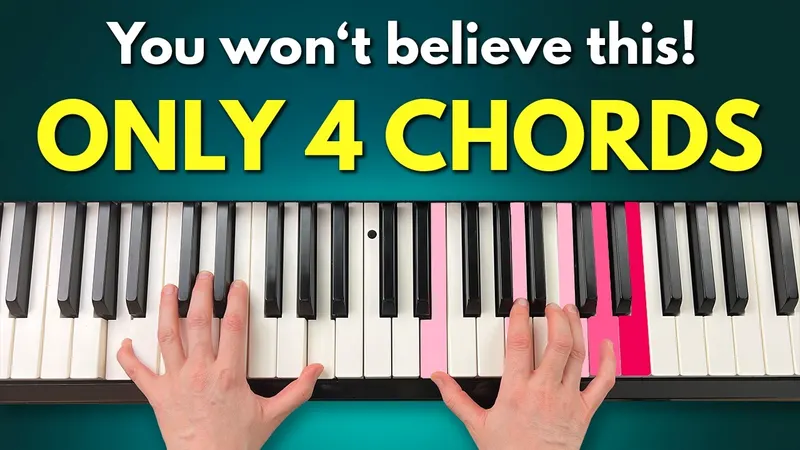
The four chords
Play an A minor triad, then F major, then E minor, then F major again. Everything is on white keys, so it's easy, but as ordinary triads, low in the left hand, they sound a bit plain and muddy.
AmFEmF
-
Trick 1: open voicings
Take the middle note of each chord, the third, and move it up one octave: A–E–C, F–C–A, E–B–G and F–C–A. That leaves more space between the notes and gives a wonderful open sound. Play the notes one after another, not together.
-
A new rhythm
Don't always change the chord on beat 1 and 3. Start the first chord on 1, and play the second chord a little earlier, on "2 and". Then the next chord on 1 again, and the last one on "2 and". Count 1 and 2 and 3 and 4 and.
-
Trick 2: power chords and thirds
Your left hand plays power chords, root, fifth and root again: A–E–A, F–C–F, E–B–E, F–C–F. Your right hand only plays the third of each chord: C, A, G and A. Play the thirds close to the left hand, not high up, for a warm sound, and use the new rhythm again. This works on any other chord progression too.
-
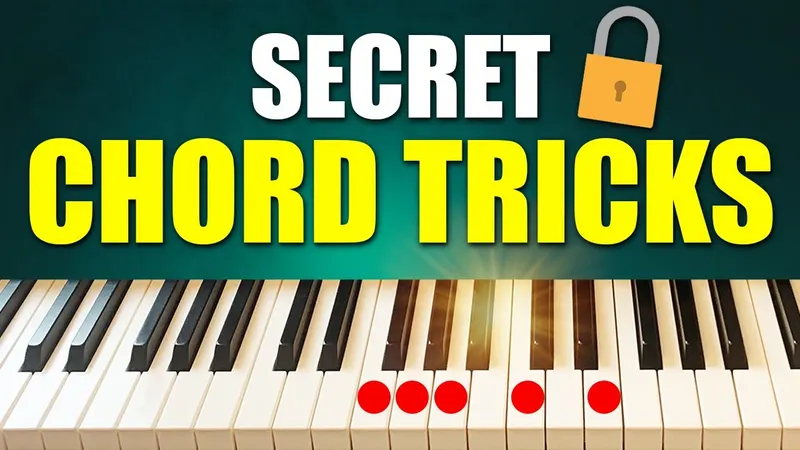
Trick 3: easy seventh chords
Turn the chords into A minor 7 (A–C–E–G), F major 7 (F–A–C–E), E minor 7 (E–G–B–D) and F major 7. The easy way: your left hand plays the root, so your right hand only needs the other three notes. That's C major over A, A minor over F, G major over E, and A minor over F. Add a 1–5–8 in the left hand and the new rhythm. Then leave out the middle note in the right hand for a cleaner, more modern sound.
C/AAm/FG/EAm/F
-
A melody from your chords
Play the two outer notes together, then walk down two notes from the top: G, F, E on the first chord, and the same from the top note of each chord. Then add the left hand. My extra trick is one tiny note before the progression starts again, which creates a beautiful anticipation: listen to it in the video.
 Want to play freely with chords?Modern Piano 1In my course Modern Piano 1 you learn a modern, step-by-step approach to chords and improvisation, so you can create beautiful piano music on your own instead of copying what's written on the page.Learn more about the course →
Full transcript
Prefer to read along? Here's everything I say in the lesson. Click a time to jump to that moment in the video.
Video transcript · about 2,500 words
Stop playing boring piano chords like this
Do your piano chords ever feel a little bit boring? Maybe you already know a handful of chords, but whenever you sit down at the piano, you end up playing the same thing over and over again. And at some point you start wondering: do I really need all these chords, or should I just stick to sheet music? Well, before you give up on playing freely, let me show you three incredibly simple chord tricks that can completely transform the way your chords sound.
And if you are new here, I am Melanie. I studied music education. And on this channel, I help you learn modern piano skills like chords, patterns and improvisation, and all the things that are often missing in traditional piano lessons. So, if that sounds interesting, don't forget to subscribe and give this video a thumbs up. This really helps the channel. And by the way, you can download a free PDF with all the chords and exercises we are going through today, and you will find the download link in the description below.
The simple 4-chord progression
Today's chord progression is incredibly simple. We start with an A minor triad, then we go to F major, then we go to E minor, and then back to F major. Everything uses only white keys, so that's pretty easy. But if we just play these chords as ordinary triads, they honestly sound a bit plain, don't they? So I would say, let's fix that.
Chord trick 1: beautiful open voicings
Our first trick is called an open voicing. Here is the problem: if we play regular triads with the left hand this low, everything sounds muddy. And this is why, instead of playing the triads like this, we are going to spread the notes out a little bit. So that means we start with A minor, and now we leave out the third of the chord and move it up one octave. Okay, that leaves much more space between the different notes, and that leads us to a wonderful open sound.
Okay, this is really beautiful, and we will not play them all together, because this would be a little bit complicated. You see, my hands are also too small for this. And this is why we play one note after another, like this. This we will do with all the other chords too. Now F major: we are doing the same thing. We take out the note in the middle and put it one octave higher, and then we get F, C, A. Wonderful, right?
Now comes almost the most beautiful chord, E minor. Like this, it sounds really muddy. But now we will take the middle note, put it one octave higher, and like this. Beautiful, right? And now back to F major. So again, middle note one octave higher, and then look how beautiful this sounds.
By the way, if you would like these voicings written out for you, don't forget that you can download the free PDF below the video. It includes everything we are covering today, so you can practise at your own pace at home. And now let's do the four chords together. We will start on A minor. 3 and 4 and, 1 and 2 and, and then we go to F major. 3 and 4 and. 1 and 2 and 3 and 4 and. Again: 1 and 2 and 3 and 4 and. 1 and 2 and 3 and 4 and.
Now, let's make it even more interesting, because rhythm changes everything. And instead of changing the chords on beat 1 and 3 every single time, I will show you something different. Now look, now we play 1 and 2 and 3 and 4 and, 1 and 2 and 3 and 4 and. Okay, that means instead of playing the second chord on beat 3, we will play it a little bit earlier. So the new note here comes already on "2 and".
Okay. So the first chord starts on beat 1, then the second on "2 and", and then the next one on beat 1 again, and then the last one also on "2 and". Okay. And this gives it such a cool rhythm. Look. Beautiful, right? So when you have a new voicing like this, you can also try to apply different rhythms and get creative with this.
Chord trick 2: power chords and thirds
Now comes the second chord trick I want to show you. Now let's try something different. In the left hand we are only going to play power chords. That means root, fifth and root again. Okay. So we play A, E and A for A minor. Then for F major, F, C, F. For E minor, E, B, E. And then again F, C, F for F major. And then in the right hand, instead of playing the whole chord, we are only playing the third now. Just one note.
And it's really amazing how full this will already sound together with the left hand. So let's listen to this. This is the first chord. Okay. Left hand 1–5–8 pattern, and right hand: when this is the A minor triad, we just play the third in the middle, and together we get a beautiful, warm-sounding chord, right? Same thing with F major. Okay. Just imagine you would play the full F major in the right hand, but now only the third, with both hands. This sounds really beautiful.
Next chord, E minor. Okay. It would look like this. And now only the middle note, only the third. And again F major, also with just the third. And I really try to play the thirds of the chords very close to the left hand. Yeah, so that I don't play them high up here. This also sounds very beautiful. But I think when we play them a little bit lower... ah, this gives this beautiful warm touch.
Okay, so try this out. And again, now we will use the other rhythm from before. So look, this is the same rhythm we had before. So the first chord we start on beat 1, and the second we already start on "2 and". Okay. So we are starting: 1 and 2 and 3 and 4 and. 1 and 2 and 3 and 4 and. 1 and 2 and 3 and 4 and. 1 and 2 and 3 and 4 and. Okay, and like this I think it sounds a little bit more interesting.
This is a principle you can also apply to every other chord progression. For example, let's try out this one here. Doesn't this sound epic? And I used the same principle. I always played the 1–5–8 in the bass, and then together with the third. Yeah. This is the third of G major, and the third of C major. And then you can also try out different rhythms. Yeah. For example.
Chord trick 3: easy major 7 and minor 7 chords
Now comes trick number three. Now let's upgrade our chords a little bit. Instead of simple triads, we are going to play seventh chords. So instead of playing A minor, F major, E minor, F major, we will now turn the chords into A minor 7, F major 7, E minor 7 and F major 7 again. Okay. So for A minor 7, we are starting with the notes A, C, E, and then the G just comes on top. Okay. So these are the four notes for A minor 7.
Then for F major 7, we play F, A, C. That's the normal F major triad. And then comes the major 7th on top. Then E minor: E, G, B. These are the three notes of E minor. And then this is the seventh. And then back to F major 7 again. Okay? So you are always following the same pattern, because we have no black keys in here.
Okay, but we will make the whole thing a little bit easier now. So, there's a really easy shortcut for A minor 7. The notes are A, C, E and G. And since your left hand is already playing the A, yeah, your right hand only needs C, E and G. And that's simply a C major triad, right? So in the right hand we can just play C, E, G, and in the left hand we are playing the root. Okay? Like this we only have three notes for the right hand. And this is easier than playing four notes together with the right hand. Okay?
Same thing with F major 7: F, A, C, E. When we leave out the bass note, yeah, then A, C and E are left. And that's just a normal A minor triad. And that's very easy together with the left hand. That sounds really interesting, right? Now for E minor 7, instead of playing four notes, we take the easy version. We just play a normal G major triad in the right hand, and in the left hand the root note, or together with the octave, or the 1–5–8. Okay. And then back to F major 7. And there you can already see it: A, C, E in the right hand, and then the rest in the left hand.
Okay. So a much easier way to write these chord symbols, instead of using the seventh chords, is just using slash chords, because then you can see it directly. Look: for A minor 7, we have C over A. For F major 7, we just play an A minor triad over F. For E minor 7, just G over E. And then again F major 7, A minor over F. Wonderful.
And now, instead of only playing the root note, you can just play a 1–5–8 shape. Okay? So A, F, E, F. Okay. So let's do that with both hands. So we are starting: C over A, then A minor over F, then G over E, and A minor over F again. Okay. And now we will apply the cool rhythm again. So we are starting: 1 and 2 and 3 and 4 and. 1 and 2 and 3 and 4 and. 1 and 2 and 3 and 4 and. 1 and 2 and 3 and 4 and. Yeah, and so on.
Now let's simplify this even more. Instead of playing all three notes in the right hand, we will again leave out every middle note. Okay? That means now it looks like this. 1 and 2 and 3 and 4 and. 1 and 2 and 3 and 4 and. 1 and 2 and 3 and 4 and. 1 and 2 and 3 and 4 and. So you only play the two notes on the outside. Okay? And like this we get a much cleaner and more modern sound, which sounds a little bit more open.
Create a beautiful melody from your chords
Now comes my favourite part. We are going to turn those chords into a little melody. And this is something I really enjoy doing when I'm playing with chords: that I just sit at the piano and try to build beautiful melodies out of the chords. What we are doing now is start by playing the two outside notes together, and then simply walk down two notes from the top. That means you are starting on the G, then you go to the F, then you go to the E.
And then you are doing the same thing with the next chord, A minor. And here also, yeah, from the top note just go two notes down. The next one is G major, right? And then from the top note, two notes down. And then comes A minor again. Yeah. But only the two outer notes. This is the highest note, and then two notes down. Okay, so this sounds like this. 1 and 2 and 3 and 4 and. 1 and 2 and 3 and 4 and.
Together with the left hand. 3 and 4 and. 1 and 2 and 3 and 4 and. 1 and 2 and 3 and 4 and. 1 and 2 and 3 and 4 and. 1 and 2 and 3 and 4 and. Beautiful, right?
And now I'll show you one little extra trick. We are playing the same thing as before, but this time here is one tiny note that makes the difference. I will play this for you. Okay. So, this is only one tiny little note, but it creates a beautiful sense of anticipation before the progression starts again. And it's a small change, but I think it has a huge effect. Yeah. Let's try that out. So, you are coming here. 1 and 2 and 3 and 4 and. 1 and 2 and 3 and 4, G.
Yeah. So, practise this and try it out. It's really beautiful, and I really love to sit at the piano and just jam a little bit over chord progressions like this, because then every time beautiful things like this come out. And if you enjoy this way of playing piano, and you would like to become really confident with chords, improvisation and just playing freely without constantly relying on sheet music, then make sure to check out my course, Modern Piano 1.
Inside the course, you will learn a modern step-by-step approach that helps you create beautiful piano music on your own, not just copy what's written on the page, right? And you will find the link in the description below. And that's it. Three simple chord tricks using only four basic chords, and yet the difference is huge.
Okay. At the beginning, we simply played four ordinary triads. Do you remember? We just played A minor, F, E minor, F. And that sounds so basic, and that's not so beautiful. And then with the three tricks, we used the open voicings, right? Then we used the trick with the thirds. Then we added new chord colours. And then we even started to improvise a little bit with this.
Right? When you are playing chords like this, then you can think of it like eating plain lettuce. Yeah. Perfectly fine, but not exactly exciting. And the rhythm and the open voicings and all the things we added are like the seasoning. Yeah. They add colour, depth and personality. So the next time you learn a chord progression, don't stop after learning just the chords. Yeah. Experiment, and move notes around, and try different rhythms, and leave notes out. And that's where the real fun begins.
How to make basic chords sound beautiful
So, thank you so much for watching, and if you enjoyed this lesson, please give the video a thumbs up and subscribe for more modern piano tutorials. And before you go, click on the next video right here, because I will show you another simple technique that will make your piano playing sound even more beautiful. And I will see you there.
Questions about this lesson
What is an open voicing?
A chord with its notes spread out. Here you move the middle note, the third, up one octave: A minor becomes A–E–C. The extra space makes low chords sound clear and open instead of muddy.
What is a power chord?
The root, the fifth and the root an octave higher: 1–5–8. It has no third, so it's neither major nor minor until your right hand adds the third.
What does C over A mean?
A C major triad in the right hand over an A in the bass. Together that's A, C, E and G: an A minor 7 chord. Slash chords like this are an easy way to play seventh chords.
Do these tricks work with other chords?
Yes. Try them on any chord progression: move notes around, try different rhythms, and leave notes out. That's where the real fun begins.