Lesson summary
The progression is C major, A minor, F major and G major: the one, six, four and five chord. Five tips give it new colours. Add the 9th or replace the third with the 2nd, let G sus4 resolve to G major, play a C major triad over an A in the bass for A minor 7, use an inversion and a dreamy F major 9, and add little sixteenth-note runs. Use them with variety, not in every bar.
- How to turn triads into add9 and sus2 chords
- How a sus4 chord resolves beautifully to the triad
- An easy way to play A minor 7
- A dreamy F major 9 voicing
- Little runs between the chords
- How to mix the colours instead of overusing them
Before you start
The chords C major, A minor, F major and G major, and what an inversion is: the same notes in a different order. Sixteenth notes come up in tip 5.
An acoustic piano or a digital piano.
About 15 minutes a day. Take one tip at a time, and listen closely to how each colour changes the sound.
Step-by-step guide
Here's what the video covers, in six steps. Click a time to jump straight to that part.
-
The chord progression
The chords are C major, A minor, F major and G major: the one, six, four and five chord in C major. Your right hand plays the chords in quarter notes, your left hand the roots in octaves. It's an important foundation, but it doesn't sound very inspiring yet.
CAmFG
-
Tip 1: add9 and sus2
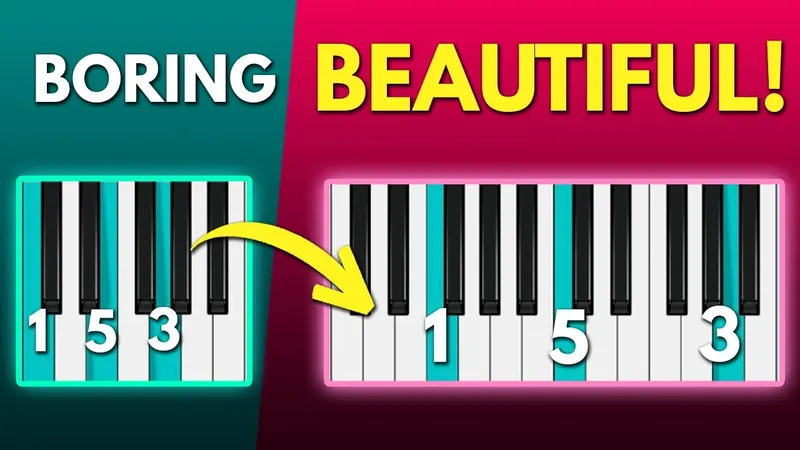
Play the triad and add the note under your index finger, one whole step above the root: C, D, E, G is C add9. Do the same on every chord. For a sus2 chord, leave out the third: 1, 2 and 5, so C, D, G. Add9 sounds sweeter, sus2 a little more hollow. Don't use them in every bar: mix plain triads, add9 and sus2 chords for variety.
-
Tip 2: G sus4 to G
On the five chord, G major, play G sus4 first: G, C, D, with your ring finger instead of your middle finger. Then resolve it to G major. The fourth resolving to the third is an effect you've probably heard in many songs.
-
Tip 3: A minor 7
A minor 7 has the notes A, C, E and G. Your left hand already plays the A, so your right hand only needs C, E and G: a plain C major triad. Coming from C major, your right hand stays where it is and your left hand moves two white keys down.
-
Tip 4: an inversion and F major 9
Play C major in second inversion (G–C–E) and C sus2 in the same position, with D instead of E. On F, leave out the root (your left hand plays it), play G, A and C, and add the major 7th, E: that's F major 9, and it sounds like time stands still. Then G sus4 and G major.
CCsus2Am7Fmaj9Gsus4G
-
Tip 5: little runs
At the end of bars 1 and 3, play the chord notes as a little sixteenth-note run on beat 4: in bar 1, G, C, D, E on "4 e and a"; in bar 3, the notes of the F major 9 chord, leading into G sus4. Emphasise the D on top of G sus4, like a little melody line.
 Want to understand the number system?Modern Piano 1In my course you learn from the very beginning how chords and the number system work, so you can play freely and improvise beautiful melodies without sheet music.Learn more about the course →
Full transcript
Prefer to read along? Here's everything I say in the lesson. Click a time to jump to that moment in the video.
Video transcript · about 2,300 words
Why basic triads sound boring
Do you sometimes feel bored by regular standard chords, like simple major or minor triads? And have you ever wondered how you can use simple techniques to play more interesting chords on the piano? Then this video is exactly right for you. So make sure to stick around.
And by the way, everything on this channel is all about playing piano using chords. So if that interests you, don't forget to subscribe to the channel and give this video a thumbs up right now. And by the way, you can download a free PDF that goes along with this lesson. You will find the link below in the video description.
The chord progression
Let's work with a typical chord progression as an example. We will use the chords C major, A minor, F major and G major. So we have C major as our one chord. Then A minor is our six chord. Then we go to F major, which is our four chord, and G major, which is our five chord.
So let's practise this chord progression together now, so that we can feel safe when we play it. Okay. In the right hand, just play the chords in quarter notes. And in the left hand, just play the root notes in octaves, like this. 3 4, 1 2 3 4, 1 2 3 4, 1 2 3 4, 1 2 3 4. And again: C major, A minor, then F major, and four times G major. And back to C.
Okay. All right. So, this is the first step. And you can already hear it. It sounds a little bit unexciting. And of course, it's an important foundation for everything else, but it doesn't sound especially inspiring yet. And that's why I will now show you five tips that you can immediately apply to make this chord progression sound much more creative.
Tip 1: add9 and sus2 chords
So tip number one: we will now use add9 and sus2 chords instead of the normal triads. We will start by turning the triads into add9 chords. So you simply play the triad, but then you are doing a trick. You also play the note which lies under your index finger, like this. Okay? So these three and the fifth, and then you have a C add9 chord. And the ninth is always one whole step above the root note. Okay?
So this is the shape for C add9. For A minor the same: just play your index finger with this triad. So you have this shape. For F major too: just fill the gap here with your index finger. Then you have an add9 chord. And then for G major, the same thing. You just fill the gap with your index finger. And then you get a beautiful G add9 chord. And these chords add a new colour to our playing. And they sound much warmer than if we would just play the plain triads.
Okay? So let's do this with both hands together now. 3 4, 1 2 3 4, 2 3 4, 1 2 3 4, 1 2 3 4. So really beautiful. A minor add9, F add9 and G add9. Okay, wonderful. But sometimes, if we only use the add9 chord during the whole chord progression, that can sound a little bit too full. This is why we'll try out the same thing with sus2 chords.
So for the sus2 chords, imagine you would play an add9 chord, but without the third. Okay. So we only play 1, 2 and 5. Okay. So this is the sus2. We will replace the 3 with the 2. And then we get this shape here. And for the other chords we are doing it like this too. So A minor: replace the third with the 2. Then F major, same thing. And for G sus2, the same thing. Just play this shape here, and then everything's fine.
Let's try this out with both hands together. 3 4, 1 2 3 4, 1 2 3 4, 1 2 3 4, 1 2 3 4. Wonderful. And did you realise how we get another colour into our playing again? Because these sus2 chords sound a little bit different than the add9 chords. Okay, the add9 chords sound a little bit sweeter than the sus2 chord, because in the sus2 the third is missing, and so it sounds a little bit more hollow.
So now, when played musically, these colours shouldn't be overused, okay? So don't apply them strictly in every bar. Do this only for practising. And then try to use more variety when you are playing. For example, we could start two times with the normal C major triad. Then we change to C sus2. Okay? Like this.
Then in the next bar, let's say, okay, why not just play the normal triad four times? In the next bar, let's play only the add9 variation. And in the last bar, we will do a mix. We start with two times add9, then one time G sus2, and back to G, the normal triad. Okay. So the last bar: 1 2 3 4. And like this we get more variation in our playing.
Let's do this once again. 1 2 3 4. A minor. F major add9, and then a beautiful mix, and then we start again. Isn't this beautiful?
Tip 2: G sus4
Now tip number two. This tip works especially well on the fifth scale degree, which in our case is G major. That means we are looking at the last bar. And by the way, if you've always wondered how this number system works, I highly recommend my online course, Modern Piano 1. You will learn from the very beginning how the system is structured. And in my opinion, it's the ultimate game changer for playing the piano freely without sheet music. And you will find more information about the course down below in the video description.
But now back to G major. Now we add a beautiful new colour by turning this G major triad into a G sus4. So instead of G, B, D, you play G, C, D. Okay. So instead of the middle finger, you take the ring finger. Okay. So in our example, we are playing this down here. So it will sound like this.
Let's try this out together. 3 4, 1 2, C sus2. Go to A minor. Now go to F add9. And then two times G sus4 and two times the normal G major triad. And listen how beautiful this sounds when I move from G sus4 to G major, because the fourth resolves beautifully to the third. Yeah. So, I am sure that you've probably heard this effect subconsciously in many songs before, and today we played it on our own at the piano.
Tip 3: A minor 7
Okay. So, but now let's go to tip number three. Here we will turn a minor triad into a minor 7th chord. And maybe you think, "Oh, this sounds complicated now." But it's actually very simple. So an A minor 7 chord consists of the notes A, C, E and G. And now look at this. We already play the root note A in the bass. So if we would remove it from the right hand, which three notes remain? C, E and G. That means a normal C major triad.
So when we now play our root note A in the deep octaves down here, together with a completely normal C major triad on top in the right hand, then we get an A minor 7th chord, which is really beautiful. And look how easy it is to play now, because we are coming from C major, right? Two times the normal triad, then C sus2. And now we go back to just C major in the right hand, but only with the left hand we go two white keys down, and then we get the beautiful A minor 7th chord.
Okay, without doing anything complicated. So once again, we are coming from C major, and then A minor 7, F add9. Now two times G sus4, and back to G major. And this already begins to sound as if you were a real pro, because you've added so many different colours to your playing, you know. So once again.
Tip 4: an inversion and F major 9
Now let's have a look at tip number four. We are making another little adjustment. Now we will play the C major triad in the second inversion. So simply move the top note from the root position one octave lower, and like this you get the second inversion of C major directly. And now if you want to play a C sus2, then just replace the third, which is the E with the ring finger, with the D. Okay.
So this is a C sus2, and you begin with the normal C major triad in second inversion and then just move to C sus2 in this inversion here. And then when we now want to go to A minor 7, then just take C major for the right hand in the second inversion as well. Do you hear how this starts to sound really beautiful? Because it sounds a little bit warmer like this.
And now for the next bar, I also have something really beautiful for you here. We don't play just an F add9. We will leave out the root note, because we already play it here with our left hand. And so we are only playing these three notes. But then we add the major 7 on top. The major 7 of F major is the E. Okay. So it's one half step below our root note. So we have the notes G, A, C and E.
And look how beautiful this sounds when we play it together. It's really like heaven on earth, right? Such a nice and gentle chord. And then in the last bar, we take our G sus4 and go to the normal G major triad. Okay, I would say let's repeat this once again. We start with C major second inversion. C sus2. Then A minor 7. Then now our special chord. And then G sus4 and G.
Wonderful. And I think this F major 9 chord sounds as if time would stand still. It's such a beautiful chord, and you really have to practise it, because just listen. Now just add the index finger, and then you have it. Okay. And then G sus4 and G major. Wonderful.
And by the way, if you haven't downloaded the sheet music for this tutorial yet, make sure to get it now. You will find the link in the video description below.
Tip 5: little runs
And now here comes the last tip, tip number five. Here we will add little runs and fills between the chords. In this case, at the end of bars one and three, we simply play the chord tones in sixteenth notes, like a little run we add between the chords in our playing. Look, in the first bar we are playing it like this. We are playing two times C major. Then we go back to C sus2, and then we just play up all the notes we had in this measure.
Look, we are playing it like this. We begin with two times C major. Then we go to C sus2. And on the fourth beat, we just play up all the notes, like G, C, D, E. Okay. So 1 and 2 and 3 and 4 e and a. Okay. 1 e and a, 2 e and a, 3 e and a, 4 e and a, 1.
And then in the third bar, here we have this beautiful F major 9 chord. And here we just take the notes we are already playing, just as a little sixteenth run on beat four. 4 e and a, then we are switching to G sus4. Yeah. So we are playing 4 e and a, and then G sus4. And make sure to emphasise the D on top of G sus4, because then it's like a nice melody line.
Okay. So 1 2 3 4 e and a, 1 and 2 and 3 and 4 and. Okay. So let's try this out together with both hands. 3 and 4 and. 1 and 2 and 3 and 4 e and a. 1 and 2 and 3 and 4 and. 1 and 2 and 3 and 4 e and a. 1 and 2 and 3 and 4 and. And when you practise this a little bit, you can also do it a little bit faster.
Okay. And always remember, these are just suggestions. So you can always do more or less. It always depends on the musical context and what fits best in each situation. And that's the beautiful thing: these extended chords give us a perfect foundation for improvising beautiful melodies.
And by the way, if you want to learn how to freely improvise on the piano using chords to create beautiful melodies, then check out my online course, Modern Piano 1. Especially if you have always dreamed of breaking free from the notes and just sitting down at the piano and playing something beautiful, then I'm sure you will like it, that you are able to just sit at the piano and just play something beautiful like this.
Yeah. So then check out my online course, Modern Piano 1, and you will find more information about the course down below in the video description. And if you want to learn more about how you can add those kinds of beautiful runs and fills between your chords when you are improvising freely, then make sure to watch this video next, because there I show you really beautiful runs and fills for the piano. And I would say click on this video next, and then we will see each other in the next one.
Questions about this lesson
What's the difference between add9 and sus2?
Both have the note one whole step above the root. Add9 keeps the third (C, D, E, G) and sounds sweeter; sus2 leaves the third out (C, D, G) and sounds a little more hollow.
Should I use these chords all the time?
No, they shouldn't be overused. Practise them in every bar, but when you play musically, mix plain triads with add9, sus2 and sus4 chords.
How do I play A minor 7 easily?
Play an A in your left hand and a C major triad (C, E, G) in your right. Together that's A, C, E, G: A minor 7.
What is the F major 9 chord here?
Your left hand plays F, and your right hand plays G, A, C and E: the 9th, third, fifth and major 7th. It's a very gentle, dreamy chord.