Lesson summary
The progression is C major, G major, A minor and F major: the one, five, six and four chord in C major. Add your index finger, the note one whole step above the root, and every chord becomes an add9 chord, warmer and more modern. Then you play a little sixteenth-note fill on beat 4 with the same four notes: down, up, or two notes together and then down. Mix the fills, and try it all in E major.
- A typical pop progression in C major
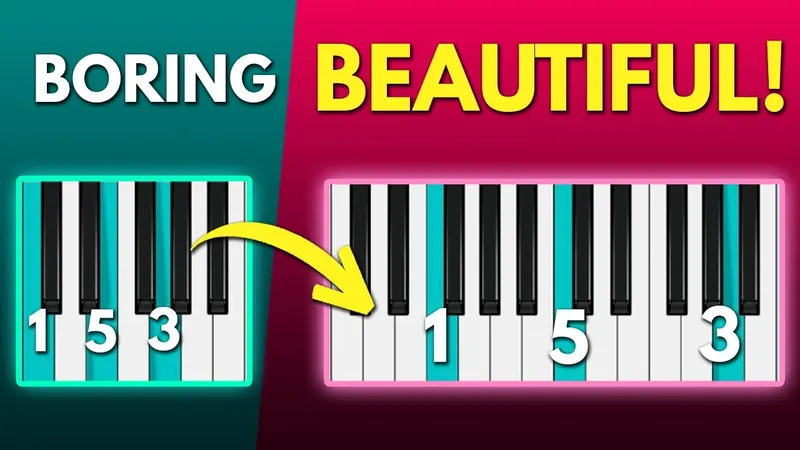
- How to turn any triad into an add9 chord
- Three easy fills on beat 4
- How to count sixteenth notes
- How to combine the fills for variety
- The same idea in E major
Before you start
The chords C major, G major, A minor and F major, and how to count 1 2 3 4. Sixteenth notes are explained in the lesson.
An acoustic piano or a digital piano.
About 10 to 15 minutes a day. Practise each fill on its own with the right hand first, then with both hands.
Step-by-step guide
Here's what the video covers, in seven steps. Click a time to jump straight to that part.
-
A pop progression
Play C major, G major, A minor and F major in root position: the one, five, six and four chord in C major. Your right hand plays the chords in quarter notes, your left hand the roots. In C major there are no sharps or flats, so your hand keeps the same shape and only shifts.
CGAmF
-
Turn the chords into add9 chords
Now the magic trick: add your index finger, the note one whole step above the root. C major gets a D, G major an A, A minor a B and F major a G. These add9 chords sound much more emotional and modern, and they're used in so many pop songs.
-
Fill 1: four notes down
On beat 4 of every bar, play the four notes of the add9 chord one after another, from the top down, as sixteenth notes: 4 e and a. Then go on to the next chord. Practise it with the right hand alone first: you already know the notes, they're just played one after another.
-
Fill 2: four notes up
The same, in the other direction: on beat 4, play the four chord notes from the bottom to the top, 4 e and a, then go on to the next chord.
-
Fill 3: two together, then down
Play your index finger and little finger together (fingers 2 and 5), then fingers 3, 2 and 1, on 4 e and a. Practise it on every chord, then with both hands.
-
Combine the fills
Fill 1 goes 5–3–2–1, fill 2 goes 1–2–3–5, and fill 3 is 2 and 5 together, then 3–2–1. Now mix them: for example fill 1, fill 2, fill 3 and fill 2 again, or fill 1, fill 2, fill 1 and fill 3. It already sounds much more like a real song.
-
The same in E major
For the next level, play it in E major: E major, B major, C♯ minor and A major, each as an add9 chord. Then add the fills, for example fill 3 in every bar. It's a little more tricky, but a great next step.
EBC♯mA
 Want to play pop chords in any key?Modern Piano 1In my course I show you step by step how to find and play chords freely, how to improvise, and how to sound beautiful without needing any sheet music.Learn more about the course →
Full transcript
Prefer to read along? Here's everything I say in the lesson. Click a time to jump to that moment in the video.
Video transcript · about 1,600 words
Intro
Hello and welcome to this tutorial. Today I will show you how to make your chords sound more like pop piano, and how to add beautiful fill-ins between your chords that instantly make your playing sound fuller, more expressive and more musical. Because let's be honest, most piano teachers never show you how to do this. But with just a few small tricks, your chords can suddenly sound warm, modern and rich.
If you enjoy this video, don't forget to hit subscribe and give it a thumbs up. And if you want the sheet music for today's lesson, you can download it for free. Just click the link below in the video description.
The chords
Okay, let's start with some easy chords. We will start with a typical pop chord progression. We are playing C major, then we go to G major, then we go to A minor, and then we go to F major. And this means that we are taking just the one chord. We are in the key of C major here. Then we go to the five chord. Then we take the six chord, and then the four chord. Okay?
And we will play each chord in root position. And now we will play every chord in quarter notes in the right hand. And with the left hand we will play just the root notes. Okay? Like this. 3 4, 1 2 3 4, 1 2 3 4, 1 2 3 4, 1 2 3 4. And then back to the beginning. G major, A minor, and then we go to F major, and then starting again with C major.
Okay? And it's really easy in C major, because you don't need any sharps or flats. That means you really only have to shift your hands to the side to get the next chords, right? Because the shape of the hand always stays the same.
Now comes our magic trick. We turn each triad into an add9 chord by simply adding your index finger. Look, this is so easy, because for C major we just add the D. Okay? For G major, we just add the A. So just play your index finger. For A minor, we add the B. Okay? And for F major, there we just add the G. So we are just adding the note that is one whole step above the root note. Okay?
And this small change makes your chords sound much more emotional and modern. And that's the trick that's used in so many pop songs. So when you are playing, just think of playing a normal triad, but also play the index finger. Okay? And then you have this beautiful add9 chord.
So I would say let's play through the full progression using the add9 chords. 3 4, 1 2 3 4, 1 2 3 4, 1 2 3 4, 1 2 3 4. And again: we start on C add9. Then G add9. Now shift your hand one white key up, and then two white keys down. Okay. And then you just begin again with C add9. And that sounds more beautiful already, right?
Fill 1
And now let's add some variation with fill-ins, one of the easiest ways to make your playing sound more professional. And what we will do now is add a small fill on beat four of every bar. So we start with fill number one. Here you just play the four chord tones down, like this. And we begin with the fill on beat four. That means we are playing 1 2 3 4 e and a. And then we go to the next chord. Okay?
And then we are doing the same. 1, 2, 3, and then we take these four notes: 4 e and a. And the next one: 1 2 3, now these four notes, 4 e and a. And the last one: 1 2 3 4 e and a. And then you jump to the C add9 again.
Let's do it together, just the right hand alone. 3 4, 1 2 3 4 e and a. 1 2 3 4 e and a. 1 2 3 4 e and a. 1 2 3 4 e and a, 1. Okay, so you really have to practise this separately. It's really easy, because we just take the notes that we already have in the add9 chord and play them one after another.
And let's try this now with both hands. 3 4, 1 2 3 4 e and a. 1 2 3 4 e and a. 1 2 3 4 e and a. 1 2 3 4 e and a, 1. Okay. All right.
Fill 2
Now let's have a look at fill number two. Here we will do the same, but this time we don't play the four notes down. We will play them up now. So, the other direction. Okay. So this one sounds like this. 1 2 3 4 e and a. 1 2 3 4 e and a. 1 2 3 4 e and a. 1 2 3 4 e and a, 1. Okay. So you are starting from bottom to top. And then we have a beautiful fill.
Fill 3
Now let's have a look at fill number three. Here we just prepare the chord, and then we play the pinky and index finger together. So fingers 2 and 5. And then we just play 3 2 1. Okay. So first fingers 2 and 5 together, then 3 2 1, like this. 4 e and a. 4 e and a. Okay, practise this a few times in a row, and then we will see how we can apply this fill.
We are starting on C major. 1 2 3. Now the fill: 4 e and a. And then we go to G add9. And then we are taking the index finger and pinky again here and just play the fill with these notes. Okay. And then A minor add9. Now 2 and 5, and then 3 2 1. And then the last one. Okay. And then from the beginning.
Let's practise the right hand alone once. 1 2 3 4 e and a. 1 2 3 4 e and a. 1 2 3 4 e and a. 1 2 3 4 e and a, 1. And now let's play with both hands together. 3 4, 1 2 3 4 e and a. 1 2 3 4 e and a. 1 2 3 4 e and a. 1 2 3 and 4 e and a, 1. So practise these three fills separately.
Combining the fills
And now let's have a look here again. You can see all three fills again. So we had the 5–3–2–1 fill. Then we had the 1–2–3–5 fill. And then the 2 and 5 together and 3–2–1 fill. Okay, this is the last one. And now let's combine the fills. For example, let's begin with fill one. Then let's say we are taking fill two, then fill three, and at the end fill two again. Okay, let's hear how this sounds.
Okay. And this already sounds so much more like a real song, because it gives us so much variety. Let's try out another combination maybe. So let's say we start with fill one, then we take fill two, then fill one again, and at the end fill three.
By the way, you can download all the sheet music and patterns from this lesson for free. Below this video you will find a link for that.
Fills in E major
And if this was too easy for you, then we are going to the next level. Then try to play the exact same thing in the key of E major. That means here we have the chords E major, then B major, then C♯ minor and A major. And the first step is that we build the add9 chords now. Okay. So we have E add9. Then we have B add9. Then C♯ minor add9. And then A add9. Okay.
And then we have the shapes, and then we are ready to add the fill-ins. Okay. So maybe let's try out the third fill-in in every bar. That means we are preparing the shape, and then again index finger and pinky together, and then 3 2 1. Okay. And like this you can do it with every other chord too. Then prepare the C♯ minor. Okay. And the last one is these notes. And then 2 and 5, and then the rest down. So together this would sound like this. And so on and so on.
Maybe this is a little bit more tricky, but a great next step. And if that still feels hard, or if you want to learn how to find and play pop chords in any key, then definitely check out my online course, Modern Piano 1. It's a step-by-step course where I show you how to play freely with chords, how to improvise, and how to sound beautiful without needing any sheet music.
And it has helped thousands of adult piano learners fall in love with the piano again, and maybe it's for you too. So if you want to have a look, you will find the link down in the description below. And if you like this lesson, then I highly recommend this video next. There I show you one of the most beautiful little runs you can play on the piano. So I would say see you there.
Questions about this lesson
What is an add9 chord?
A triad with the note one whole step above the root added. For C major that's C, D, E, G. In this lesson you simply add your index finger to each triad.
How do I count the fills?
Each fill is four sixteenth notes on beat 4: count 1, 2, 3, 4 e and a. The four notes are the notes of the add9 chord you're already playing.
Which fill should I use?
Any of them, and you can mix them. Using different fills in different bars gives your playing variety and makes it sound like a real song.
Does this work in other keys?
Yes. In E major the chords are E major, B major, C♯ minor and A major. Build the add9 chords and use the same fills.