Lesson summary
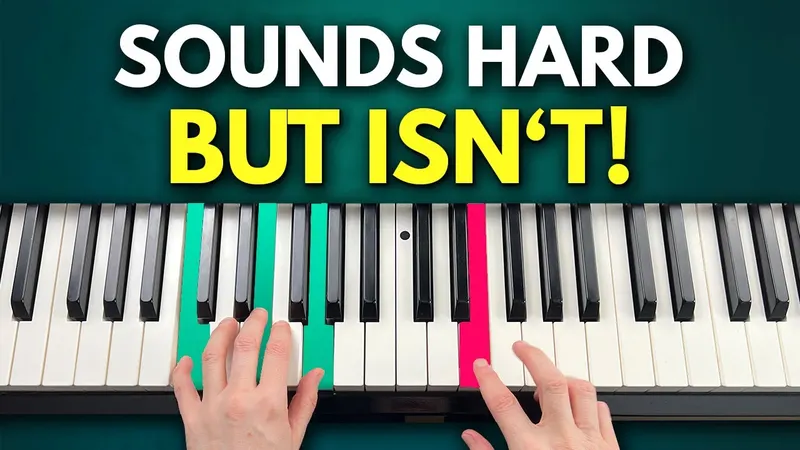
Everything is built on one left-hand pattern in F major: a flowing 1–5–8 arpeggio on F major, G minor and B♭ major, and A, F, A, F on F over A. Your right hand stays in one position, F major in first inversion, and plays top, middle, bottom, middle, while your left hand changes the harmony. Then your little finger starts to sing: first F and G, then F, G, A, G. A second hand position higher up gives a new mood and a descending melody, and together they become a complete little piece.
- A flowing 1–5–8 left-hand pattern in F major
- How to change the pedal with every chord
- One right-hand position that fits every chord
- How to let your little finger sing a melody
- A second hand position for a new mood
- How to build a whole piece from a few ideas
Before you start
The F major and B♭ major chords and how to count 1 and 2 and 3 and 4 and. An inversion is the same notes in a different order; I show you the one you need.
An acoustic piano or a digital piano with a sustain pedal, which is part of the pattern.
About 15 minutes a day. The more natural the left hand becomes, the more freedom you have in the right hand.
Step-by-step guide
Here's what the video covers, in seven steps. Click a time to jump straight to that part.
-
The left-hand pattern
We're in F major. Your left hand plays a 1–5–8 arpeggio: F, C, F, C, twice per bar. Then G minor: G, D, G, D. Then F over A: start on A and play A, F, A, F. Then B♭ major: B♭, F, B♭, F. Count 1 and 2 and 3 and 4 and, and change the sustain pedal on the 1 of each bar: up, down.
FGmF/AB♭
-
One right-hand position
Place your right hand on F major in first inversion: A, C, F. Play top, middle, bottom, middle, over and over. Your right hand repeats exactly the same movement while your left hand changes the harmony underneath. The goal isn't to memorise a melody, but to understand the pattern.
-
Let your little finger sing
Change just one note: instead of returning to F each time, alternate between F and G with your little finger. Then let it play a small melody: F, G, A, G. Your little finger is the singer, the other notes only add rhythm, so play the melody notes a little louder.
-
Make up your own melodies
Now try other combinations of those top notes, in another order, and simply listen to what you like. You'll quickly notice that almost everything sounds beautiful.
-
A second hand position
Move one level higher: C, F, C, an F5 chord with the fifth doubled an octave lower. Play the same pattern, top, middle, bottom, middle, over the same left hand. The whole mood changes: it's a sound you hear in modern neoclassical piano music and film scores.
-
A descending melody
Now your little finger moves slowly down: C, B♭, A, G, each note twice. Then move down step by step without repeating: C, B♭, A, G, and end with G, A, G. You can change the order too.
-
Build a complete piece
Start with the left hand alone, then pattern 1, a few variations and your own notes. Move to the second hand position and its descending melody, come back to the first pattern, and end on F major in first inversion with F, C, F in your left hand. That's a whole little piece, without sheet music.
 Would you love to play like this anytime?Modern Piano 1In my course I teach you step by step how to master chords, inversions and the patterns that form the foundation of modern piano playing, so you can create your own music.Learn more about the course →
Full transcript
Prefer to read along? Here's everything I say in the lesson. Click a time to jump to that moment in the video.
Video transcript · about 2,700 words
Just sit down and play freely
Have you ever been somewhere where there was a piano, and suddenly somebody asked you to play something, and then you had to say, "Oh, I'm so sorry, I don't have my sheet music with me"? And I know so many piano players who've been in exactly that situation. But what if you could simply sit down and play something beautiful anytime you wanted? That's exactly what I'm going to show you in this video today.
You are not going to memorise another piece. Instead, you will learn one simple pattern that you can turn into countless beautiful melodies, so you can start playing freely and confidently. If you are new here on this channel, my name is Melanie. I studied music education. And on this channel, I teach a modern approach to playing the piano. It's not just about reading sheet music. It's about learning chords and playing freely and improvising.
So, if that sounds interesting to you, make sure to subscribe and give this video a thumbs up. And as always, I've also prepared a free PDF for you with all the sheet music and exercises from today's lesson. You can download it using the link in the video description below, and then you can print it out and follow along at your own pace. All right, so then I would say let's get started.
The left-hand pattern in F major
Everything we are going to build today is based on one very simple left-hand pattern. We are in the key of F major today, and we are going to use a simple 1–5–8 arpeggio. We will start with an F major chord, but instead of playing it like this, we will play the notes F, C, F, C, and then repeat the same thing once more: F, C, F, C.
Okay, so the next chord is G minor. And instead of playing just a G minor triad, we also turn that into the beautiful 1–5–8 arpeggio. That means we play G, D, G, D, and then repeat again: G, D, G, D. Our third chord is F over A. Don't let the name scare you. It simply means we start on the A, and then we are playing F, and then A, F, and then we repeat: A, F, A, F. And finally we move to B♭ major. Here you will play B♭, F, B♭, F, and then once again.
Okay. So let's put the whole left-hand pattern together now. 3 and 4 and. 1 and 2 and 3 and 4 and. G minor. F over A. And B♭ major. Once again: F major, one note higher. Now F over A, and B♭ major. Okay. All right. So this is our beautiful left-hand pattern.
And make sure that you don't forget to use the sustain pedal. Okay. So we are starting here on F major. 1 and 2 and 3 and 4 and, and then on the next beat one, the foot goes up and then down again. Okay. Up, down. Up, down. Up, down. Up, down. Okay, and so on and so on. So it's very important that you also practise the sustain pedal. Beautiful.
Once this feels comfortable, you've already mastered the foundation of the entire piece. So learning beautiful left-hand patterns like this is one of the most important foundations of playing freely at the piano. The more natural this pattern becomes, the more freedom you will have in your right hand.
Hand position 1 and pattern 1
And now comes the secret that makes this tutorial so much fun. For the first pattern, your right hand stays in just one position the whole time. That's what makes it surprisingly easy, even though the result sounds much more advanced. Yeah. So place your hand on an F major chord in first inversion. And that gives you the notes A, C and F.
And instead of playing all the notes at once, we are going to turn it into a flowing pattern. We will play top, middle, bottom, middle, top, middle, bottom, middle. And this we will repeat over and over again. So practise this a few times. Top, middle, bottom, middle, top, middle, bottom, middle, and so on.
And now your right hand keeps repeating exactly the same movement while your left hand changes the harmonies underneath. I will play this for you once. Yeah. So you can really see how my right hand stays exactly on these three notes and only my left hand moves. And the goal is not to memorise this melody. The goal is to understand the pattern behind it.
Let's play it slowly together now. We will place our right hand in the F major shape in first inversion. And then the left hand also starts here, on the F. 3 and 4 and. 1 and 2 and 3 and 4 and. 1 and 2 and 3 and 4 and. 1 and 2 and 3 and 4 and. 1 and 2 and 3 and 4 and. This already sounds really beautiful, right?
So practise this a few times, and then we will go on. And as you can see, chords are really the language of modern piano playing. The better you know them, the more freely you can play. So learning chords and inversions is one of the most valuable skills you can learn if you want to play freely.
Melody variation 1
Now, let's make it even more interesting. We are only going to change one single note, and that's it. And here, instead of returning to the F with your pinky every time, we are going to alternate between F and G. So we are playing F, G, F, G, F, G, F, G. Doesn't this sound lovely? So we have F, G, F, G, F, G, F, G. And that's the secret. Let's play both hands together. 3 and 4 and.
Wonderful, right? And I think it's really amazing how much difference that tiny change makes. And just one note creates the feeling of a completely new melody.
Melody variation 2
Now let's take it one step further. Instead of moving between just two notes with the pinky, between the F and the G, now your pinky is going to play a small melody. Yeah, we will play this melody here. You can already see it in the sheet music. Look. F, G, A, G, F, G, A, G. These are the highest notes, which you always play with your pinky.
Okay. So, we are taking this shape here, and then we begin: F, G. Now, one note higher, to the A. Back to the G. And again: F, G, A, G, F. Okay. Take a moment now and practise just the right hand alone. And then we join with our left hand. 3 and 4 and.
This feels like your pinky would become a singer, while the other notes, yeah, the A and the C, are just there to make a little bit more rhythm. Okay. But the melody, the singer, is your pinky. The pinky sings the melody, and the other fingers just have a rhythmic function. So when you play this, really make sure that you can hear these three melody notes, that they really come out, that you just play them a little bit louder than the other notes.
Create your own melodies
And now feel free to try different combinations and simply listen to what you like. You will quickly notice that almost everything sounds beautiful. And that's one of the things I love most about this approach to piano playing, right? You sit down at the instrument, start exploring, and every time something new comes out. Let me show you this.
Look here. I just took the highest notes and put them in another order. This would sound like this. So I just brought these three notes into another order. Yeah. And you can also play something completely different. For example. And by the way, if you haven't downloaded the free PDF yet, now is the perfect time. It contains all of today's patterns and variations, so that you can easily practise everything later.
Hand position 2 and pattern 2
And now let's move to our second right-hand position. So the first position was F major in first inversion. And now for the next hand position, we are simply moving one level higher on the keyboard. And you will immediately hear how the entire mood changes. This time we will play C, F, C, and you can think of this as an F5 chord, only that the fifth is doubled one octave lower.
Okay. And just like before, we will turn these notes into a flowing pattern. And little by little you are building a musical vocabulary instead of just memorising songs. So I will show you this. So we keep playing our pattern: top, middle, bottom, middle, top, middle, bottom, middle. Okay. Now together with the left hand. 3 and 4 and. Beautiful, right? And of course you can also play it a little bit faster.
And this is actually a technique you will hear all the time in modern neoclassical piano music and film scores. And yeah, this is why I think it's a really beautiful idea.
Melody variation 1 in position 2
And now with the second pattern too, let's add our first variation. This time, instead of moving upwards with the little finger, our little finger will move slowly downwards. Look, you can already see it. Now it goes down, down, down, and down again, from the C to the B♭ to the A to the G. So let's listen to how this sounds. We will start with the second finger position: C, F, C, right?
And now we are starting on the highest note, like this. C once more. And then we go down to the B♭, once more. Then to the A, once more, and then to the G, and once more. Okay, let's repeat this. Okay, so practise this a few times, just the right hand alone. A, A, G, G. And then we will put both hands together.
Melody variation 2 in position 2
And now, instead of repeating every highest note twice, we will simply move down step by step. Let me show you this. Here you see we begin on the C, and then we are moving down to the B♭, to the A, to the G, and then we just take a random order here at the end. So think of F5, and then just take the C one octave lower too, like this. You get the second hand position, right? And then we start on the C.
Then you go directly down to the B♭. Now to the A, to the G. And then we just repeat: G, A, G. Okay. So the pattern goes like this: C, B♭, A, G, A, A, G. Okay, of course, if you want you can also change the order, but let's try it out with both hands together. 3 and 4. Beautiful, right. Once again.
Create your own improvisations
And now let's put everything together. This is something you can play whenever you just want to sit down at the piano and start playing something beautiful right away. I will show you now how you can build up the whole thing, and maybe one day, when you are playing in front of other people, you can use this to impress them a little bit, right? Because the great thing is, you are not stuck with sheet music here anymore. You can just play freely.
And my experience is that whenever people want to play something in front of others using sheet music, many piano players get nervous. They forget everything they learned. They have a blackout, or they stare at the sheet music and think, "Oh no." Yeah, now they have to start again from the beginning, and then they get even more nervous, and it often becomes a very embarrassing situation for everybody, right?
But when you are playing freely and you really understand the patterns, there isn't that much that can go wrong. You can simply enjoy playing, and you can really impress people with something like this. And many, many piano players actually can't do this. When they are somewhere where there is a piano and somebody asks them, "Oh, play us something," then they always have to say, "Oh, I'm so sorry, I can't play anything, because I don't have my sheet music with me."
But once you learn how to play like this, you become so much more free and creative. And I'm sure the people listening will love it.
Build a complete piano piece
So what you can do is that you just begin with the left-hand pattern by itself, because that's also a great warm-up, to just get familiar with the left hand and the chord progression. And that means you can just start like this. And then you could start with the first pattern. And then after that we will just play a few variations. Maybe this one here.
Yeah. Or we can also include the third note here: F, G and A. Okay. Maybe like this. And then you can also choose the notes freely, for example. Yeah, just try out some things, and then you are going to the next hand position. Think of F5, and then you are starting with this beautiful pattern here. And then let's play variation one, where you just play this beautiful descending melody. And if you want, you can also repeat it once.
And what you can do now is that you return to the first pattern before we end the whole improvisation. Look, that means you are coming from above. Yeah. From this pattern here. And then you just go back into the first position, and we are playing the very first pattern, like this, maybe.
And when you want to come to an end, then you just play an F major triad in first inversion, yeah, which is our first hand position, and then in the left hand just F, C, F. Okay. Together, like this. So you are coming maybe from this first pattern, and then you just go to the F major triad.
Play freely without sheet music
Wonderful. And just like that, you've built an entire little piano piece from only a handful of simple ideas. And if you've enjoyed this style of playing and you would like to become truly confident with chords and learn how to improvise freely without relying on sheet music all the time, then make sure to check out my online course, Modern Piano 1.
In this course, I will teach you step by step how to master chords, how to master inversions, and all the patterns that form the foundation of modern piano playing. And once these become second nature, you will be able to sit down at the piano and create beautiful music of your own, instead of always depending on written notes. You know, once you've learned these skills, they stay with you for the rest of your life. And this is something that will enrich your piano playing forever.
And of course, this doesn't mean that playing without sheet music is easier, or that you have to practise less. It simply means you are learning the piano in a different way. And if you've been playing from sheet music for many years and you are starting to think there must be another way, or you feel that this isn't really the direction you want to go in for the long term, always depending on sheet music, then I would really encourage you to check out the course.
I would love to help you on that journey, and you will find the link in the video description below. Okay. I really hope this tutorial has shown you that improvisation doesn't have to be difficult. Sometimes all you need is one simple, beautiful pattern and a few ideas to create music that sounds expressive and emotional. And if you've enjoyed this lesson, don't forget to give this video a thumbs up and subscribe to the channel. Thank you so much for watching, and I will see you in the next lesson.
Questions about this lesson
Which chords does the left hand play?
F major, G minor, F over A and B♭ major, each as a flowing arpeggio: F, C, F, C; G, D, G, D; A, F, A, F; and B♭, F, B♭, F. On F major, G minor and B♭ major that's the 1–5–8 pattern: root, fifth and root again.
What does F over A mean?
An F major chord with A in the bass. In this pattern your left hand simply starts on A and plays A, F, A, F.
Why does the right hand stay in one position?
Because the left hand changes the harmony underneath. The same notes sound different over each chord, which makes it easy to play and still sound beautiful.
What can I play when someone asks me to play something?
Exactly this. Start with the left hand alone, add the patterns and variations in any order, and end on F major. If you understand the patterns, there isn't much that can go wrong.