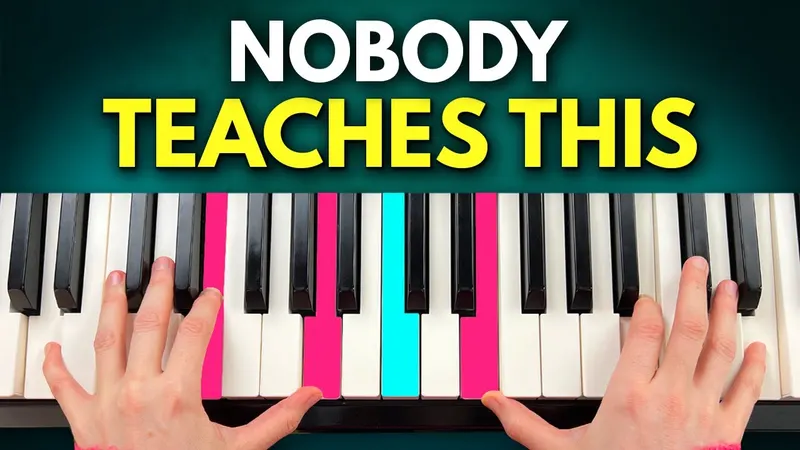
Lesson summary
Number the notes of the major scale from 1 to 7. Your right hand plays notes 1, 2 and 5, one after another: C, D and G in C major, a C sus2 chord. Your left hand plays the melody, each note twice, from a "phone number" of scale numbers: part A starts on 3, part B uses 6, 7 and 1. Because the system only uses numbers, the same piece works in D major and E major too.
- How to number the notes of a major scale
- A sus2 pattern from notes 1, 2 and 5
- A left-hand melody from scale numbers
- When to change the sustain pedal
- A shimmering octave variation
- The same piece in C, D and E major
Before you start
The C major scale. A scale degree is a note's number in the scale: in C major, C is 1, D is 2, E is 3 and so on. For D major and E major I show you the black keys.
An acoustic piano or a digital piano with a sustain pedal.
About 15 minutes a day. Learn the piece in C major first, then try one new key at a time.
Step-by-step guide
Here's what the video covers, in seven steps. Click a time to jump straight to that part.
-
Number the scale
Play the C major scale with your left hand: C, D, E, F, G, A, B, C. Now number the notes: 1, 2, 3, 4, 5, 6, 7 and 1 again. Wherever you play it on the piano, the numbers stay the same, because every octave follows the same pattern.
-
The right-hand pattern, 1–2–5
Your right hand uses the first, second and fifth notes of the scale: C, D and G. That's a C sus2 chord. Play the three notes one after another, again and again: C, D, G.
-
The scale exercise and the pedal
Your left hand plays every note of the scale twice, going up: 1, 1, 2, 2 and so on. To reach the 6, cross over with your middle finger to the A. Count 1 and 2 and 3 and 4 and: on 1 and 3 only the left hand plays, and the right hand plays C, D, G in between. With the sustain pedal, lift it and press it down again with every new bass note.
-
Part A: the secret phone number
The right hand never changes, so it's almost impossible to make it sound bad. Your left hand plays the melody: 3, 4, 5, 3, then 4, 5, 1, each note twice. In C major that's E, F, G, E, then F, G, C. Start with your third finger on the E. Look at the numbers, not the sheet music.
-
Part B, and the octave variation
The second part is 6, 7, 1, played one octave lower: A, B, C, and then again. Play part A once and part B twice, then go back to part A. For a shimmering effect, play every second bass note two octaves higher: reach over your right hand with your left hand. Watch my hands in the video.
-
The same piece in D major
D major has two sharps, F♯ and C♯. Number the scale, and your right hand plays 1, 2 and 5: D, E and A, a D sus2 chord. Play the scale exercise first. Then part A starts on the 3, F♯, with your middle finger, and part B is B, C♯, D, one octave lower.
-
The same piece in E major
E major has four sharps: F♯, G♯, C♯ and D♯. The right hand plays E, F♯ and B. Part A starts on the 3, G♯, and part B is C♯, D♯, E, one octave lower: 6 and 7 are the group of two black keys. The numbers are scale degrees, not fingerings. Play with expression, louder and softer, faster and slower, not like a robot.
 Want to understand why this works?Modern Piano 1In my course Modern Piano 1 I explain the complete system behind free piano playing and the number system step by step, so you understand exactly why this works and can create beautiful music on your own.Learn more about the course →
Full transcript
Prefer to read along? Here's everything I say in the lesson. Click a time to jump to that moment in the video.
Video transcript · about 3,100 words
The piano trick I wish I had learned years ago
Welcome to this new piano lesson. Today I'm going to show you one simple piano trick that sounds absolutely beautiful. And once you understand it, you can use it in almost any key. And I really wish somebody had shown me tricks like this when I first learned piano. Back then, almost everything was about reading sheet music, but the piano becomes so much more fun when you understand simple musical patterns like the one I will show you today.
And if you are new here, my name is Melanie. I studied music education. And on this channel, I teach a modern approach to piano playing. So instead of only learning how to read sheet music, you will discover chords, improvisation and all those practical skills that many piano students never learn in traditional lessons. So if that sounds interesting, don't forget to subscribe and give this video a thumbs up. It really helps the channel.
So let's jump right in. By the way, I've prepared a free PDF for today's lesson. It contains all the exercises and everything we are going to practise together. So you can download it for free using the link in the video description.
Numbering the C major scale
Let's start with the C major scale. I'm sure you already know it. We will play it with the left hand. We have the C, D, E, F, G, A, B, C. Okay. And now we are simply going to number these notes. That means 1, 2, 3, 4, 5, 6, 7, and then comes the 1 again. And no matter where you play this on the piano, the numbers stay the same, because every octave follows the exact same pattern.
So when you play the C major scale here, this is the 1, 2, 3, 4, 5, 6, 7, 1. Yeah. And then this repeats again and again. So every note of the scale has its own number, and that's the first thing we need. Now let's prepare the right hand. Here we can also play the notes of the C major scale. Yeah. And what we will do now is that we also give them numbers. And you already know them. 1, 2, 3, 4, 5, 6, 7, and 1 again.
The secret right-hand pattern (1–2–5)
And now our secret recipe for the right hand is incredibly simple. We are going to use the first, second and fifth note of the scale. That means we are playing C, D and G for the right hand. So the secret formula is 1 + 2 + 5. Okay. So these are the magical notes for the right hand. And by the way, this is a C sus2 chord. Beautiful, isn't it?
First practice exercise with the scale
Now here is the first exercise. Your left hand plays every scale note twice. Okay, we will begin on the 1. 1, 1. Then comes the second note of the scale. Then the third note of the scale. Then the fourth note. Then comes the 5. And then to reach the 6, you have to cross over with your middle finger to the A. Then 7, and again the 7. And then to the 1. Okay?
And between those bass notes, your right hand simply plays C, D, G, but one note after another, like this. C, D, G. Okay. And this repeats again and again. C, D, G, C, D, G, C, D, G, C, D, G. Okay. All right. And the rhythm goes like this: 1 and 2 and 3 and 4 and. Okay. So on the 1 and on the 3 only the left hand is playing, and then in between comes the right hand. 1 and 2 and 3 and 4 and.
Okay. So, let's practise this together. 3 and 4 and. 1 and 2 and 3 and 4 and. 1 and 2 and 3 and 4 and. 1 and 2 and 3 and 4 and. 1 and 2 and 3 and 4 and. 1 and 2 and 3 and 4 and. 1 and 2 and 3 and 4 and. 1 and 2 and 3 and 4 and. 1.
How to use the pedal
Okay, and there you have it. Okay, let's try that again. And this time I will also show you the sustain pedal. So you are starting: 1 and 2 and 3 and 4 and, and then up, down, up, down, up, down. Yeah. 1 and 2 and 3 and 4 and. 1 and 2 and 3 and 4 and. 1 and 2 and 3 and 4 and. 1.
Okay. All right. And by the way, if you are enjoying this lesson, don't forget that you can download today's free PDF below the video. Okay. And now here is where things become really exciting. Instead of simply playing the scale, we are now going to create a beautiful melody. And here is the amazing part: our right hand never changes. No matter which scale degree you play in the left hand, it will always sound beautiful.
If you've played piano before, you probably know one of the biggest fears every pianist has: what if I hit a wrong note? Okay. And the wonderful thing about this exercise is that it's almost impossible to make it sound bad, because everything fits together naturally. Okay, let's look at this.
The secret phone number
Now, let me give you the secret phone number, which tells us which notes of the scale we will play in the left hand. The first part is 3 3 4 5 3, and then the second part, 4 5 1 1.
Learning the A section
Okay. But what does this mean? So think of the numbers 1, 2, 3, 4, 5, 6, 7, 1. And that means we simply begin with two times the 3. 3, then 4. Then 5, 5, then 3, 3. Okay. And then in the second half of the first part, we begin with the 4. Yeah. 1, 2, 3, 4. So 4, 4, 5, 5. And then back to 1, 1, 1. And as you can already hear, we get a nice, beautiful melody. Yeah. 3, 3, 4, 4, 5, 5, 3, 4, 5, 5, 1, 1, 1.
Okay. And now to the beautiful melody we play in the left hand, we will now add the right hand pattern, exactly as before. That means we are going to play our three right-hand notes. Yeah. And this time we start with the 3 in the bass. 3, 4, 4, 5, 5, 3, and then comes 4, 4, 5, 1, 1, 1. Isn't this beautiful?
So this is the sheet music for this exercise, but you can also just look at the yellow numbers. Okay. So I would recommend to start with the third finger on the E. Okay. And then let's repeat this again. 3 and 4 and. 1 and 2 and 3 and 4 and. 1 and 2 and 3 and 4 and. Beautiful. Yeah. And if you want, you can also practise this a little bit faster.
Okay. And what makes this exercise so easy is that the right hand doesn't change at all. Only the left hand creates the melody.
Learning the B section
And now let's learn the second part of the secret number. This is like a second melody part now. And the second part of the number is 6 6 7 7 1 1. And this you will repeat again: 6 6 7 7 1 1. And when we play this now, let's have a look. 1, 2, 3, 4, 5, 6. Here is the 6. But this time we will begin one octave lower, because this is also a 6, right? So we are starting: 6, 6, 7, 1, 1, 1. And again: 6, 6, 7, 1, 1, 1.
Okay, let's listen to how this sounds with both hands together. So here you play 6, 6, 7, 1, 1, 1, 1. And then you repeat this again. 6, 6, 7, 7, 1, 1, 1. Beautiful, right? And you can also have a look whether you can play this only with the numbers. Yeah. So that you don't look at the sheet music, that you just know. Okay. In the right hand, you play the first, the second and the fifth note of the scale. And in the left hand, you start with the 6, 7, 1.
Okay. 6, 6, 7, 1, 1. And then a second time. 6, 7, 1, 1. Beautiful. Okay, so now it's time to put both melody parts together. We will start with the A part, and then we will play the B part. So here you see again the whole number for this piece, and we will start with part one, and then we go into part two, and part two we will play twice. Okay, let's have a look at whether this really works when we only know the number, right? Okay.
Beautiful. Right. And if you want, you can then go back into part one. Yeah. And so on. So, I think this is a really beautiful melody.
A beautiful octave variation
Okay, now it's time to get creative. Look here, you see some bass notes that are highlighted, right? Every second bass note is pink. What does this mean? Whenever you see one of those notes, you will reach over with your left hand and play that second note two octaves higher. That means you will cross over your right hand. Yeah, you will take your left hand over and play the second bass notes here, high up in the air.
Okay, look, I will play this for you. So, you are starting with number 3, right? 1 and 2 and, and then you reach over, and then you play the E here, two octaves higher. Then the next note is the 4, the F. Then comes the G. Back to the E. 4, 5. 1, 1. Yeah. So the pattern goes like this.
Yeah. And if you want, then you can practise this with the second melody part too. Yeah. Here you also see every second note is highlighted. And then let's have a look at this. So we are starting with the 6. 6, 7. 1, 1. 6, 6, 7, 1, 1. Beautiful, right? And this creates such a beautiful shimmering effect, yeah, because the melody is repeated with the higher notes, and I think this is really something special.
Playing the pattern in D major
Okay. And here is why this is so powerful. This entire concept works in every major key. So once you understand the system, changing keys becomes surprisingly easy. Let's try the same exercise in the key of D major this time. Okay. So remember, D major has two sharps. It has the F♯, and it has the C♯. And first we will number the scale exactly like before, like 1, 2, 3, 4, 5, 6, 7, 1.
All right. And for the right hand we again choose the 1, the 2 and the 5. So we get 1, 2 and 5. So we play D, E and A. And that's a beautiful D sus2 chord. Okay. Now let's put both hands together. In the left hand, we play the scale going up, and we will play every note twice. And in the right hand we always play the same three-note pattern. So this should already feel familiar.
We are starting with the first note of the scale. 1, 1, 2, 2, 3, 4, 5, 6. Now C♯, C♯, and D. Okay, we finally made it. Yeah. Repeat this a few times to get familiar with the scale. Beautiful, right?
And now we will apply the phone number. So look, here again is the number, 3 4 4 5 5 3. Yeah. What does this mean? Now in the key of D major, that means when we count 1, 2, 3, aha, we start with the F♯ this time. Yeah. So we start with the middle finger on the F♯. F♯. Then comes the 4, 4, 5. Back to 3. Then again 4, 4, 5, 5. And the 1, the 1 is the D, right? 1, 1, 1, 1. Yeah. Again. 3, 4, 5, 5, 3, 3, 4, 4, 5, 5, 1, 1.
Wonderful. And now the second part. Here you play the 6, the 7 and the 1. But which notes are these in the key of D major? Let's count. 1, 2, 3, 4, 5, 6. Okay, the B is the 6, and the 7, this is the note with the C♯, right? And then the 1 is clear. And this time we play the second part one octave lower. So we play 6, 6, 7, 1, 1.
Okay. Then let's practise this with both hands together. Right hand: first, second and fifth scale degree. Wonderful. With the left hand, we start on the 3. 3 and 4 and. 3, 3, 4, 4, 5, 5, 3, 3, 4, 4, 5, 5. Back to the 1. 1, 1, 1. Now 6. 6, C♯, C♯, 1, 1. And again: 6, 6, 7, 1, 1. Okay, beautiful. So you can practise this, so that you can also play it a little bit faster.
Yeah. And then you can really repeat this like a circle, so that you begin with part one again. Okay. Yeah. I think this is really amazing.
Playing the pattern in E major
And now let's use our secret phone number again. This time we will use it in the key of E major. Here we have the F♯, the G♯, then the C♯ and the D♯. Okay. So E, F♯, G♯, A, B, C♯, D♯, E. Okay. You can repeat this a few times. Yeah. You go with your third finger on the C♯. So don't be afraid of the E major scale. Yeah, it's not as difficult as it seems.
And now we will number the scale again. This is the 1. This is the 2. This is the 3, the 4, the 5, the 6, the 7, and the 1 again. Okay. And now let's have a look at the right-hand notes. So here again we choose the first, the second and the fifth. And then we get the E, the F♯, and the fifth is the B. Okay. So these are our three notes we will use for our three-note pattern in the right hand.
Now let's quickly repeat our scale exercise. Yeah, just going up the scale with the left hand. Beautiful, right? And now we finally use our phone number once again. So let's go through the number just with the left hand alone. So let's count the notes of the E major scale. 1, 2, 3. And this is where our phone number begins. So yeah, just play this note with your middle finger.
Yeah. And be careful: the numbers that you see here, these are not the numbers for the fingerings. Yeah. These are the numbers of the scale degrees, of the notes of the scale. So we are starting here with the G♯. 3, 3, 4, 4, 5, 5, back to the 3. Then 4, 4, 5, 5, and back to the E, which is the first note of the scale, right?
And then comes the 6. What was the 6 again? 1, 2, 3, 4, 5, 6. Aha. Okay. This was the 6. This was the 7. This is the 1. Yeah. So this is where the two black keys are in one group. We just play it one octave lower, like 6, 6, 7, 1, 1. 6, 6, 7, 7, 1, 1. Easy, right? Now let's put both hands together. So these are the three right-hand notes, and then the fun can begin. 1, 1, 1, 1. 6, 6, 7, 1, 1. 6, 7, 1, 1.
Yeah. And when you play this, you can also try to play a little bit louder or a little bit softer. And you can also play it faster, or you can play it a little bit more slowly. Yeah. As you like, so that you really put all of your musical expression into this. Yeah. Don't play like a robot. Try really to make something out of it that sounds musical. And also here, yeah, you can have so much fun with this exercise, because you can also get creative again.
Yeah. Isn't this beautiful? You can do the trick with the second bass note played two octaves higher. And I think this is such a sweet melody. And this is so much fun.
How this leads to free improvisation
And it's really exactly the same system in the key of E major as in the key of D major and in the key of C major. Yeah. Even if this is a completely different key. This is one of the easiest ways to become comfortable playing in new keys, because every key has its own personality and colour, and the piano becomes so much more exciting once you stop limiting yourself to the key of C major.
And if this lesson opened your eyes to what's possible, and you would like to become confident with chords, improvisation and playing freely without depending on sheet music all the time, then make sure to check out my online course, Modern Piano 1. In the course, I explain the complete system behind free piano playing and the number system step by step. So you will understand exactly why today's exercise works and how to create beautiful music on your own. Because look, then you can also play improvisations like this.
Yeah, this was in the key of C major. And then you can also play this, let's say, in the key of A major, where you are just starting on different notes. And this is such a creative and inspiring way to discover the piano. And honestly, I really, really wish someone had shown me this system years ago, because it completely changes the way you look at the instrument.
Instead of always depending on sheet music, you can finally start playing freely. And that's so much fun. So, if you would love to play with more freedom, improvise beautiful melodies, and feel confident at the piano without relying on sheet music all the time, then make sure to check out the link in the description below. So, thank you so much for watching. If you enjoyed this lesson, please give the video a thumbs up, and don't forget to subscribe for more modern piano tutorials every week.
And before you go, click on the next video right here, because there I will show you another amazing piano trick that will instantly make your playing sound even more beautiful. And I hope I will see you there.
Questions about this lesson
What is the number system?
You give every note of a major scale a number from 1 to 7. In C major, C is 1, D is 2, E is 3 and so on. Because you think in numbers instead of note names, the same pattern works in every major key.
What is a sus2 chord?
A chord with the second note of the scale instead of the third. C sus2 is C, D and G: notes 1, 2 and 5 of the C major scale. It's the right-hand pattern in this lesson.
What is the "secret phone number"?
The scale numbers your left hand plays as a melody. Part A is 3, 4, 5, 3, then 4, 5, 1; part B is 6, 7, 1, one octave lower. Each bass note is played twice.
Does this work in other keys?
Yes, in every major key. Number the scale, play 1, 2 and 5 in the right hand, and follow the same numbers in the left hand. In the video I show it in C, D and E major.