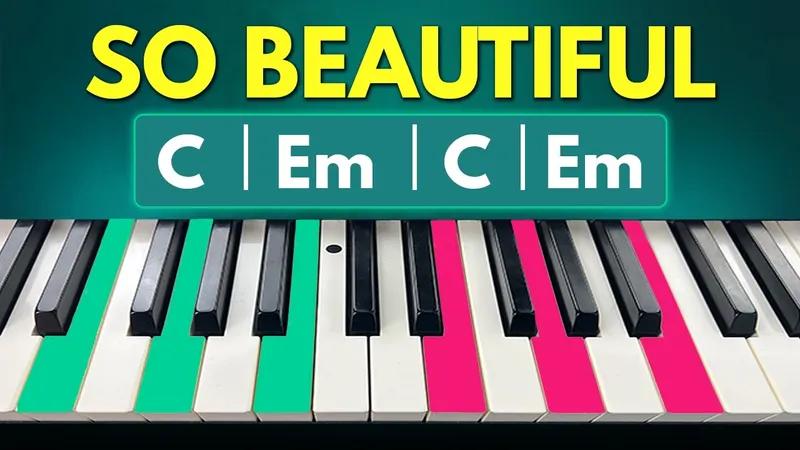
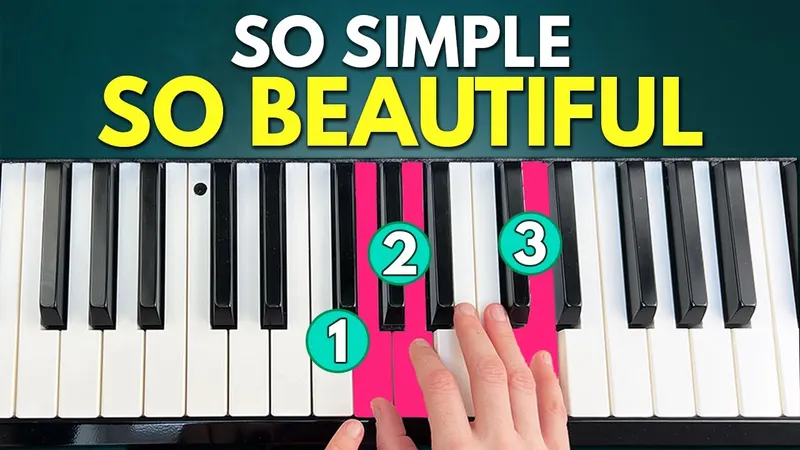
Lesson summary
Your left hand plays F major 7, E minor 7, D minor 7 and C major 7: one shape that moves down a white key at a time (or the triads F, E minor, D minor and C). Your right hand improvises on the white keys. Then you add five ideas: a little melody, a sequence, black keys you only touch quickly, an offbeat rhythm, and thirds and octaves.
- Four seventh chords in one moving shape
- Improvising with only the white keys
- Sequences, one idea repeated lower
- Black keys as tiny embellishments
- An offbeat rhythm for contrast
- Thirds and octaves for a fuller sound
Before you start
The white keys and the triads F major, E minor, D minor and C major. A seventh chord is a triad with one more note on top, the seventh; you can also play just the triads.
An acoustic piano or a digital piano.
About 15 minutes a day. Play with one idea at a time, and see it like a game: don't overthink it.
Step-by-step guide
Here's what the video covers, in six steps. Click a time to jump straight to that part.
-
The left-hand chords
Play F major 7 (F–A–C–E), E minor 7 (E–G–B–D), D minor 7 (D–F–A–C) and C major 7 (C–E–G–B). Begin on F with your pinky, freeze your fingers, and move the shape down one step at a time until your pinky reaches C. If four notes are too much, play the triads F major, E minor, D minor and C major. Play each chord four times: 1 2 3 4.
Fmaj7Em7Dm7Cmaj7
-
Idea 1: melodies on the white keys
All the white keys are allowed: all the notes of the C major scale. Try to invent little melodies, find one you like, and try out different things. For more power, play the left-hand chords as quarter notes. Don't overthink it: see it like a game.
-
Idea 2: sequences
Take a small melody and repeat it, each time starting on a different note. That's called a sequence. For example, play four notes down, then start one white key lower, and again one lower, keeping the same rhythm each time. Then bring in a little more rhythm and let your ears guide you.
-
Idea 3: black keys as hot stones
Now add a few black keys. Don't really play them: imagine they're hot stones. Touch one very quickly and land on a white key. These little embellishments sound sweet and peaceful. Listen to the examples in the video and experiment, taking your time like on a sunny Sunday afternoon.
-
Idea 4: an offbeat rhythm
Take two notes as a melody and always go one white key down, in a rhythm. Count 1 and 2 and 3 and 4 and, slowly at first, then faster. Throw this offbeat motif into a calm melody now and then, and you get a nice contrast.
-
Idea 5: thirds and octaves
Play some of your melody notes as thirds, or as octaves, which sound wider than a single note. It makes your sound fuller and richer. Then mix all five ideas: you don't need many notes, just a few ideas used in a creative way.
 Want to improvise beautiful melodies?Modern Piano 1In my course Modern Piano 1 you learn how to play the piano with chords and how to improvise beautiful melodies.Learn more about the course →
Full transcript
Prefer to read along? Here's everything I say in the lesson. Click a time to jump to that moment in the video.
Video transcript · about 1,500 words
Intro
Maybe you already know some chords, but you are not quite sure how to turn them into real music. And in this video, I want to show you something simple, but very powerful. I will give you five easy ideas you can use to start improvising right away.
And if you are new here, my name is Melanie. I studied music education, and on this channel I show you all the things you probably don't learn in traditional piano lessons. And if you enjoy playing with chords and creating your own music, feel free to like this video and subscribe to the channel. And now let's sit down at the piano and start creating something beautiful.
Left-hand chords
Let's start with the left hand first. We play these chords. We start with F major 7. Then we are going to E minor 7. Then we are going to D minor 7. And then we are going to C major 7. And you can see, we just have to move the shape down step by step. Okay. And this makes it very easy to play, right?
So you are beginning on the F with your pinky, and then it's like you would freeze your fingers. You are just taking this shape, and then you are going down, down again, and down again, until you reach the C with your pinky. And if playing four notes together still feels a bit difficult, no problem. Then you can also take the normal triads, so that you start with F major. Then you go to E minor, then to D minor, and then to C major.
Okay? So this is when you want to play something easier. But when it's no problem for you to play four notes at the same time, then you can also play the seventh chords. Now let's play each chord four times. 1 2 3 4, 1 2 3 4, 1 2 3 4, 1 2 3 4, 1 2 3 4. And again: F major 7, E minor 7, D minor 7, and C major 7. Isn't this beautiful?
So, take your time and get comfortable with these chords. And by the way, you can also download a free PDF with all chords and ideas from this video. Just check the link in the video description below.
Idea 1: white-key melodies
Okay. Now, let's go to the right hand. And the right hand is very simple, because we are only using white keys. So all white keys are allowed. Yeah. All notes of the C major scale. And then you just try to invent little melodies. Maybe something like this. Try to find a melody that you like, and then you can try out different things. For example.
Okay. And if you want to add a little bit more power behind it, then you can also play the chords in the left hand as quarter notes. Yeah. So that you are playing maybe something like this. Yeah. And then it starts to sound a little bit more full. And the trick is that you don't overthink this. Yeah. Just try to see this like a game.
Idea 2: sequences
Now let's go to idea number two. Here we will take small musical ideas. We had small melodies, and we will just repeat it and repeat it, but each time we start on a different note. So this is called a sequence. I will show you what I mean. For example, you could do something like this. Yeah. Here I just took these four notes, played them down, and then I just began one note lower, and again one note lower.
And maybe you come up with your own ideas. Yeah, you could start with something like... Yeah, I just took this melody, and then I repeated it just one white key lower, one white key lower, one white key lower. And every time I kept the same rhythm.
Yeah. Of course, you can also bring in a little bit more rhythmic variation. Just something like this. Let your ears guide you. Or you just play something easy and beautiful like this. Okay. So this is all the same idea: we are taking the same melody and repeating it, just on another key. Just starting on another key.
Okay. And by the way, if you want to learn more about how to play the piano with chords and how to improvise beautiful melodies, then make sure to also check out my online course, Modern Piano 1. You will find more information about that in the video description below.
Idea 3: black keys
Now, let's have a look at idea number three. Here we will add some black keys. Now, just a few notes can already change the sound. And yeah, we can just try it out and experiment a little bit. And I will show you an example. So when we bring in these black keys, then we don't really play them. We just tease them a little bit, like... Yeah. We are doing it as if this were a hot surface or something. We just touch it quickly, and then we go away. Yeah. Then we land on a white key.
Okay. Yeah. Just imagine these are hot keys. Hot stones. Really, really hot stones. And you really must be careful, because if you touch them too long, this will hurt your fingers, right? So, you just slip over them, and then something like this comes out. And this can sound so easy and beautiful and peaceful when you just add this to your improvisation. I will play you an example. For example. Yeah.
And just feel free to experiment. Yeah. Imagine it's a Sunday afternoon, and you just ate a delicious cake or something, drank a nice hot coffee, and then you are sitting at the piano, and the sun is shining, and you just take your time. Yeah. And I think these are such sweet elements you can use as tiny little embellishments in your playing, that it's really very fun to improvise with these little embellishments.
Idea 4: rhythm and offbeats
Okay, next idea. Idea number four. Here we will play a little bit with the rhythm, and I will show you an example. What you can do here is that you are taking these two notes as a melody, and then you always go one white key down. Okay, like this. And then we are playing this rhythm here. And we are doing the rhythm slowly. So we are playing 1 and 2 and 3 and 4 and. 1 and 2 and 3 and 4 and. 1 and 2 and 3 and 4 and. 1 and 2 and 3 and 4 and.
Okay. And when you play this a little bit faster, this sounds like this. Wonderful, right? And this is really cool to get some contrast, yeah, when you are improvising: that you are playing a melody, and then you just throw in these little accents. Yeah. That you are playing this as an offbeat motif. Okay. So maybe you start with a melody, and then... Yeah, for example.
And then you have just more contrast. Yeah. Between the nice little melody and then a more rhythmic style of playing. Just a quick reminder: don't forget to download your free PDF below. It really helps you while practising. So go to the video description, and there you will find a link where you can download the free sheet music for this tutorial, and there you will find all ideas together, and then you can just go through them on your own.
Idea 5: thirds and octaves
Okay. Now let's come to the last idea. Idea number five. Here we will use intervals in our playing. We will throw in thirds, or sometimes also octaves. Let's listen to how this can sound. For example, you could play thirds like this. Yeah. Or you can also use octaves, because this will sound wider than just playing one single note.
Yeah, really sweet. And I think this makes your sound fuller and richer when you start using intervals in your improvisations. And yeah, please write me in the comments and let me know which idea you liked the most. And the cool thing is that you can mix everything together. You can mix up just single melodies. You can mix up the sequences. You can play around with the rhythm variations, with the offbeats. Okay? Then you can bring in the black keys, and then also the intervals.
So this will be lots of fun, and then your playing starts to sound like real music, right? And the best part is that you don't need many notes, just a few ideas used in a creative way. Because when you play more, that doesn't have to mean that it will sound more beautiful. Try to keep it easy. And now have fun playing, and see you in the next video.
Questions about this lesson
Which chords does this lesson use?
F major 7, E minor 7, D minor 7 and C major 7. It's one shape that moves down one white key at a time, from F to C. If four notes are too hard, play the triads F major, E minor, D minor and C major.
Which notes can I use for the right hand?
All the white keys: the notes of the C major scale. In idea 3 you also touch a few black keys very quickly, as little embellishments.
What is a sequence?
A short melody that you repeat, starting on a different note each time, for example one white key lower, with the same rhythm.
Do I have to play more notes to sound better?
No. Playing more doesn't mean it sounds more beautiful. A few ideas used in a creative way are enough: try to keep it easy.