Lesson summary
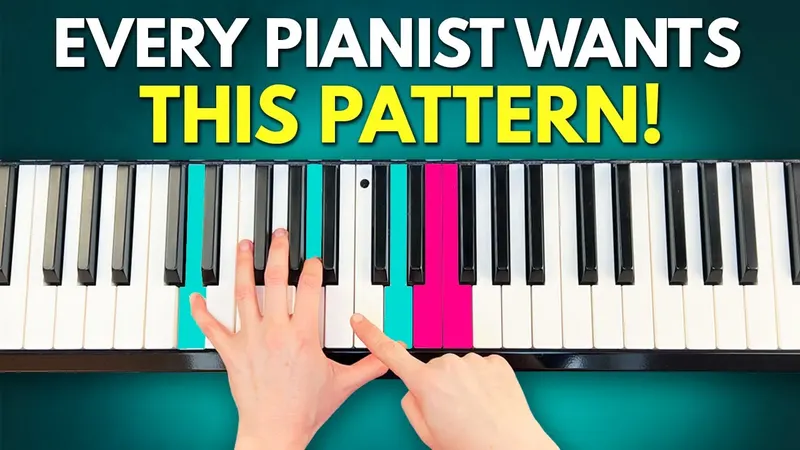
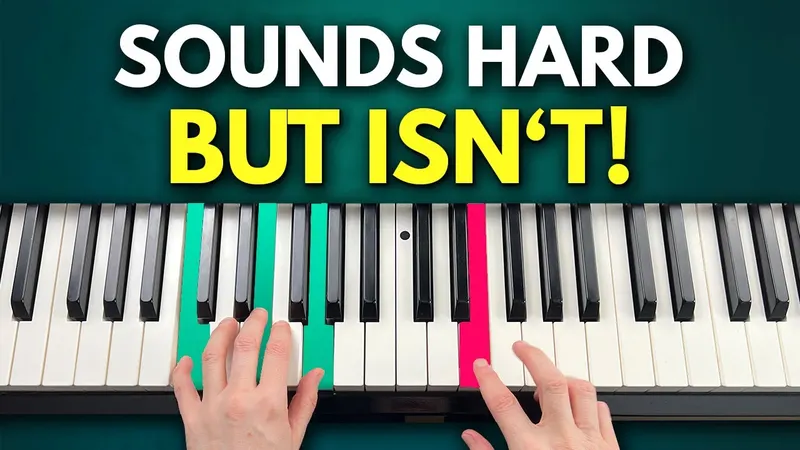
Everything happens on one chord, G major. Your left hand plays a 1–5–8 shape (G, D, G) and then lets your thumb wander up and down through the notes above, alternating with your index finger, in relaxed sixteenth notes. Your right hand stays simple: one note of the G major triad per bar, a tiny decoration, two notes alternating, or just two notes held. Mix the ideas and you have a little song.
- A dreamy sixteenth-note pattern for the left hand
- How a single right-hand note already sounds musical
- Little decorations, including the major 7th
- Alternating notes, and when to let them ring
- Held intervals for contrast and calm
- How to build a mini song from these ideas
Before you start
How to play a G major triad (G, B, D) and how to count sixteenth notes: 1 e and a, 2 e and a. Remember the F♯ in G major.
An acoustic piano or a digital piano with a sustain pedal, which makes the pattern sound more dreamy.
About 15 minutes a day. Practise the left hand a few times in a row until it flows on its own.
Step-by-step guide
Here's what the video covers, in seven steps. Click a time to jump straight to that part.
-
The left-hand pattern
Place your left hand on G and play 1–5–8: G, D, G. Go back to your index finger, then let your thumb move through the notes above, always alternating with your index finger: one down, one up, one up, one down, one down, one up. Watch out for the F♯. It's in sixteenth notes, 1 e and a, 2 e and a; use the sustain pedal. Watch my thumb and index finger at 2:50.
G
-
One right-hand note per bar
Your left hand does most of the work, so your right hand can stay simple. Place it like a G major triad and play only the root, G, on beat 1. Then try the third, B, and then the fifth, D. It already sounds very musical.
-
Add a little sixteenth note
At the end of the bar, add one tiny sixteenth note on "4 e and a", together with the last D in your left hand before it starts again: repeat the root. You can also use another note: the F♯ (the major 7th), the B, or all three notes of the triad in turn.
-
Alternate two notes
Now alternate between two notes in sixteenth notes: the root and the third (G and B), then the root and the fifth (G and D). Keep the left hand flowing calmly underneath.
-
Make some space
Don't play the alternating notes through the whole bar: play them for "1 e and a, 2 e and a", then let the note ring while your left hand keeps moving. Instead of constantly playing, you create contrast, and that makes the music feel much more emotional.
-
Hold an interval
Sometimes the most beautiful thing is almost nothing: hold two notes for the whole bar, G and B, then G and D, while your left hand keeps playing. Mix it with the other ideas: small melodies, alternating notes and held notes, a balance between movement and relaxation.
-
Build a mini song
Combine everything: single notes going up and down the triad, then the sixteenth-note decorations, then held intervals to relax, then alternating notes for movement, and the intervals again. To end, play the 1–5–8 shape in your left hand and the root and third in your right.
 Want to create your own music?Modern Piano 1In my course I show you step by step how playing the piano freely actually works, with a clear structure, so you can sit down and create your own music.Learn more about the course →
Full transcript
Prefer to read along? Here's everything I say in the lesson. Click a time to jump to that moment in the video.
Video transcript · about 1,700 words
Intro
Have you ever noticed that some piano players sit down at the piano, start playing, and somehow everything sounds beautiful, and the craziest thing is they don't even need sheet music? What nobody told me when I started learning piano is how this works, and that it's much easier than you might think. All it takes is a beautiful left-hand pattern and a few carefully chosen notes.
And today I'm going to show you one of my favourite left-hand patterns, which instantly creates a beautiful, dreamy sound. But before we start: you can download the free sheet music for today's lesson. You will find the link in the video description below.
And if you are new here, my name is Melanie. I studied music education. And on this channel, you will learn how to play piano with chords, how to improvise freely and how to create beautiful music without feeling stuck to classical sheet music. And if that sounds interesting, make sure to subscribe and give this video a thumbs up. It really helps the channel, and yeah, it makes sure that you don't miss any future lessons. So, I would say let's jump right in.
The left-hand pattern
Okay, let's start with the left hand. This is a sixteenth-note pattern that sounds incredibly relaxing, and I will play it once for you. Beautiful, right? So place your left hand on the G. And now we are going to play a simple 1–5–8 pattern. That means G, D, G. So this is our starting position.
And then after that your thumb starts moving through the upper notes here, while alternating with the index finger. Okay? And the motion is very smooth. So you are starting with the 1–5–8, back to the index. Then you go one down with your thumb. One up, one up, one down, one down, one up. Okay. And then again you start with the starting position. Look how my thumb and the index finger are moving. Wonderful, right?
And we will count along the sixteenth notes. And yeah, we will play this a few times now. And don't forget to use your sustain pedal to make it sound more dreamy. Okay. So we are starting. 3 e and a, 4 e and a, 1 e and a, 2 e and a, 3 e and a, 4 e and a, 1 e and a, 2 e and a, 3 e and a, 4 e and a, 1. Wonderful.
So practise this left-hand pattern a few times in a row. And attention, here we have the F♯, so keep this in mind. Yeah. And then this left-hand pattern will sound really beautiful. If you also find it fascinating how a few simple notes can create something this beautiful, make sure to give this video a thumbs up and let me know in the comments how you like this beautiful left-hand pattern. I read every single comment.
The right hand
And now we will add simple right-hand notes. And now that the left hand is doing most of the work, the right hand can stay very simple. Position your right hand as if you would play a G major triad. And now let's start by playing only the root note, the G, on beat one, like this. And again.
Great. Now let's try the third, the B. And again. Now let's try the fifth. Okay. The D. And a second time. Excellent. And that already sounds very musical, doesn't it?
Add sixteenth notes
Now, in the last part of the measure, you can add a tiny little sixteenth note as a little decoration. Okay, look here. I added a sixteenth note. And this sixteenth note falls exactly here, on this note in the left hand. That means we are simply repeating the root note. Okay? Like this.
When we are counting, this is on the "4 e and a", okay, like 1 e and a, 2 e and a, 3 e and a, 4 e and a, 1. Yeah. It's like it would be a one. Okay. 1 e and a, 2 e and a, 3 e and a, 4 e and a, 1. So it's on the last D here, with the index finger, before we go back to the starting 1–5–8 position.
Okay. And now for that little extra note, you can also use other notes, like maybe the F♯. Yeah, which is the major 7th. Or you can use the third or the fifth. Yeah, I will show you a few examples. Let's start maybe with the F♯. Okay. Like this. Look how beautiful this sounds. Or let's just try the whole thing on the B.
Or we can also take all three notes of the triad. We are beginning with the B and then we are going to the fifth and back to the root. Okay. Like this. And I think it's really wonderful how these tiny movements instantly make the music sound more expressive.
And by the way, a quick reminder: if you haven't downloaded the free sheet music yet, make sure to grab it from the link in the description. You can print it out, keep all the exercises in one place and follow along much more easily. Okay?
Alternating motion
And now let's continue with the next exercise. Now we will alternate between the third and the root. Okay. Between the G and the B, like this. 1 e and a, 2 e and a, 3 e and a, 4 e and a. Okay. Together with the left hand, it sounds like this.
And you can do the same thing with the root and the fifth. Okay? So that you are starting here on the D and you are alternating between the D and the G. Let's repeat this. First root and third. Now root and fifth again. Yeah. And the left hand calmly plays the left-hand pattern. Yeah. Just keep the left hand flowing while the right hand alternates between the two notes. Okay.
Alternating motion and long held notes
And now we will create a little bit more space. Okay. So the trick is that you don't play this during the whole measure, that you are just playing it like this: 1 e and a, 2 e and a. Yeah. And then you simply let the note ring. And then you are doing the same thing with the next pattern, with the root and the fifth, like 1 e and a, 2 e and a. Yeah. And then you just let it ring. Together with the left hand, it sounds like this.
So that means the left hand keeps moving while the right hand relaxes. Okay. Like this. Yeah. So when the left hand goes to the A here, then you just leave the right hand where it is. Okay. And this instantly creates more space. So instead of constantly playing, yeah, you create contrast, and that makes the music feel much more emotional.
Intervals
Now let's create even more contrast. Until now, we've played little melodies and we alternated the notes in the right hand. But sometimes the most beautiful thing you can do is almost nothing. Okay? So try holding just two notes for the entire measure. We are going to play intervals here. Look, we are starting with G and B, with the root and the third. And we will just hold them during the whole bar. And the left hand keeps playing the pattern, like this.
And then we will take the root and the fifth. Okay. Again. Beautiful, right? And this is so easy, but it sounds really wonderful. This is really a great way to create contrast and give your ears a little break from all the movement. You can also alternate between these different note combinations whenever you like.
Yeah. Sometimes you play small melodies, sometimes you alternate between two notes, and sometimes you simply hold the notes and enjoy the sound. And this creates a wonderful balance between movement and relaxation. Okay?
And if you enjoy this way of playing the piano and you would like to learn how to play more freely using chords and patterns, then I highly recommend checking out my online course, Modern Piano 1. In this course, I show you step by step how free piano playing actually works, with a clear structure. Because let's be honest, in traditional piano lessons, we are often taught how to play pieces from sheet music, but very rarely how to sit down at the piano and create our own music. And that's exactly what Modern Piano 1 is all about. You will find more information in the description below.
A mini song
And now we are coming to the end. Now we will build a mini song with everything we learned. We will create a tiny little piece of music now. Okay. And for that we will repeat some elements from this lesson, and we will start with the right hand going up the G major triad, going up and down again. Okay. Like this. Third. Fifth, third.
Wonderful. Now, let's bring in a different rhythm, okay? So that we start playing these tiny, beautiful sixteenth notes, like this. Third, fifth, root. Now we need something to relax. Okay, let's bring in the simple intervals. And again.
Okay, now we are ready, and now we need a little bit of movement. So we are going to bring in the alternating notes. Now. And again. And then again we start with the intervals. Just relax a little bit.
And when you want to come to an end, you just take the 1–5–8 shape for the left hand, and for the right hand you are taking the root and the third. Yeah. And then you have a beautiful ending. Okay. So this is just an idea of how you could combine all the different exercises so that you get something like a mini song. You can repeat it however you like.
And I think this is a wonderful idea to practise all this stuff. So have fun experimenting with these ideas and creating your own music. And don't forget to check out the Modern Piano 1 course. And if you enjoyed this tutorial, make sure to watch this video next, where I show you another beautiful piano pattern that instantly makes your piano playing sound more professional. Okay, I will see you.
Questions about this lesson
Which chord does this lesson use?
Just one: G major. The left-hand pattern starts with G, D, G, and the right hand uses the notes of the G major triad, G, B and D, plus the F♯ as a decoration.
How does the left-hand pattern move?
After G, D, G, your index finger stays on the D while your thumb moves through the notes above: one down, one up, one up, one down, one down, one up. It's easier to see than to read, so watch my hand in the video.
What is the major 7th here?
In G major it's the F♯, one half step below the G. Used as a little decoration at the end of the bar, it sounds really beautiful.
Do I need to read sheet music?
No. Once the left-hand pattern flows, your right hand only needs a few notes of the G major triad. That's what makes it possible to sit down and just play.