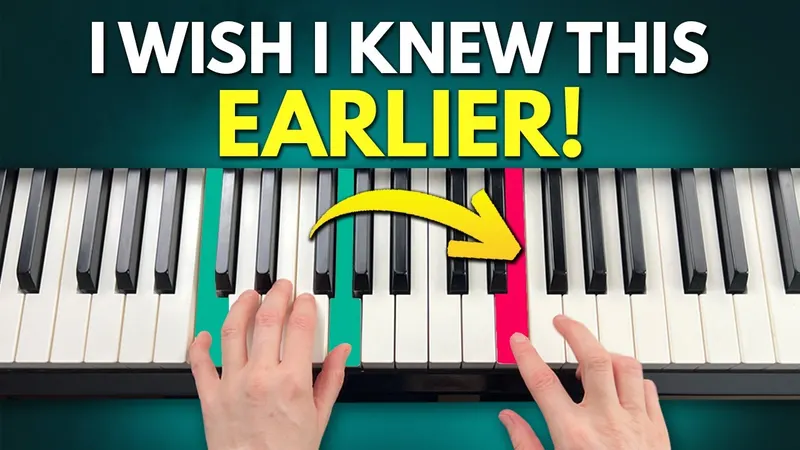
Lesson summary
The progression is E minor, G major 7, D major and C add9, and the second time it ends on A minor. Your right hand plays them in easy shapes: E minor and D major in second inversion, only the top three notes of G major 7, and C add9 without its root. Your left hand plays the roots. Then you play it with the pedal, as broken chords, and over a backing track, and improvise in E minor.
- Four emotional chords in easy shapes
- A simpler G major 7 and C add9
- An eight-bar progression with two endings
- Changing the sustain pedal with each chord
- Broken chords from the outer notes
- A first improvisation in E minor
Before you start
The triads E minor, D major, C major and A minor, and what an inversion is: the same notes in a different order. A seventh chord and an add9 chord add one note to a triad; I show you an easy way to play them.
An acoustic piano or a digital piano with a sustain pedal. The backing track comes with the free PDF.
About 15 minutes a day. Practise the right hand alone until the chord changes feel safe, then add the left hand and the backing track.
Step-by-step guide
Here's what the video covers, in six steps. Click a time to jump straight to that part.
-
The four chords in the right hand
Play E minor in second inversion: put the top note one octave down, B–E–G. G major 7 is G, B, D and F♯, but your right hand only plays the top three notes, B–D–F♯. For D major in second inversion, just move your thumb one white key lower: A–D–F♯. For C add9, take C major in second inversion (G–C–E), replace the C with the D, the ninth, and you play G–D–E.
EmGmaj7DCadd9
-
Add the left hand
Your left hand plays the roots: E, G, D and C. It plays the G of G major 7 and the C of C add9, so the right hand doesn't need them. Count 1 2 3 4 on each chord.
-
A new ending with A minor
Play the first three chords again, but instead of C add9, move your hand up to A minor in first inversion: take the lowest note of the triad and put it one octave higher, C–E–A. The left hand plays A. The whole progression is eight bars: the first four end on C add9, the next four on A minor.
EmGmaj7DAm
-
The backing track and the pedal
Play the eight bars along with the backing track. Press the sustain pedal down on E minor, and every time you play a new chord, lift it and press it down again at the same moment. If both hands are too much with the backing track, practise each hand alone first.
-
Broken chords
Now leave out the middle note of each right-hand chord and alternate between the highest and the lowest note, counting 1 and 2 and 3 and 4 and: G and B on E minor, F♯ and B on G major 7, F♯ and A on D major, E and G on C add9, and A and C on A minor. Think one bar ahead, so your hand is ready for the next chord.
-
The ending and first improvisation
To end, play the E minor triad in second inversion. For an extra challenge, improvise over the chords: we're in E minor, so use the white keys with F♯ instead of F. Almost every note sounds beautiful.
 Struggling to find inversions quickly?Modern Piano 1In my course Modern Piano 1 I teach you a method to find all inversions very quickly, develop beautiful chord progressions and improvise with confidence.Learn more about the course →
Full transcript
Prefer to read along? Here's everything I say in the lesson. Click a time to jump to that moment in the video.
Video transcript · about 2,100 words
Intro
There are certain chord progressions that instantly touch your emotions, and as soon as you play them, they create this beautiful and sad atmosphere. And today, I'm going to show you one of my absolute favourites. And by the end of this lesson, you will be able to play it confidently, together with a beautiful backing track.
If you are new here, my name is Melanie. I studied music education, and on this channel I teach a modern approach to piano playing. We focus on chords and patterns and all those practical skills that are often missing in traditional piano lessons. And if that sounds interesting, don't forget to subscribe and give this video a thumbs up, so that you won't miss any future lessons. And I've also prepared a free PDF for this lesson with all the chords and exercises we are using today. You will find the download link below in the video description.
The four chords in the right hand
Let's begin with the right hand. Today we are learning four beautiful chords, and the first one is E minor, but we don't play it in root position. We will take the second inversion: you just put the highest note one octave down, and then you have E minor in second inversion. Then the next chord is a G major 7th chord. That means we have the notes G, B, D and F♯. But to make it a little bit easier, we will only play the upper three notes of the chord. Okay? That means we only play the B, the D and the F♯. And the G we will play later with the left hand.
Okay. So now the next chord is a D major chord, also in second inversion. And the thing is, the only thing you have to do when you are on this beautiful G major 7th chord is that you just take your thumb and put it one white key lower, and there you have D major in second inversion. Now we are coming to the last chord. This is a C add9 chord, and I'll tell you what you have to play here.
Look, we don't play the C major triad in root position. We just play it in the second inversion. That means again you are putting the top note just one octave lower. And then like this you have C major in second inversion. Now we are adding the ninth. And the ninth is always one whole step above the root note, which is the C. So that means we are filling this gap here with the D.
And now comes the last step, because now we will throw out the root note, C. That means there are only the notes G, D and E left over now. And the C we are going to play with the left hand later. And like this it sounds so much more beautiful, because sometimes when you play the full add9 chord, it sounds a little bit messy and full, and like this, with these tiny little tricks, the chords begin to sound really beautiful.
Okay. So I would say, let's repeat the chords with the right hand only. So we are beginning with E minor in second inversion. Then we are doing the trick with G major 7, where we just play B, D, F♯. Now just take your thumb and put it one white key lower. There you have your D major in second inversion. And then just imagine you would play a C major triad in second inversion, but then instead of the C, just take the D.
Okay. So once again: 3 4, 1 2 3 4, 1 2 3. Now the thumb down. 1 2 3 4, 1 2 3 4, and again up to E minor. Okay. So practise this several times in a row.
Adding the left hand
And then if you feel ready, you can also join in with your left hand. And there we will just play the root notes. That means E, G, D and C. Together this will sound really beautiful. 3 4, 1 2 3 4, 1 2 3 4, 1 2 3 4, 1 2 3 4, 1. Wonderful. I think this one here is my favourite so far, because it sounds like heaven on earth, right?
A new ending with A minor
Okay, so these are our first four chords. And now we are doing exactly the same again. Look, the first three chords stay the same, but only here at the end we will change the chord to A minor in first inversion. So that means we are starting with E minor in second inversion. Then we are playing the upper part of G major 7. Then we are playing D major in second inversion. And now instead of going to C add9, we will move our hand up and play an A minor chord in first inversion.
Okay? So we have the notes in another order. Okay? We don't play it in root position. We take the lowest note and put it one octave higher. Then we get A minor in first inversion. By the way, if you are still struggling to find the inversions of the triads quickly, then I really can recommend my online course, Modern Piano 1, where I teach you a method that helps you to find all these inversions very, very quickly.
Okay. So, but now let's repeat these four chords with our new ending. 3 4, 1 2 3 4, 1 2 3 4, 1 2 3 4. Now A minor. Wonderful. And then we are beginning to play the bass notes. Okay. The root note of the chord. 3 4, 1 2 3 4, 1 2 3 4, 1 2 3 4, and A minor. Isn't this beautiful?
Playing with the backing track
Okay. So, repeat this again and again, and then we will put all the chords together. That means, look, here we have an eight-bar chord progression, and in the first round you see we play the C add9 at the end, and then in the second round we play the A minor at the end. Okay. And by the way, if you haven't downloaded it yet, remember that you will find all of today's chords and exercises in the free PDF, which is linked below the video.
And the best thing is that we will practise this now with a beautiful backing track. Okay. So I will count us in, and then we will try to combine the beautiful chords. Okay. 3 and 4 and. 1 and 2 and 3 and 4 and. 1 and 2 and 3 and 4 and. 1 and 2 and 3 and 4 and. Now C add9, and back to E minor. 2 and 3 and 4 and. 1 and 2 and 3 and 4 and. 1 and 2 and 3 and 4 and. 1 and 2 and 3 and 4 and. 1.
Using the sustain pedal
Okay. Beautiful, right? And when you practise this, there is one more important thing: don't forget to use the sustain pedal. Look, when we are beginning, we are just starting with E minor, and the foot goes down. And then as soon as you play the next chord, yeah, you push the keys down, and at the same moment the foot comes up and goes down again. With the next chord too. Look: up, down. Yeah. And the next chord too: up, down. Okay. All right. And like this, you can separate the chords beautifully.
And if playing both hands together with the play-along still feels challenging, don't worry at all. You can also practise with only your right hand or only your left hand first. That's a fantastic way to build confidence. So when you download the free PDF, you will also have access to the backing track. Then you can download this and practise it all at home at your own pace.
Broken chords
And now let's make everything sound even more beautiful. So instead of block chords, we will now use broken chords. And the trick is that you don't play the whole chord. You always leave out the note in the middle now, and you will alternate between the highest and the lowest note, like this. 1 and 2 and 3 and 4 and. Then you go to the next chord, to the G major 7. And also here you leave out the note in the middle. And then you are beginning with the higher note, like 1 and 2 and 3 and 4 and.
Now the same thing with D major. Leave out the middle note, and then 1 and 2 and 3 and 4 and. And then we had the C add9. And here also just throw out the note in the middle, and then 1 and 2 and 3 and 4 and. Okay, let's practise this together, only the right hand. 3 and 4 and, 1 and 2 and 3 and 4 and. Now F♯ and B. Now F♯ and A. And now E and G. Okay. And then you are starting again.
And I would suggest that you practise this a few times in a row. And then you can add your left hand. Okay? 3 and 4 and. 1 and 2 and 3 and 4 and. 1 and 2 and 3 and 4 and. 1 and 2 and 3 and 4 and. 1 and 2 and 3 and 4 and. Okay.
And then come the next four measures. And here again everything stays the same except the last measure. There we play the A minor again. Okay, that means we are beginning here with E minor. Now F♯ and B. Now F♯ and A. And now in the last measure we have to jump up a little bit. And then look, this is A minor in first inversion. We leave out the note in the middle, and then we alternate between the highest and the lowest note. That's the trick.
Okay. And together with the left hand, this sounds like this. 3 and 4 and. 1 and 2 and 3 and 4 and. 1 and 2 and 3 and 4 and. 1 and 2 and 3 and 4 and. 1 and 2 and 3 and 4 and. Wonderful. And then we are putting all the chords together, and we can practise this again with our beautiful play-along. 3 and 4 and. 1 and 2 and 3 and 4 and. 1 and 2 and 3 and 4 and. 1 and 2 and 3 and 4 and. 1 and 2 and 3 and 4 and. Again and again. Okay.
The whole progression with the backing track
All right. Now, let's play the entire progression again, together with the backing track. We will start with the block chords, and then we will go on with the broken chords. And when you play this, try to think one measure ahead, so your hand is already prepared for the next chord. Okay, that's the trick. And let's see how this works.
Okay, prepare your hands. 3, and 4. And now comes my favourite. Just go down one white key with your thumb. C add9. Wonderful. Now already prepare the A minor in your head. Okay. Now the broken chords. And again. Okay. Wonderful.
Ending and first improvisation
So when you want to come to an end, you just play the E minor triad in second inversion, and then you have a beautiful ending, right? And if this still feels too difficult, no problem. You can just practise this with the right hand only first. Yeah. Until you feel safe, and then maybe you can play together with the backing track just with the left hand, and then you can put both hands together, as you like. So no pressure here.
And if you like an extra challenge, we can start improvising over the chords. Almost every note will sound beautiful. Just remember that we are in the key of E minor, and here we have the F♯ instead of the F natural. Okay. So these are our notes we can use. And then you can just try to create something beautiful.
If you would like to become more confident with chords and inversions, and learn how to play freely without relying on sheet music all the time, make sure to check out my course, Modern Piano 1. Inside the course, you will learn a modern approach to piano playing, develop beautiful chord progressions, improvise with confidence, and enjoy much more freedom at the piano. And you will find the link in the description below.
So, thank you again for playing along today. And if you enjoyed this lesson, don't forget to subscribe and give the video a thumbs up. And now, click on the next video, because there I will show you another beautiful way to create emotional piano music using simple chords. And I will see you there.
Questions about this lesson
Which chords does this sad progression use?
E minor, G major 7, D major and C add9, and in the second half A minor instead of C add9. It's in E minor.
How do I play G major 7 the easy way?
G major 7 is G, B, D and F♯. Your right hand only plays the top three notes, B–D–F♯, and your left hand plays the G.
What is a C add9 chord?
A C major chord with an added D, the ninth. In this lesson the right hand plays G, D and E and leaves the C to the left hand, which sounds less messy than the full chord.
Which notes can I use to improvise over these chords?
The notes of E minor: all the white keys, but F♯ instead of F. Almost every note sounds beautiful over this progression.