Lesson summary
The chords are G major, E minor, C major and D major, a 1–6–4–5 progression. Your left hand plays each one as root, fifth and the third an octave higher. Instead of the whole G major scale, your right hand only uses a few notes: first G, A and D (a Gsus2 chord), then with an F♯ added, then G, D, G and F♯. You play the same pattern in every bar, and the changing chords underneath make it sound beautiful.
- A 1–6–4–5 progression in G major
- A beautiful left-hand arpeggio pattern
- Why fewer notes make improvising easier
- Three emotional melody patterns
- How to find the major 7th of a chord
- How to vary the notes, rhythm and octave
Before you start
The chords G major, E minor, C major and D major (triads: three notes), and how to count 1 and 2 and 3 and 4 and. You don't need to know any scales.
An acoustic piano or a digital piano with a sustain pedal, which makes the left-hand pattern sound much more beautiful.
About 15 minutes a day. Get the left hand smooth first, so you can concentrate on the right hand later.
Step-by-step guide
Here's what the video covers, in six steps. Click a time to jump straight to that part.
-
The chord progression
The chords are G major, E minor, C major and D major: the one, six, four and five chord in G major, a 1–6–4–5 progression. As block chords low in the left hand they'd sound muddy, so we play them as arpeggios.
GEmCD
-
The left-hand arpeggio
Play the root, go straight to the fifth, then play the third one octave higher: G–D–B. Do the same on every chord: E–B–G, C–G–E and D–A–F♯. Use the sustain pedal, and prepare each chord well so it flows: the better your left hand knows the pattern, the more you can concentrate on the right hand.
-
Melody 1: just G, A and D
"Use the notes of the G major scale" can feel overwhelming, so limit your notes: only G, A and D, the notes of a Gsus2 chord. Your left hand plays its three notes on "1 and 2", then your right hand takes over, playing G, A, D up and down on "and 3 and 4 and". Play the same melody in every bar: the changing chords create the harmony.
-
Melody 2: add the major 7th
Now add a note that gives you goosebumps: the major 7th. To find it, imagine the root an octave higher and go one half step down: for G that's F♯. Play the F♯ just below your G, A and D, so all the notes are close together. Then play the notes from top to bottom and back to the G, in the same rhythm.
-
Melody 3: G, D, G, F♯
Leave out the A and play only G, D, G and F♯. This melody sounds higher and gives a nice sense of lift and intensity. Play it over all four chords.
-
Combine, go higher, experiment
Play the three melodies one after another, and you have something beautiful to play when someone asks you. For more contrast, play everything one octave higher: higher notes sound more expressive. Then experiment: add the B, which is also in the G major triad, and change the rhythm a little.
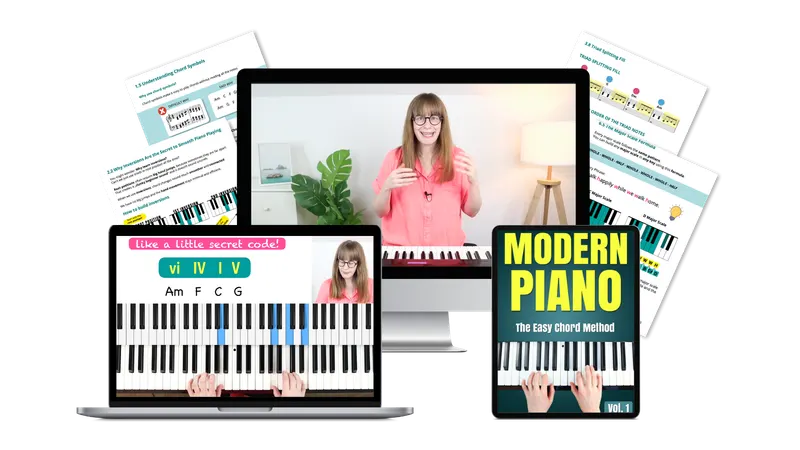 Want to improvise like this?Modern Piano 1In my course I explain step by step how to play piano freely with chords and improvise in exactly this style, with a clear and structured system.Learn more about the course →
Full transcript
Prefer to read along? Here's everything I say in the lesson. Click a time to jump to that moment in the video.
Video transcript · about 1,600 words
How to improvise emotional piano music
Have you ever sat at the piano wanting to improvise something emotional, but had no idea where to start? In this video, I am going to show you three insanely beautiful piano melodies that sound professional, emotional and deep. The best part: you don't need to know a thousand scales or complex music theory. We will use a simple system that works instantly and sounds amazing right away.
If you are new to the channel, don't forget to subscribe and give the video a thumbs up right now. By the way, you can also download a free PDF that goes along with this lesson. You will find the link below in the video description. So, let's get started.
The chord progression (1–6–4–5 in G major)
Today's chord progression consists of G major, then we go to E minor, then we go to C major, and then we go to D major. This means that we are using a 1–6–4–5 progression. Okay? So this is the one chord. This is the six chord. This is the four chord. And this is the five chord in the key of G major.
But now, instead of playing these chords as simple block triads, we are going to play them in arpeggios, because like this it would sound very muddy down here. Okay. So what I'm about to show you now is one of the most beautiful left-hand patterns out there, and I will show you how it works.
A beautiful left-hand arpeggio pattern
So we take the chord tones and rearrange them slightly.
Applying the arpeggio to all chords
First we play the root, then we go straight to the fifth, and then we take the third, which is normally in the middle of the chord, but we play it one octave higher. Okay? So G, D, B. Do you hear how beautiful that sounds? And we will apply the same principle to the other chords as well. So that means when we have the E minor, we play the root note, the fifth and the third up here.
Make sure to also use your sustain pedal. Then the next one, the C major. This sounds way too deep here. And what we are doing here is also taking the root and the fifth, and the third we are putting on top here. Then the last one: here also root note, fifth, and then the third, which is the F♯. Okay.
So let's do this together. 3 4, 1 2 3 4, 1 2 3 4, 1 2 3 4, 1 2 3 4. And again, 3 4. Now E minor. 3 4. C major. 3 4. And D major. Wonderful. And then start again with G major.
And make sure to prepare it well so you can play it smoothly, because the better you can play this chord progression in the left hand, the more you can concentrate on the right hand later. Okay? And by the way, if you haven't downloaded the PDF with the sheet music yet, now is the perfect time. You will find the link down below in the comments or in the video description.
Why improvising feels overwhelming
Okay. And now I will show you what you can play in the right hand if you want to improvise. And a common problem is that someone says: just use the notes of the G major scale. Okay, when you want to improvise in the key of G major, then just take the notes of the G major scale. But this can feel very overwhelming, because you don't know where to start. And that's why I like to use a simple trick.
And the trick is that we limit our note choices. And we will start now with the notes of a Gsus2 chord. The Gsus2 consists of G, A and D. Okay, these three notes. And we will improvise now using only these three notes.
Melody pattern 1
And the rhythm is also predefined. So the left hand plays the first three notes, like 1 and 2, and then the right hand takes over: and 3 and 4 and. Okay. So you are playing the three notes of the Gsus2 up and down. Okay. So 1 and 2 and 3 and 4 and, 1 and 2 and 3 and 4 and. Okay. So, and this is everything you need, because you will play the same melody now in every bar.
Look, we will start with G major in the left hand. 1 and 2 and 3 and 4 and, and now you are going to E minor. 1 and 2 and 3 and 4 and. C major. Now D major in the left hand, and then you can begin again with G major.
Okay. So let's practise this together. So prepare your fingers for the Gsus2, and then 3 and 4 and. 1 and 2 and 3 and 4 and. 1 and 2 and 3 and 4 and. 1 and 2 and 3 and 4 and. 1 and 2 and 3 and 4 and. C major, D major.
Okay. All right. And what makes the whole thing so beautiful is that you play the same melody pattern in every bar, and the pattern stays the same, but you are only changing the chords in the left hand, and this creates wonderful harmonies for us. And that was melody pattern number one.
Now let's add a special trick. We will now add one more note that really gives you goosebumps, and it's the major seventh. So if we are starting from a G major triad, then the major seventh is the F♯. And you can find the major seventh easily by just imagining the root note of the chord one octave higher in your mind, and then moving one half step down.
Okay? So this is like a treasure map. You have the G major triad. We take the root note, put it one octave higher, and then a half step down. This is the major seventh of a major triad. Okay? And now we are keeping the three notes of our Gsus2 chord. And we don't take the F♯ here. We just put it one octave lower. And like this, all the notes are closer together.
Melody pattern 2
And what we are going to do now for our next melody is that we just play the notes from top to bottom and then just go back to the G. Okay, like this. And now we will add the left hand, and we are using exactly the same rhythm. So we are starting. 1 and 2 and 3 and 4 and, 1 and 2 and 3 and 4 and, 1 and 2 and 3 and 4 and, 1 and 2 and 3 and 4 and.
Okay. And then you go back to the G major. And if you play this a little bit faster and practise this, this is going to be, yeah, very beautiful. Yeah. Okay. So, this was melody number two.
And now I will show you a third melody pattern, which is also incredibly beautiful and uses the same notes. Here we won't take the A, but we will only play G, D, G and F♯. Do you hear this? And this is our next melody.
Melody pattern 3
And this melody sounds higher and creates a nice sense of lift and intensity. And I think this sounds really emotional. And I would say let's listen to how this sounds with both hands together. 3, 4. Again. E minor, C major, D major, back to G major.
Combining all melody patterns
Wonderful. So the great thing is, now you have three different options, and we can even play them all one after another. So let's begin with the first melody, which contains just the notes of the Gsus2 chord. 3, 4. Again. Now. This is the second melody again. This is the third one. Again.
Yeah. And like this you have a nice, beautiful idea of what you can play when somebody asks you to play something. Yeah. And I think this will always sound good, and people will like it when you are playing things like this on the piano.
Playing in higher octaves
And if you want to add even more contrast, you can play everything one octave higher, like this. Okay. And I think when you play this in the higher octaves, it instantly becomes more emotional, because the higher notes naturally sound a little bit more expressive.
Creative variations and note choices
And of course you can start experimenting with these four notes here. And maybe you can also add the B, because it's also inside the G major triad. So you can add the 9 and the 7th. And then you have some beautiful colours you can experiment with. And if you want, you can also change the rhythm a little bit more to get more variety while playing.
Modern Piano 1
And if you like this emotional, expressive improvisation style, make sure to check out my online course, Modern Piano 1. In this course, I explain step by step how to play piano freely with chords and how to improvise in exactly this style. And I will break the entire system down in a clear and structured way, so that anyone can sit down at the piano and just start playing.
And I think it's a wonderful thing if you just want to sit at the piano and have a good time without feeling stuck in notes. And yeah, if you really want to play something beautiful. And you will find more information about the course in the video description below. And yeah, now I would say, if you like this tutorial, give the video a thumbs up, and definitely check out this video here as well. It's another beautiful guide to improvisation. I hope you enjoyed it, and I will see you in the next one.
Questions about this lesson
Which chords does this lesson use?
G major, E minor, C major and D major, a 1–6–4–5 progression in G major. Your left hand plays each as root, fifth and the third an octave higher.
Why use only a few notes?
Because "use the notes of the scale" can feel overwhelming: you don't know where to start. With just three or four notes and the same pattern in every bar, it sounds musical right away, and the changing chords do the rest.
How do I find the major 7th?
Imagine the root of the chord one octave higher, then go one half step down. For G major that's F♯.
Is this for beginners?
Yes, if you can play the four chords. The right hand uses only a few notes and repeats the same melody, so you can focus on the left-hand pattern and the sound.