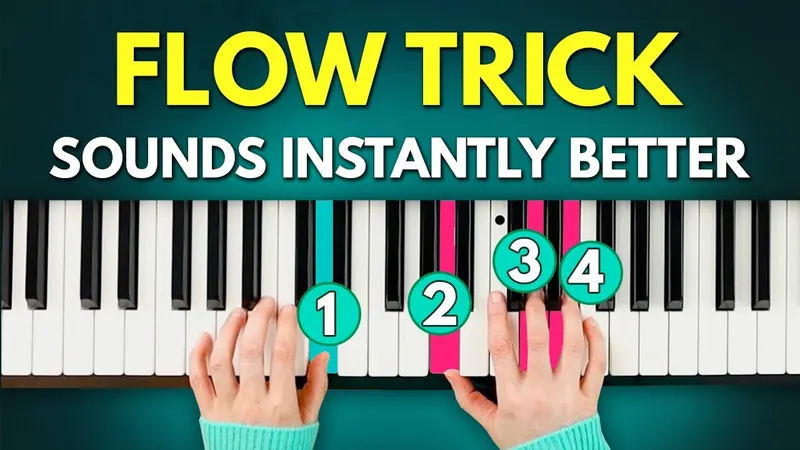
Lesson summary
You play four simple chords, C major, A minor, F major and G major, all in second inversion, so your hand keeps the same shape and only moves. One tiny change, from your fifth finger to your fourth, turns each chord into a sus2 chord. With that you learn two guitar-style patterns: strumming, with the sus2 chord on the "2 and", and fingerpicking, one note at a time. Then you mix them, and try a second progression: D minor, C, A minor and G.
- Four chords in second inversion, with one hand shape
- An easy way to turn each chord into a sus2 chord
- A strumming pattern for both hands
- A flowing fingerpicking pattern
- How to mix the two patterns
- A second progression for a different mood
Before you start
The chords C major, A minor, F major and G major. An inversion is the same notes in a different order; here every chord is in second inversion, and I show you each one.
An acoustic piano or a digital piano. A sustain pedal helps the patterns sound fuller.
About 15 minutes a day. Get the coordination comfortable first, and only then speed up.
Step-by-step guide
Here's what the video covers, in seven steps. Click a time to jump straight to that part.
-
Four chords in second inversion
The chords are C major, A minor, F major and G major, all in second inversion: G–C–E, E–A–C, C–F–A and D–G–B. Keep the same hand shape: from C major, move two white keys down to A minor, two more to F major, and one white key up to G major.
CAmFG
-
The sus2 trick
In second inversion, the top note is the third of the chord. Switch it from your fifth finger to your fourth finger, one white key lower: now you play the second (a whole step above the root) instead of the third, and the chord becomes a sus2 chord. C major becomes Csus2 (G–C–D). Practise five, four, five, four on every chord.
-
Pattern 1: strumming
Like strumming a guitar, your right hand moves between the chord and the sus2 chord: the chord on 1, the sus2 chord on "2 and", the chord again on 4, counting 1 and 2 and 3 and 4 and. Your left hand plays the root as an octave: the low note with your little finger on 1, the high note with your thumb on 3. Together, right, left, right.
-
Pattern 2: fingerpicking
Like a guitarist picking the strings, play the notes one at a time: top, bottom, middle, then the sus2 note with your ring finger, which you let ring a bit longer, then bottom, top. Both little fingers start together, and your left thumb plays the root on 3. Practise it slowly, then faster, and it flows beautifully.
-
Combine both patterns
You don't have to choose. Play three bars of strumming and one bar of fingerpicking, or two and two, or alternate them bar by bar. To end, play the C major triad in first inversion.
-
A bonus progression
For a different mood, try D minor, C major, A minor and G major, also in second inversion, with the same sus2 move between your fifth and fourth finger. Play it with both patterns. Then switch between the two progressions, or mix the patterns as you like.
DmCAmG
 Want to use patterns without thinking about every note?Modern Piano 1In my course I show you a simple system to find your chords and inversions much more easily, so you can actually use patterns like this freely.Learn more about the course →
Full transcript
Prefer to read along? Here's everything I say in the lesson. Click a time to jump to that moment in the video.
Video transcript · about 2,200 words
Make simple piano chords sound beautiful
Imagine this. You can take four very simple chords, like C major, A minor, F major and G major, and you can make them sound like this. Or you can make them sound like this. Both patterns are actually inspired by guitar playing. And in this tutorial, I will show you exactly how it works, so that you can turn simple piano chords into something beautiful like this.
And by the way, I've prepared a free PDF for you with everything you need for this tutorial, including the chords, the patterns and the sheet music. And you can download it for free with the link in the video description below. And if you are new here, my name is Melanie. I studied music education. And on this channel, I show you a modern approach to piano playing, using chords, patterns and improvisation to play more freely.
And if that sounds interesting to you, make sure to subscribe to the channel and give this video a thumbs up.
The four simple chords
So today we are going to work with just four simple chords. We will use C major, then we go to A minor, then we go to F major, and then we go to G major. And I'm pretty sure you already know these chords very well, but for today's pattern, we are going to play all four chords in second inversion.
So we have C major in second inversion. Then A minor in second inversion, F major in second inversion and G major in second inversion. So before we continue, make sure you can move comfortably between these four chord shapes. Yeah. So you start with C major. Then you take exactly the same hand shape, yeah, and play it two white keys down. And then again two white keys down, and then everything one white key up. That's the trick. Okay. C major, A minor, F major, G major.
The sus2 trick
All right. And now we are going to take each of these chords and make one tiny change. Let's start with the C major chord. So here is our normal C major chord in second inversion. And now we are going to turn it into a sus2 chord. But don't worry, it's really easy. Simply switch from your fifth finger to your fourth finger. Okay? So, we have fifth finger, fourth finger, fifth and fourth.
And what we do here is that we simply replace the third of the chord, which is the top note when we play a chord in second inversion. And then we replace this third with the major second, yeah, which is one whole step above the root note. Yeah. And that's it.
And then let's try the same thing with A minor. Okay. A minor, second inversion. And now simply switch from your fifth finger to your fourth finger. Okay. Then the same thing with F major. Okay. Fifth finger, fourth finger. It's easy like this. And then G major: fifth finger, and then fourth finger. Let's repeat this one more time, and let's go through all four chords. Yeah. Five, four, five, four, five, four, five, four. Okay.
Pattern 1: strumming on the piano
All right. And now we are ready to turn these chords into our first beautiful rhythm pattern. And for our first pattern, we think about strumming a guitar. So listen to this. Okay. And now let's break it down. So, as you can see, with your right hand you are going to move between the triad in second inversion and the sus chord we just practised. And then you go back to the regular chord.
And now we add the rhythm. Look, I've marked every place where you play the chord with an x, so you can follow along very easily. Let's count this together. 1 and 2 and 3 and 4 and. Okay, that means you play the chords on 1, "2 and" and 4 and, and on the "2 and" you play the sus2 chord. So let's count it evenly together. 1 and 2 and 3 and 4 and, 1 and 2 and 3 and 4 and.
Okay. And we will use exactly the same rhythm for all the other chords too. So we are just going through the chords. 1 and 2 and 3 and 4. Now A minor. 1 and 2 and 3 and 4 and. Then we go to F major. 1 and 2 and 3 and 4 and. And G major. 1 and 2 and 3 and 4 and. So practise this with me together. 1 and 2 and 3 and 4 and. 1 and 2 and 3 and 4 and. 1 and 2 and 3 and 4 and. 1 and 2 and 3 and 4 and. Okay. All right.
And now we just need to add the left hand. And luckily the left hand is really simple. We are going to play the root note of each chord as an octave. That means for C major we will play root and octave on the C, then A minor, then F major, then G major. Okay? And now on beat one, we play the lower note with the fifth finger. And on beat three, you play the same note one octave higher with your thumb. Okay.
So for C major, we would play 1 and 2 and 3 and 4 and. And I've marked these notes with an L for left hand as well, so you can see exactly when the left hand comes and when the right hand comes. So let's put both hands together. Prepare your right hand for C major, second inversion. So let's start. On the 1, you play both hands together. 1 and 2 and 3 and 4 and. Again. 1 and 2 and 3 and 4 and.
Okay. 1 and 2 and 3 and 4 and. So you are starting with: together, right, left, right. Together, right, left, right. And then once you've got this rhythm, you are doing the same thing with all the other chords too. Yeah. A minor. 1 and 2 and 3 and 4. And then you go to F major. 1 and 2 and 3 and 4 and. 1 and 2 and 3 and 4 and.
Okay. So, let's practise that together. I will also show you when I use the pedal. So, 1 and 2 and 3 and 4 and. 1 and 2 and 3 and 4 and. 1 and 2 and 3 and 4 and. 1 and 2 and 3 and 4 and. 1 and 2 and 3 and 4 and. 1 and 2 and 3 and 4 and. 1 and 2 and 3 and 4 and. 1 and 2 and 3 and 4 and.
Okay. So, don't worry about playing it fast yet. First, make sure the coordination feels comfortable, and then you can speed up the tempo.
Okay. All right. And if you love playing piano this way, but you still struggle to find your chords and inversions quickly, that's exactly what we work on in my Modern Piano 1 course. I show you a simple system that helps you find your chords and inversions much more easily, so you can actually use patterns like this without having to think about every single note. And you will find the link below in the video description if you would like to check it out.
Pattern 2: fingerpicking on the piano
But now let's take the exact same four chords and create a completely different sound. This time we are going to borrow another idea from guitar playing, and it's called fingerpicking. So instead of strumming the strings up or down, a guitarist can pick the strings one at a time. Okay? And that's what creates this beautiful flowing sound. So let's try to imitate this on the piano. Listen. Isn't this beautiful?
And again, it's much easier than it sounds. And I would say, let's start with the C major chord. Get your right hand ready as if you were going to play the second inversion. But instead of playing all three notes together, we are going to play them one at a time. Look, you just have to follow the yellow letters: top, bottom, middle, ring. Yeah, let it ring. And then bottom, top.
Okay. The ring finger lasts a bit longer. So top, bottom, middle, ring, bottom, top. Bottom, middle, ring, bottom, top. Wonderful. And now you just take this pattern and apply it to all the other chords too. So you are starting with C major. 1 and 2 and 3 and 4 and. 1 and 2 and 3 and 4 and. 1 and 2 and 3 and 4 and. 1 and 2 and 3 and 4 and. Okay, so that's it.
And now we just have to combine it with the left hand. So go back to C, second inversion. And then we just try it out with the C major chord. Okay. So both pinkies start. Top, bottom, middle, ring, left, bottom, top. Okay. So on the 3, there you can see, you play the C with the thumb. Top, bottom, middle, ring, left, bottom, top. Okay. Again. Yeah. 1 and 2 and 3 and 4.
So practise this slowly, and then you can apply it to all the other chords too. 3 and 4 and. 1 and 2 and 3 and 4. 1 and 2 and 3 and 4 and. 1 and 2 and 3 and 4 and. And if you play this a little bit faster, you have this beautiful, flowing fingerpicking style.
Combining both patterns
Okay. All right. But here is my favourite part. You don't have to choose between these two patterns. You can also mix them. For example, let's play the strumming pattern for the first three bars and then switch to the fingerpicking in the last bar. Okay, that would sound like this. Yeah. And so on and so on. Now let's try two bars of the strumming style and two bars of the fingerpicking style.
Okay. All right. And now let's alternate them. So in bars one and three we use the fingerpicking style, and in bars two and four the strumming style. Yeah. When you want to come to an end, you can just play the C major triad in first inversion. I think this is a good way to end the improvisation.
And I think this is really beautiful, because, you know, all we did is that we just used these four simple chords, C major, A minor, F major, G major, okay? And turned them into something beautiful. And then we learned the two different patterns. And that's what gives you so many possibilities at the piano.
A bonus chord progression
And if you want even more variety and a little more depth in your playing, you can simply try the same idea with another chord progression. Let's take D minor, C, A minor, G. And first of all, let's find all four chords in second inversion. That means D minor second inversion, C major second inversion, A minor second inversion and G major second inversion.
And again we can add our little movement to the sus2 chord. Yeah. So you change between your fifth and your ring finger. And this is so easy. Yeah. D minor, Dsus2, C major, Csus2, A minor, Asus2, G major, Gsus2. And now let's try our rhythmic strumming pattern with this new chord progression.
Yeah, really beautiful. We just used the same idea, but a completely different mood. And now we can take the same chords but use the fingerpicking pattern. Yeah. And if you want to come to an end, simply play a G major triad in first inversion. A minor, G major, and then C major in first inversion.
Switching between both progressions
And of course, you can also switch between the two different chord progressions. Let's say you could start with C, A minor, F and G. And then you could go on with D minor, C major, A minor, G major, and then you have a really beautiful exercise. Yeah. Or you can do the same thing with the fingerpicking pattern. First start with the higher chord progression. Now D minor.
Okay. All right. So that's it. And of course you could also repeat the first chord progression once and then go to the next chord progression, or you could also mix the different rhythm patterns. And that's how just a few simple chords can give you so many different possibilities.
I think it's really fun to take ideas from another instrument, like the strumming and the fingerpicking on the guitar, and see how we can use them on the piano. So definitely try this out and experiment with the patterns yourself. And don't forget to download the free PDF below. You will find everything from today's tutorial in there, so you can practise it at your own pace. And if you enjoyed this video, please give it a thumbs up and subscribe to the channel.
Play chords and inversions freely
And if you would like to become really comfortable with chords and inversions and learn how to use them freely at the piano, take a look at my Modern Piano 1 course. You will find the link below as well. So have fun playing, and I will see you in the next one.
Questions about this lesson
What is a sus2 chord?
A chord where the third is replaced by the second, a whole step above the root. C major (C–E–G) becomes Csus2 (C–D–G). In this lesson you get there by moving one finger.
Why are all the chords in second inversion?
Because then your hand keeps the same shape and only moves along the white keys. And the top note is the third, so the sus2 trick is just one finger, from five to four.
Do I need to play the guitar to understand this?
No. The patterns are only inspired by the guitar: strumming the strings together, or picking them one at a time. On the piano it's simply chords and broken chords in a certain rhythm.
How do I end the improvisation?
With the C major triad in first inversion. In the bonus progression, I end with G major in first inversion, A minor, G major and then C major in first inversion.