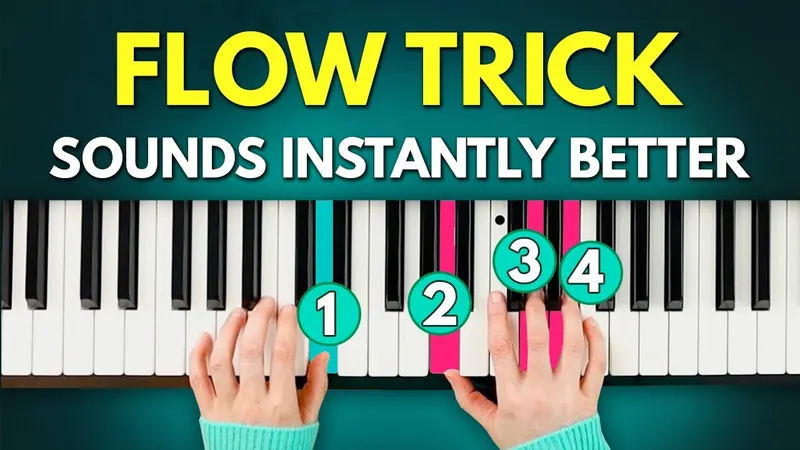
Lesson summary
Normally your left hand plays the root of each chord. Here it stays on C, while your right hand plays C major, G major, F major and G major: that's a pedal point, harmonies moving over one bass note, and it instantly sounds more exciting. You play it in four rhythms, from quarter notes and offbeat thumb notes to arpeggios and an advanced two-hand pattern, and then add new colours with inversions and other keys.
- What a pedal point is and why it sounds exciting
- The progression C, G over C, F over C, G over C
- Four rhythms, from easy to advanced
- Offbeat notes with the left thumb
- How inversions give the chords new colours
- How to use the trick in other keys
Before you start
The chords C major, G major and F major (triads: three notes). For the last part it helps to know inversions, the same notes in a different order.
An acoustic piano or a digital piano.
About 15 minutes a day. Take one rhythm at a time; the fourth one needs some coordination practice.
Step-by-step guide
Here's what the video covers, in six steps. Click a time to jump straight to that part.
-
Chords over one bass note
Usually your left hand plays the root of each chord. Now play C major, then switch to G major with only your right hand, while your left hand stays on C. Then F major over C, and G major over C again. This is called a pedal point: the harmonies change on top while the bass note stays the same. It sounds tense, exciting and much more interesting.
CG/CF/CG/C
-
Idea 1: quarter notes
Play the chords in your right hand as quarter notes, four per bar, counting 1 2 3 4, over the C in your left hand: C major, G major, F major, G major.
-
Idea 2: offbeat thumb notes
Add offbeat eighth notes with your left thumb, while your little finger holds the C for the whole bar. In bars 1 and 3, add one on the "4 and"; in bars 2 and 4, on the "3 and" and the "4 and".
-
Idea 3: arpeggios from the top
Instead of playing the chord notes together, play them in a pattern: all three notes from the top to the bottom, then once again, counting 1 and 2 and 3 and 4 and. Do it on every chord, then a little faster.
-
Idea 4: an advanced rhythm
This one needs some coordination. Learn each hand on its own first: the left hand has its own rhythm that repeats in every bar, and the right hand plays chord, thumb, chord, thumb, chord. Then put them together very slowly, beat by beat, until it flows naturally. Follow along with me from 8:36; it sounds like a rock song from the 80s.
-
Inversions and other keys
If you're comfortable with inversions, play the right-hand chords in root position, first or second inversion for new colours, combined with any of the four rhythms. You don't always have to use the nearest inversion. Then try the same principle in another key, for example D major.
 Want inversions to flow smoothly?Modern Piano 1In my course you learn from the beginning how to let inversions flow smoothly into your playing, and how to use ideas like this in any key.Learn more about the course →
Full transcript
Prefer to read along? Here's everything I say in the lesson. Click a time to jump to that moment in the video.
Video transcript · about 1,700 words
Intro and welcome
Maybe you can already play some basic chords like C major, G major or F major, but you are searching for new ways to make your music more interesting. Then you are exactly in the right place. In this video, I will show you an amazing trick that will take your piano chords to a completely new level. And if you are new here, don't forget to subscribe to the channel and give this video a thumbs up. And then let's dive right in.
The problem: simple chords sound boring
You have probably already learned that when you play a chord with your right hand, you simply play the root note with your left hand. That means if you play a C major triad, then you play a C in your left hand, or the octave C in your left hand. And when you play a G major triad, then you know, okay, just play the root with your left hand, or the octave in your left hand.
Or if you play an F major triad, then you know, okay, when you just play the root note in the bass, then everything's all right. So far so good. But today, today we do one little thing differently. And the beautiful thing is, it's also very easy.
The trick: moving chords over one bass note
Look, I will play the C major triad now. And then I switch to the G major, but only with my right hand. In the left hand, I simply stay on the C in the bass. Like this. Isn't that genius? And we will do the same with F major. We play F major with the right hand, but in the left hand we stay on the C. And look how beautiful this sounds. Let's go back to the G again. And in the bass, we stay on the C.
What a pedal point is
Okay? And like this, we get very interesting colours. This is known in music as the pedal point. This is when the harmonies on the top change while the bass note always stays the same. So that means we are moving harmonies over the same bass note. And that instantly sounds tense and exciting, and immediately so much more interesting than if we would just play the normal chords the usual way.
Normal chords and pedal point compared
And let's listen to the difference again. These are the normal chords: C major, then G major, F major, G major. And if we apply the trick with the bass note, then this sounds like this. We get C major, then G over C, then F over C, and G over C again.
The chord progression (C, G over C, F over C, G over C)
So this sounds really interesting and beautiful. We start on C major, then go only with the right hand to G major, then only with the right hand to F major, then only with the right hand to G major. Now I want to give you a few ideas of how you can apply this principle practically, and I will also give you a few different rhythms at different levels.
By the way, you can also download the free PDF with the sheet music for this lesson. Just have a look below in the video description. There you will find a link to download it.
Idea 1: quarter notes
Idea number one. Here we play the chords in the right hand just as quarter notes. So we start on C major, like 1 2 3 4, 1 2 3 4, 1 2 3 4, 1 2 3 4. Play along with me. We start on C major. Right. Then go to G major, to F major, and back to G major.
Idea 2: offbeat thumb notes in the left hand
Let's look at idea number two. Here we add some offbeat eighths with the left thumb. Let's say in bars one and three we will add an extra offbeat note on the "4 and", and in bars two and four we will add an extra offbeat note on the "3 and" and the "4 and". Okay, let's look how this sounds. 1 2 3 4 and, 1 2 3 and 4 and. 1 2 3 4 and, 1 2 3 and 4 and, 1.
Okay. And I only play the offbeat note with the thumb, while the pinky is waiting the whole bar. Okay? Like 1 2 3 4 and, 1. So another time together. 3 and 4 and. 1 and 2, 3 and 4 and. 1 and 2 and 3 and 4 and. 1 and 2 and 3 and 4 and. 1 and 2 and 3 and 4 and, 1.
Idea 3: an arpeggio from top to bottom
Now, idea number three. Here we will build in some nice arpeggios. That means we don't play the chord notes all at once, like this. Instead, we play the chord notes in a specific order, like a pattern. Let me explain. So, we start from the top to the bottom. Play all three notes down. And then once again, but the rhythm goes like this. 1 and 2 and 3 and 4 and.
Same thing on G major. 1 and 2 and 3 and 4 and. Now F major. 1 and 2 and 3 and 4 and. And back to G major. 1 and 2 and 3 and 4. Play along with me. 1 and 2 and 3 and 4 and. 1 and 2 and 3 and 4 and. 1 and 2 and 3 and 4 and. 1 and 2 and 3 and 4 and.
Let's do it a little bit faster. 3 and 4 and. Now G over C, F over C, and G over C. Once again. 1 and 2 and 3 and 4 and. 1 and 2 and 3 and 4 and. 1 and 2 and 3 and 4 and. 1 and 2 and 3 and 4. Okay. All right. And now I'm curious which of these three rhythms you like the best so far. Write me in the comments below.
Idea 4: an advanced rhythm
And now we come to the last rhythm that I want to show you. This rhythm is already a bit more complex, and I will play it for you first. I've notated above what exactly the two hands are doing. And by the way, the sheet music for this tutorial you can also download. Check the video description or have a look in the comments. There you will find the link.
The left-hand rhythm step by step
So let's have a look at the last rhythm together. Let's have a look at the left hand first. Here we are playing 1 and 2 and 3 and 4 and. Okay. 1 and 2 and 3 and 4 and. And this you repeat exactly like this in every bar. So 1 and 2 and 3 and 4 and, 1 and 2 and 3 and 4 and, 1 and 2 and 3 and 4 and, 1 and 2 and 3 and 4 and. So this is the left hand.
The right-hand rhythm step by step
And now let's have a look at the right hand. Okay. So here you start with all three notes of the chord. 1 and 2 and 3 and 4 and. So we have chord, thumb, chord, thumb, chord. Okay. 1 and 2 and 3 and 4 and. Chord, thumb, chord, thumb, chord.
Both hands together
So once you have that, you can try to play both hands together. So on the 1 we play. 1 and. This is the first step. 1 and. Then you start with the right hand alone. Okay. 1 and 2 and. Okay. 1 and 2 and. So until here, once again: 1 and 2 and.
Then on the 3 comes the thumb next, and you play thumb, thumb. Okay. 1 and 2 and 3 and. Yeah. 3 and, thumb, thumb. 1 and 2 and 3 and 4 and. Yeah. On the 4 we play "4 and": right, left. Once again, the whole bar. 1 and 2 and 3 and 4 and. Once again. 1 and, thumb, chord, thumb, thumb, chord, thumb. 1 and 2 and 3 and 4 and.
And you can do this faster and faster. Yeah. Until it just flows naturally. And then you are doing the same rhythm on the G major. And in the left hand you are staying on the C. Yeah. 1 and 2 and 3 and 4 and. F major, and back to G major.
Play-along with the full rhythm
Let's play the whole chord progression once again. So we start. 3 and 4 and.
Inversions for richer sounds
Okay. All right. And I think this sounds like a rock song from the 80s or so. Now, one pro tip at the end. If you are comfortable with inversions, then you are going to really enjoy this, because it sounds really great. You can now of course also play the inversions of the chords above, and then we get new colourings of sound.
For example, you could play C major in root position, in first inversion or second inversion. Or when you go now to the G major, there you can also play the root position, first or second inversion. Same thing with F major. Look, this is root position, first inversion, second inversion. And then you get really different variations of how this can all sound.
Mixing inversions and rhythms
And then you can try out one of the four rhythms and try out some different inversions. For example, when we take the arpeggios, and I start with C major in second inversion, G major root position, F major first inversion, and back to C major in the second inversion. Look how differently this starts to sound. And you don't always have to use the nearest inversion. So feel free to move over the whole keyboard.
And if you still struggle to find chords and inversions so quickly, then I warmly recommend my course, Modern Piano 1. There you learn from the beginning how to let inversions flow smoothly into your playing. And you will find the link below in the video description.
An example in D major
And I have another tip for you. Also try other keys. That's also a principle that I explain in my course, and it's really fun when you try examples like this in other keys as well, because then it sounds completely different, and it can bring you totally new inspiration. For example, I will now do the same principle in the key of D major.
Outro
So really, really nice. And that's it for today's video. I hope you are now well stocked with input. And don't forget to subscribe to the channel so you don't miss any piano tips. And I hope to see you soon in my online course or in the next video.
Questions about this lesson
What is a pedal point?
It's when the harmonies on top change while the bass note stays the same. In this lesson your right hand plays C, G, F and G major while your left hand stays on C.
What do G/C and F/C mean?
They're slash chords: G major (or F major) in your right hand, with a C in your left hand. The note after the slash is the bass note.
Which rhythm should I start with?
Idea 1, quarter notes. Then add the offbeat thumb notes, then the arpeggios. The fourth rhythm is more advanced: practise each hand alone first.
Does this work in other keys?
Yes. Keep the bass note of the key and change the chords on top. In the video I show it in D major, and it sounds completely different and brings new inspiration.