Lesson summary
The melody lives in an A minor hand shape: A and E, then B and E, C and E, D and E, each twice, in 3/4 time. The left hand plays F major, G major, A minor and G major, two bars each, first as two outer notes, then in two flowing patterns. Then you improvise on the white keys, the notes of A minor, with six rhythm patterns, add octaves, and put everything together into your own piece.
- A simplified version of the Interstellar theme
- Three chords and three left-hand patterns
- When to change the sustain pedal
- Six rhythm patterns for improvising
- Repeating patterns that make improvising easy
- How to build your own Interstellar-inspired piece
Before you start
The triads F major, G major and A minor, and how to count in 3/4 time (1 2 3, 1 2 3). The fifth of a chord is its top note in root position; the third is the middle one.
An acoustic piano or a digital piano with a sustain pedal.
About 15 to 20 minutes a day. Learn the melody and the first left-hand pattern first; the improvising can grow slowly over a few weeks.
Step-by-step guide
Here's what the video covers, in seven steps. Click a time to jump straight to that part.
-
The melody
Think of the hand position of an A minor chord and play only the two outer notes, A and E, twice. Then move the bottom note up one white key: B and E, twice. Then C and E, twice, and D and E. At the very end play D, E, B, and start again on A. It's in 3/4 time: count 1 2 3, 1 2 3.
-
Left-hand pattern 1: two outer notes
The chords are F major, G major, A minor and G major, two bars each. Leave out the middle note and play only the two outer notes: F and C, G and D, A and E, G and D. Your thumb and pinky just shift together: one key up, one key up, one white key down. Change the sustain pedal each time the chord changes.
FGAmG
-
Left-hand patterns 2 and 3
For pattern 2, play the root, go with your index finger directly to the fifth, and move the third up one octave: F, C, A, twice. Then G, D, B; A, E, C; and G, D, B. For pattern 3, keep going: move back and forth between the fifth and the top note, F, C, A, C, A, C. You'll find all three patterns in the free PDF; they work for any chord progression.
-
Improvise with one note per bar
You can use all the white keys, the notes of the A minor scale. Focus on the rhythm first. Rhythm pattern 1: play one note on beat 1 of each bar, any white key you like. Pattern 2: sometimes let a note ring for two bars, which gives the music space. Pattern 3: build up energy with a few bars of a note on every beat.
-
Eighth notes and repeating patterns
Pattern 4: use eighth notes to lead into the next bar. Pattern 5: fill a whole bar with eighth notes, which go note on note with the left hand. Pattern 6: continuous eighth notes. To make that easy, use a repeating pattern: in the A minor shape, alternate between the two outer notes, then move one white key up, and up again, then back down to the B. Or, inspired by the Amélie soundtrack, play three notes with the root doubled as an octave, from bottom to top, and move up while the middle note stays. Watch my hand in the video.
-
The octave trick
To make your improvisation sound bigger, play octaves instead of single notes, starting with rhythm pattern 1, then vary the rhythms.
-
Build your own piece
Start with the melody and left-hand pattern 1, then move on to pattern 2 and pattern 3. Then improvise: soft and peaceful with long notes first, then vary the rhythm, use patterns, then octaves. Four, eight or sixteen bars are enough. Come back to the calm pattern and the melody, and end on F major 7: F and C in the left hand, A and E in the right hand.
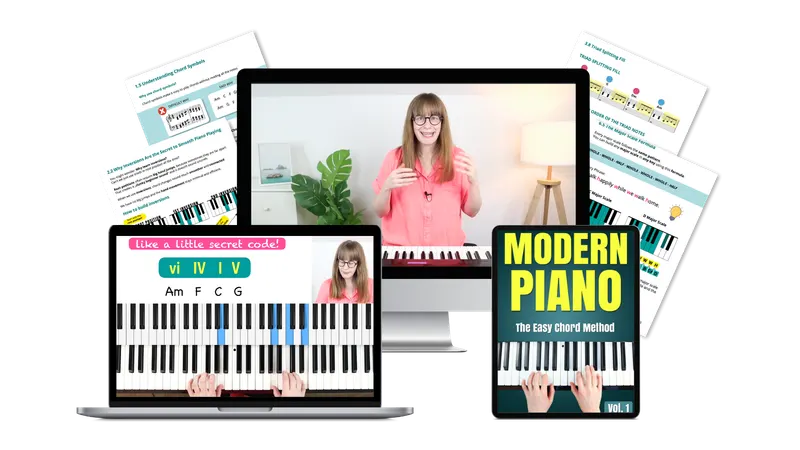 Want to make your own music with chords?Modern Piano 1My course Modern Piano 1 is for people with a little piano experience who want a different approach: how to play with chords, create beautiful left-hand patterns and become confident playing freely without sheet music.Learn more about the course →
Full transcript
Prefer to read along? Here's everything I say in the lesson. Click a time to jump to that moment in the video.
Video transcript · about 2,700 words
How to play Interstellar by Hans Zimmer
Interstellar by Hans Zimmer is one of the most beautiful and emotional movie soundtracks of all time. And in this tutorial, I will show you how to play a simplified version of the famous theme, and how to create your own beautiful improvisations. And the best part is that we only need three simple chords. And if you are new here on this channel, please give this video a thumbs up, and don't forget to subscribe. And then let's get started.
The melody: which notes to play
Let's start with the melody first. It's very easy to remember. Just think of the hand position when you play an A minor chord. Okay? We start with just the two outer notes, A and E. And we play these two notes twice, like this. A, E, and then again A, E. And then we move up just one white key from the bottom. And now we play B, E, and again B, E. Then we move up another white key from the bottom, and we play C, E, and again C, E.
And finally we move up to the D, and we play D, E. And at the very end we play D, E, B. And then it starts again from the beginning, on the A. And that's already our melody. So let's play the whole thing together. We are playing in 3/4 time. That means we always count 1 2 3, 1 2 3. Okay. So like this: 1 2 3, 1 2 3. Okay. I will count us in, and then we begin together on the 1.
Okay. 1 2 3, 1 2 3, 1 2 3, 1 2 3, 1 2 3, 1 2 3, 1 2 3, 1 2 3, 1 2 3, 1 2 3. Yeah. And so on and so on. So play the melody several times and practise this.
The chord progression
And now let's take a look at the chords. We only need three different chords. Look, our chord progression is F major, G major, A minor, and back to G major.
Three left-hand patterns
But now we will always leave out the note in the middle, and we are only going to play the two outer notes of each chord. That means for F major you play F and C. For G major, G and D. For A minor, A and E. And then back to G and D. And have a look at the movement, because you just shift your thumb and pinky both one key up. Yeah. Again one key up. And then one white key down. Yeah. It's like a parallel movement.
Let's try this. Now the thing is, you play every chord twice. That means we are playing 1 2 3, 1 2 3, 1 2 3, 1 2 3, 1 2 3, 1 2 3. Back to G. 1 2 3, 1 2 3. And then everything starts from the F major chord again.
Okay. So now let's put both hands together. The left hand goes to F and C. And for the right hand, think of A minor, and then just start with the two outer notes. Okay. 1 2 3, 1 2 3, 1 2 3, 1 2 3, 1 2 3, 1 2 3, 1 2 3, 1 2 3. Again. 1 2 3, 1 2 3, 1 2 3, 1 2 3, 1 2 3, 1 2 3, 1 2 3, 1. Wonderful.
And now remember to use the sustain pedal. So each time the chord in the left hand changes, you also change the sustain pedal. So when you are starting, the pedal goes down. Now when you change the chord, as soon as you press down the new keys, the pedal goes up, down. Next chord: pedal goes up, down. And also when you are changing back to G major, then again and again. Okay.
And I think it's absolutely fascinating how Hans Zimmer creates such an emotional atmosphere with just a few simple chords and a beautiful simple melody like this. And by the way, if you would like to learn more about playing piano with chords, I have a complete course called Modern Piano 1, where I teach you this approach step by step. You will find the link in the description below.
Now, I want to show you a second left-hand pattern you can also use. It sounds like this. And here is the trick. Look, we are starting with F major, and we start with the root. Then we go directly with the index finger to the fifth, and then we just move the third, the middle note of the chord, up one octave. Okay. So we are playing F, C, A. And repeat this once more. F, C, A.
Let's do the same thing with G major. This is the G major chord. And we take the middle note and put it just one octave higher. And then we get G, D, B. And then again G, D, B. Okay. Same thing for A minor. Just take the third and put it at the top. Okay. And then you play A, E, C, and then again A, E, C. And then G major again. You already know it. G, D, B, and once again G, D, B.
All right. So let's do that once more, just the left hand alone. 1 2 3, 1 2 3, 1 2 3, 1 2 3, 1 2 3, 1 2 3, 1 2 3, 1 2 3, 1. Okay. All right. And now let's put both hands together again. So right hand: A minor, just the two outer notes, and then we start. 1 2 3, 1 2 3, 1 2 3, 1 2 3, 1 2 3, 1 2 3, 1 2 3, 1 2 3, 1 2 3, 1 2.
Okay. All right. And that's it. So, we are already getting a lot more movement, and the music starts to feel more flowing with this new left-hand pattern. Now, let's take this one step further. This time, we are going to keep the movement going. So, instead of stopping at the top note, we move back and forth between the fifth and the top note. Okay? So for F major we play F, C, A, C, A, C. And once more: F, C, A, C, A, C.
And we use exactly the same idea for the other chords too. So for G major, G, D, B, D, B, D. For A minor, A, E, C, E, C, E. A, E, C, E, C, E. And back to G major. G, D, B, D, B, D. Okay, so practise this, and make sure to use the sustain pedal. You will also find the three left-hand patterns, which you can use for any chord progression, in the free PDF sheet I prepared for you. The link is in the video description below.
The A minor scale for improvising
And now comes my favourite part, because we are going to create our own beautiful melodies now. And the great thing is, you can use all the white keys, because we are basically using the notes of the A minor scale. Okay? So you don't have to worry too much about which notes to play. Of course, some notes will sound more peaceful, while others create a little more tension, but when you are just starting out, I recommend focusing on something else first, and that's the rhythm.
Rhythm patterns for improvising
Because finding beautiful notes is one thing, but playing them in a nice rhythm can be just as challenging. So, let's make this really simple. Look, in this first rhythm pattern, we will just play one note on beat 1 of each bar. Okay? So, the X's in the sheet music simply mean that you can choose the pitch yourself. So don't overthink it. Just pick any white key and see what happens. Okay? So, maybe this could sound like this. Yeah. Or you are taking other notes, like maybe this.
Yeah, it's easy like this. So try to let go of the idea that every note has to be perfect. This is how you start feeling more comfortable with improvisation. And after a while, you will naturally discover little melodies that you like. And by the way, if you want to learn how to improvise beautiful melodies on the piano, but you really want to learn it with a system and a method behind it, then you will love my online course, Modern Piano 1. I will link it for you in the description below.
And now I will show you a second rhythm pattern you can use, because if we always play one note in every bar, it can sound a little predictable or repetitive. So let's add some variety. So you can already see it: sometimes, instead of playing a new note, we will simply let it ring. Yeah. And then we just play it for two bars. So I will play you an example. Maybe you could play something like this.
And can you hear how this creates a little more space? And that's so important when we want the music to sound emotional. We don't always need to play more notes. And if you would like to have all these rhythm patterns in one beautiful, easy-to-follow overview, I've prepared a free PDF guide for you. You can download it using the link below.
Okay. Now, rhythm pattern number three, I would say. Now, let's slowly build up the energy. And one simple way to do this is to add a few bars where we play a note on every beat. Yeah. Like this: 1, 2, 3. 1, 2, 3. And in the other bars, we are just playing one note on beat 1. Okay. So, let me play you an example. Maybe you could play something like this. Yeah, for example. And remember, you can choose any white keys for these notes. And we are just focusing on the rhythm now.
So let's have a look at rhythm pattern number four. Now let's make our melody a little more interesting by adding eighth notes. And one idea I really like is to use them to lead into the next bar. Look, here you have the eighth notes, here too. I will show you an example how this could sound. Isn't this beautiful? Yeah. And you can really hear how this leads to the next one.
But I would say, let's take this a little further. Here comes rhythm pattern number five. And I would say, let's try inserting more eighth notes. Now look, we are going to fill an entire bar with eighth notes. Yeah. So we count 1 and 2 and 3 and. And the best thing is that it goes along with the left hand. Yeah. Because here you have note on note. Okay. So let's insert some beautiful notes here for the X notes. And yeah, maybe you could play something like this. Yeah, for example.
And now let's really take it to the next level. We are going to play continuous eighth notes in the right hand now. But I tell you, playing six different notes in each bar spontaneously can be very challenging. Try to use repetitive patterns. For example, let's do a pattern which is a little bit inspired by the famous intro. Okay? So remember the A minor chord in the right hand, and then you begin with the two outer notes, and then you can just play this in eighth notes.
Yeah. Now, one white key up. One white key up. And then you maybe go down to the B again. And that's so easy, but it's so beautiful when you combine both hands now. Yeah. So, it's very, very beautiful when you combine your improvisations with ideas like that, when the whole thing really begins to flow.
And now I will show you a second idea for a repetitive pattern you can use. And this one is maybe a little bit inspired by the famous soundtrack of Amélie. You know, there you also have these octave patterns. So just think of the A minor triad again. Take the first two notes, and then just double the root note as an octave. Okay? And then you just play these three notes from bottom to top. Then you go one white key higher, but the note in the middle stays the same.
Then you go one white key higher with your thumb and pinky, and the note in the middle stays the same. And then back again to the B. And with both hands. That sounds so beautiful. Yeah. And it's so easy to remember. And like this, you don't have the stress that you need to choose six different notes in every bar immediately, because this is really beautiful. And I think with the help of these patterns for the right hand, you will have lots of fun.
The octave trick: a fuller sound
And one extra trick: when you want to make your improvisations sound even bigger, then try playing octaves instead of single notes. So you can start with pattern one. Instead of using single notes, just play octaves. Isn't this beautiful? And then you can start varying the rhythms.
Your own Interstellar-inspired piece: recap
So now, at the end, here is how you can create your own Interstellar-inspired performance. First we start with our original melody and the first left-hand pattern, just like this. And then after that, just move on to the next left-hand pattern, just to get more motion into this. And then you can start with the third left-hand pattern. That was this one.
And then after that you can just begin to improvise. Yeah, just keep going with this left-hand pattern, or use the easier version at the beginning. Keep it soft and peaceful, and then gradually you can build up the energy a little bit more. Maybe start with long notes like this, so that you are starting... Just keep it simple. And then you begin to vary the rhythm a little bit more. Yeah. Or you can use patterns. And then octaves maybe. Yeah. And so on.
So I think this is very beautiful. And remember, you don't have to make this super long. You can just play four or eight bars or 16 bars of improvisation, and then you just come back to the calm pattern. Yeah. So that you are playing... And then you can come back to the first left-hand pattern. Yeah. So maybe this is your last round. Okay. And then you can end the whole thing on these notes. Maybe this is a beautiful F major 7 chord. And yeah, then you have a beautiful ending.
And you see, it's actually incredible how much beautiful music we can create from just three simple chords. You know, so many people download sheet music from the internet and then spend hours trying to copy every single note of a complicated arrangement. And of course, there's nothing wrong with that. But sometimes it can feel like a lot of hard work, and you miss out on so much fun, because, yeah, you don't create the music yourself.
Learn to improvise with Modern Piano 1
And when you just play with chords, then this is a much more creative way of playing. And when you understand chords and a few simple patterns, you can just sit down at the piano and make your own beautiful music. And if you would like to learn how to do this step by step, I can really recommend my course, Modern Piano 1. It's designed for people who already have a little bit of piano experience and want to discover a different approach to playing. I will show you how to play with chords, how to create beautiful left-hand patterns, and gradually become more confident playing freely without relying on sheet music.
And you will find the link in the description below. I hope you enjoyed this tutorial and that it inspired you to try creating your own music. And if you like this video, give it a thumbs up and don't forget to subscribe. And if you love these beautiful epic piano sounds, then I've got another tutorial that I think you will really enjoy. In this video, I show you a pattern that creates instant goosebumps. So, don't skip this. Just click on this video right here. And thank you so much for watching, and have fun practising.
Questions about this piece
Who wrote the music for Interstellar?
Hans Zimmer composed the soundtrack for the film Interstellar, released in 2014. This lesson teaches a simplified version of the famous theme and how to improvise in the same mood.
Which chords do I need for Interstellar?
Only three: F major, G major and A minor, played as F, G, A minor, G, two bars each. In the easiest version, your left hand plays just the two outer notes of each chord.
Which notes can I use to improvise?
All the white keys, the notes of the A minor scale. Some sound more peaceful and some create a little tension, but when you start out, focus on the rhythm first.
Is this version good for beginners?
Yes. The melody stays in one hand position, and the first left-hand pattern only uses two notes. The improvising grows step by step, from one note per bar to eighth notes.