Lesson summary
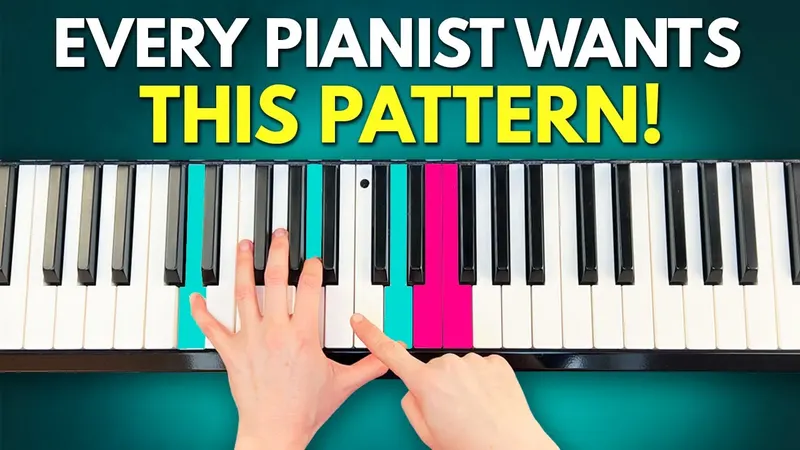
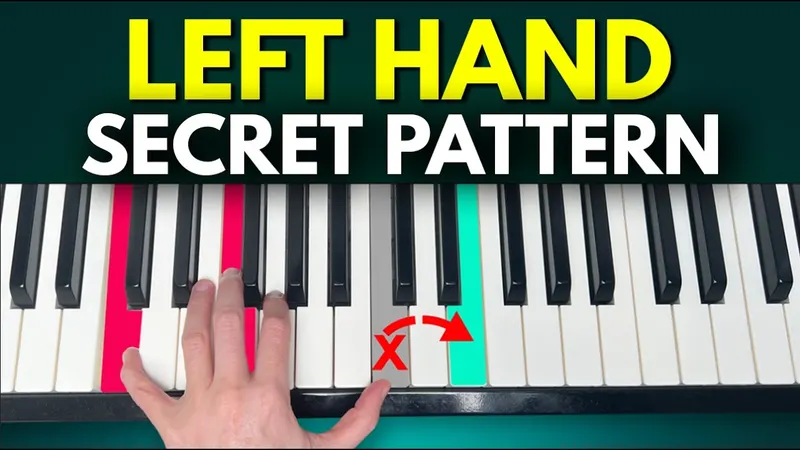
The whole piece is built on one left-hand pattern: 1–5–8–9–10. In part 1 your left hand plays C–G–C–D–E♭, then the same with A♭ instead of G, while your right hand only holds a C. In part 2 the pattern runs through C minor, E♭ major, B♭ major and A♭ major, and your right hand adds a melody from the first five notes of the C minor scale, with a pickup on beat 4. Then you connect both parts and improvise over part 1.
- The 1–5–8–9–10 arpeggio pattern in the left hand
- A small trick that turns C minor into A♭ major over C
- Four chords in C minor with the same pattern
- A melody that starts with a pickup on beat 4
- How to move between the two parts
- First improvising with the C minor scale
Before you start
The C minor triad (C, E♭, G) and how to count 1 and 2 and 3 and 4 and. An arpeggio is a chord played one note after another instead of all together. A pickup is a few notes that lead into beat 1 of the next bar.
An acoustic piano or a digital piano.
About 15 minutes a day. Spend the first days on the left hand only: once the arpeggios run by themselves, the right hand is easy.
Step-by-step guide
Here's what the video covers, in seven steps. Click a time to jump straight to that part.
-
The C minor arpeggio
C minor has the notes C, E♭ and G: the 1, 3 and 5. Play the C, then go with your index finger directly to the G (the 5). Your thumb plays the C one octave higher, then your middle finger crosses over to the D, one whole step above the C, and your index finger lands on the E♭. So the arpeggio is C–G–C–D–E♭. Play it a few times in a row until it sits under your fingers.
Cm
-
One note changes, and the right hand joins
Now play A♭ with your index finger instead of the G: one half step higher. The rest stays the same: C–A♭–C–D–E♭. This is an A♭ major triad over C. Switch between the two versions, one bar each. Then add your right hand: just one note, a C with the thumb, held for the whole bar and played again in every bar, counting 1 and 2 and 3 and 4 and. That's part 1.
CmA♭/C
-
Part 2: four chords, one pattern
The chords are C minor, E♭ major, B♭ major and A♭ major, all in the same 1–5–8–9–10 pattern: C–G–C–D–E♭, then E♭–B♭–E♭–F–G (the first three notes are black keys), B♭–F–B♭–C–D and A♭–E♭–A♭–B♭–C. Count 1 and 2 and 3 and 4 and on each chord. Practise this again and again before you add the right hand.
CmE♭B♭A♭
-
The melody with a pickup
The melody uses the first five notes of the C minor scale: C, D, E♭, F and G. It starts with a pickup on beat 4, counted "4 e and 1". When your pinky arrives on the G on 1, your left hand starts the C minor arpeggio. Do the same pickup into the G on E♭ major. Then play G and E♭ on beat 4 and go to the D as the left hand starts B♭ major. Then D and E♭ on beat 4, and on to the C with A♭ major. Watch my hand in the video for the pickup notes, and play it in a loop.
-
Try other octaves
Play part 2 one octave higher, or in the lower octaves. Down low it can sound a bit muddy, depending on your instrument. Each octave gives the piece a completely different mood, so explore a little, then come back to the middle.
-
Connect the parts and end
Start with the left hand of part 1, then bring in the right-hand C. To go to part 2, count the last bar "1 and 2 and 3 and 4 e and" and start the melody's pickup. To go back to part 1, play "4 and 1" in the last bar. Back in part 1, you can play the left hand alone for a while to calm down, then bring in the C again. To end, play 1–5–8–9–10 once more, go back to the 5, and let your right hand play C, D and E♭.
-
Improvise over part 1
Part 1 is perfect for improvising, because the left hand stays very calm. Start with the first three notes of the C minor scale (C, D, E♭), then use the first five, then go one octave higher and use the whole C minor scale. Keep it easy: even one note per bar sounds really good. No pressure, just search for beautiful melodies.
 Want to improvise freely?Modern Piano 1In my course Modern Piano 1 I show you step by step how to improvise and play freely with chords and patterns. If you always played from sheet music before, this opens up a whole new world.Learn more about the course →
Full transcript
Prefer to read along? Here's everything I say in the lesson. Click a time to jump to that moment in the video.
Video transcript · about 1,800 words
Intro
Have you ever played just a few notes and suddenly got goosebumps? Today I show you an epic piano melody that sounds like movie music. And if you are new to this channel, don't forget to subscribe and give this video a thumbs up.
On this channel, I share all the stuff you don't always learn in regular piano lessons. And by the way, for today's video, you can also download a free PDF with all the exercises. You can find the link below in the video description. So, let's start right away.
Part 1
We have two different parts in this piece. And now we look at the first part, and we will start with the left hand. And here we will start with a C minor triad. But we won't play the normal C minor triad. Instead we are playing an arpeggio. So C minor has the notes C, E♭ and G. And these are the notes 1, 3 and 5. Okay.
But now we play it in a special way. First we will play the C. Then we take the index finger and go directly to the 5, to the G. And then we take the lowest note, the root note, and play it one octave higher with the thumb. And then we are crossing over with the middle finger one whole step above the C. That means we are playing the D with our middle finger. And then we arrive with the index finger at the E♭.
Okay. So the arpeggio goes like this. We start here. C, G, C, D, E♭. Okay. So play that a few times in a row, so that you really get this under your fingers.
Okay. So this is the one thing, and now we are doing a small trick, because now we are going to change one of these notes. Okay. And this is very easy, what we are doing now. Instead of playing the G, we will play the A♭ with our index finger. That means we are going with our index finger just one half step higher. Okay? And the rest stays the same.
So we begin again with the C, go to A♭, C again, and then we are crossing with our middle finger and play the E♭. Okay. So once again, instead of the G we are taking the A♭. Okay. Like this. And we will now switch between these two versions. That means we will begin with the C minor arpeggio. And then we are going to play version two with the A♭. And then back to C minor. And now the other version. And so on and so on.
By the way, the other version, the version two with the A♭ here: this is an A♭ major triad over C. Okay. And here we just decorated this arpeggio a little bit. Okay. So I will play it once more.
And I think this already sounds very beautiful, like film music. Very calm and almost a bit meditative. And now we are going to add the right hand. Okay? And the right hand is very easy. You only play one note here. You will play the note C with the thumb, and you will hold this C for the whole bar. And you will play this in every bar.
So this will sound like this. 1 and 2 and 3 and 4, and then change again. So, it's very simple and very effective. And this is already part one. And just a quick reminder, if you haven't downloaded the PDF with the notes yet, now is the best time. The download link is below in the video description, or you can also find it in the comments below.
Part 2
Now let's look at part number two. Again we start with the left hand. Here the chords are C minor, E♭ major, B♭ major and A♭ major. And we will play all of them in the same arpeggio pattern. Our pattern is 1–5–8–9–10. Then we go to E♭ and we are doing the same. First the three black notes. Then we are crossing over to the F, and then we take the G.
Okay. The next arpeggio is for B♭ major: B♭, F, B♭, C, D. And then the last one is A♭. So we are playing A♭, E♭, A♭, B♭, C. Beautiful. So let's repeat this. We are starting with C minor. 1 and 2 and 3 and 4 and. 1 and 2 and 3 and 4 and. 1 and 2 and 3 and 4 and. 1 and 2 and 3 and 4 and.
Okay. And do this again and again, because you really need to practise this, otherwise you have no chance to get the right hand right. Okay. So play this really a few times in a row, so that you are familiar with these arpeggios.
Now we will have a look at the melody for part number two. Here you start with the first five notes of the C minor scale, and we are starting the melody with a pickup on beat 4, like "4 e and 1". Okay. And we will do this a few times together. 4 e and 1. Play with me. 4 e and 1, 2, 3, 4 e and 1, 2, 3, 4 e and 1, 2, 3, 4 e and 1.
Okay, so this is something very important that we will need, and then we connect the parts. So we start with the pickup, 4 e and, and when you arrive here with your pinky on the G, you start the C minor arpeggio. Okay? 4 e and 1 and 2 and 3 and. Okay. 4 e and 1. Once again, 4 e and 1.
And now we are doing exactly the same on beat 4. Also a pickup, like 4 e and, but then when you arrive at the G here, you are playing the arpeggio for E♭ major. Okay. So we are beginning: 4 e and 1 and 2 and 3 and 4 e and 1 and 2 and 3 and.
Okay. Then on beat 4 we are playing G and E♭. And then we are going to the D, and with the left hand we start our arpeggio on B♭ major. Now on beat 4, D, E♭, and then we go to the C. And when we are on the C, we start the arpeggio for A♭ major. And then again the pickup, 4 e and. Okay. And this you can play in a loop.
So I will show you. 4 e and 1 and 2 and 3 and 4 e and 1 and 2 and 3 and 4 and 1 and 2 and 3 and 4 and 1 and 2 and 3 and 4 e and 1 and 2 and 3 and 4 e and 1 and 2 and 3 and 4 and 1 and 2 and 3 and 4 and 1 and 2 and 3 and.
And then when you want to come to an end, you can play 4 and, and then you are going to the first part again. Okay, where you are doing the trick with the index finger. The part that sounds a bit strange, but also very beautiful at the same time, right?
Okay. And when you want to go from the first part again to the second part, then you just take the last measure, and there you are counting 1 and 2 and 3 and 4 e and 1 and 2 and 3 and 4 e and 1. Okay. And so on.
And what you also can do is that you can also try part two just one octave higher, like this. Or maybe, if you want, you can try it here in the lower octaves.
Okay. And I think down here this can already sound a bit muddy. That always depends a bit on the instrument you are playing on. But I think it still sounds impressive. And just try it out, to play a little bit with different octaves, because you can reach a completely different mood when you are playing it up here, or more in the middle, or more in the lower octaves. And I think this is a very beautiful thing to explore.
How to connect everything
Okay. But for now we will stay in the middle, and I will show you now how you can connect the different parts. So what you can do is that you just start with your left hand, and you start with the arpeggios for part one. Okay. Once again. Then you bring in your right hand. Then once again.
And now in the last measure: 1 and 2 and 3 and 4 e and 1. Okay, here we are in part two. Then repeat. Now we change back to part one. And there you play... Okay. So on the 4 you play in the last measure: 4 and 1. Okay. And here we are back in part number one.
We just play the left hand to calm down a little bit. Then you can bring in the C again. And now we go back: 4 e and 1. 1 and 2 and 4 and 4 e and 1. Once again. 4 and 1. 4 and 1. 4 and 1.
Yeah. So when you want to come to an end, then just play 1–5–8–9–10. Then go again to the 5, and then play these three notes here with your right hand: C, D, E♭. Okay.
How to improvise
If you want to improvise, part one is perfect, because the left hand stays very calm. And maybe you can start improvising with the first three notes of the C minor scale. Then you can take the first five notes of the C minor scale. And then you can go one octave higher here, so that you take the whole C minor scale and try to improvise with this.
And I think this opens up so many creative doors that it's really fun to experiment a little bit, and try really to stay easy. You can only play one note per bar, and this will also sound really good. For example.
Okay. So just search for beautiful melodies, and really no pressure. Just listen if you want, and then I can give you some ideas of what's possible when you want to improvise freely. And if you want to learn more about improvisation and how to play freely with chords and patterns, then take a look at my online course, Modern Piano One. You will find a clear step-by-step path.
Especially if you always played with sheet music before, this will open up a whole new world for you. And I hope you enjoyed this tutorial. Have fun with it, and don't stop experimenting. And if you want more improvisation tutorials, then check out this playlist here. I'm happy to see you.
Questions about this lesson
What does 1–5–8–9–10 mean?
The numbers are steps of the scale, counted from the root of the chord. For C minor that's C (1), G (5), C one octave higher (8), then D (9) and E♭ (10), the second and third notes one octave up. The same numbers give you the pattern for every chord in this piece.
What key is this piece in?
C minor. The chords C minor, E♭ major, B♭ major and A♭ major all belong to it, and the melody and the improvising use the notes of the C minor scale.
What is A♭ major over C?
It's an A♭ major triad (A♭, C, E♭) with C as the lowest note. In part 1 you get it by moving one note of the C minor arpeggio, the G, a half step up to A♭. That small change gives the piece its slightly strange, beautiful sound.
Is this piece suitable for beginners?
Yes, if you take your time with the left hand. The right hand in part 1 only plays one note per bar. The left-hand arpeggios with the crossing middle finger need the most practice, so play them slowly until they feel natural.
Can I improvise over part 2 as well?
In the video I improvise over part 1, because its left hand stays so calm. Once you feel safe there, you can try the same idea over part 2: the notes of the C minor scale fit there too.